
Design Integration Mastery Journal

Overview

Design Integration, the eighth course in the Media Design MFA program from Full Sail University, continued the development of a brand identity for a fictional client: Boxpark Sushi, located in East Side Milwaukee.

My classmates and I learned how to express the brand’s personality and voice through static vision boards, then added motion and sound to create dynamic vision boards. We also developed a media delivery plan to strategize the best media outlets and assets to reach the brand’s target audience. Finally, we integrated all the previous research and strategies into a design brief for the brand identity.

Connecting / Synthesizing / Transforming

The Voice and Tone assignment established the Boxpark Sushi voice as fun but wise, like an old friend who happens to know everything about sushi. Before work could begin on the brand’s static vision board, research was conducted to find an appropriate color palette. One of the resources recommended by Professor Argo was a Design Shack article by Carrie Cousins. Many positive color associations were listed in the article, including the association of “energy, ambition, and enthusiasm” with the color orange (Cousins, n.d.).

Further research uncovered the work of psychologist Nick Kolenda, who compiled information from numerous academic studies into easy to read marketing guides about the psychology of colors. Discussing color meanings and associations, Kolenda (2016) lists “fun, happiness, and abundance” as a few words associated with the color orange. However, it is also noted that these associations emphasize hue, but neglect the color’s value (brightness) and chroma (saturation).

Cousins (n.d.) addressed the associates of color value, noting that a darker shade of any color gives it a more negative association, while brighter tints create a more positive feel. On the Color Psychology website, Przybyla (n.d.) also notes that warm reds and oranges can increase one’s appetite. This is an important physiological response for food brands like Boxpark Sushi.

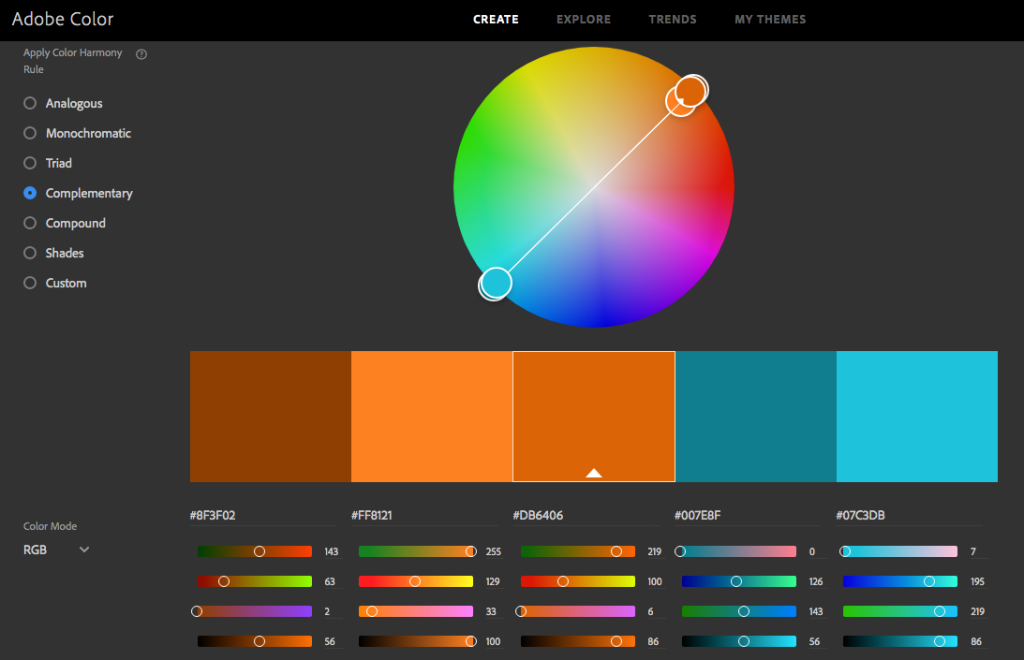
For these reasons a light orange was selected as the starting point for Boxpark Sushi’s primary color. The Adobe Color website was utilized to find an appropriate tint of the color orange. A complementary color harmony rule was used to find a secondary color. The teal blue color denotes intelligence and competence (Kolenda, 2016) as well as being visually complementary to the primary orange.
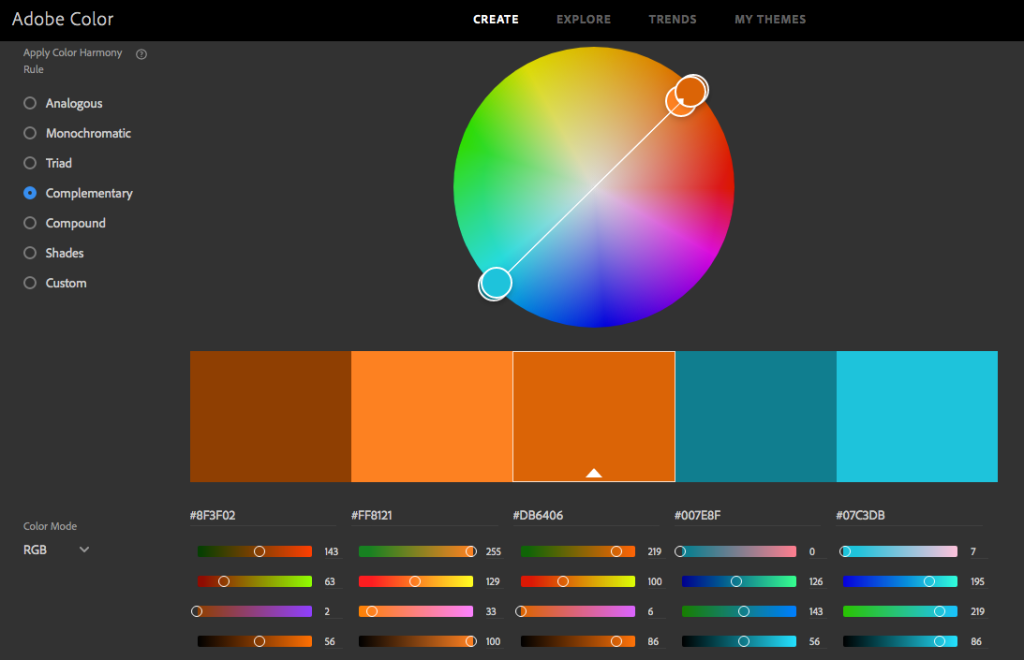
Adobe Color color wheel

Problem Solving

Boxpark Sushi is a service-based brand, not product-based. The dynamic vision board needed to feel like a demonstration of the brand’s personality, not a commercial promoting the brand’s product. For that reason, the video included no clips of sushi being prepared or eaten. While sushi illustrations do pop up in the video, they are decorative and secondary to the imagery denoting the brand’s fun but wise personality.

Searches for royalty-free and attribution-free video clips were conducted on Pixababy and Pexels using search terms like “fun” and “laughter” to find inspiring images with orange and blue colors similar to the brand color palette established in the static vision board. Color adjustments were made in Adobe After Effects to closer match the brand colors.

Innovative Thinking

A Media Matrix is a graphical media planner that explains the pros and cons of advertising in four categories of delivery media: print, environmental, on-air, and online (Stone, 2010). Stone listed many of these advantages and disadvantages in the media matrix below.
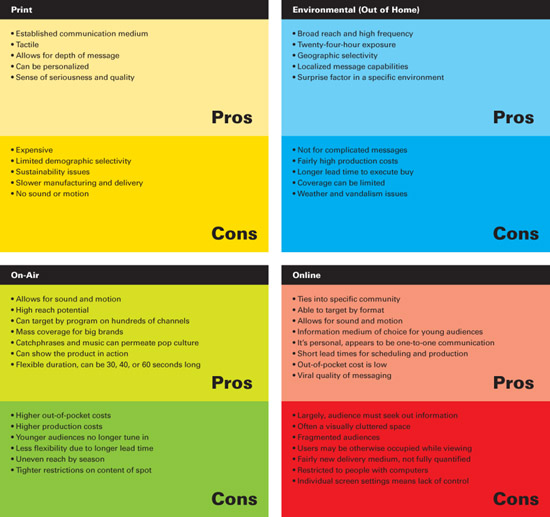
Media Matrix
Media Matrix

This matrix was used as a starting point while customizing a plan appropriate for Boxpark Sushi. The updated plan (below) was included in the final design brief and used to define which media assets would best serve the brand.

Media Matrix

 PrintEnvironmental
PROS• Tactile
• Allows for depth of message
• Sense of quality
Distinctive take-out boxes turn customers into walking advertisements.
• Broad reach and high frequency
• Twenty-four-hour exposure
• Geographic selectivity
Signage and ad banners near the Boxpark mall target a hungry local audience.
CONS• Expensive
• Sustainability issues
• No sound or motion
Eco-friendly printed packaging costs more but is beneficial to the brand and the planet.
• Not for complicated messages
• Fairly high production costs
• Weather and vandalism issues
Signage and banners must be visually simple and resistant to Milwaukee weather.
 On-AirOnline
PROS• Allows for sound and motion
• High reach potential
• Catchphrases can permeate pop culture
• Can show the product in action
Local tv and radio spots could connect with older consumers in Milwaukee.
• Allows for sound and motion
• Information medium of choice for young audiences
• It’s personal, appears to be one-to-one communication
The brand’s young target audience uses the internet more than other media.
CONS• Higher out-of-pocket costs
• Higher production costs
• Younger audiences no longer tune in
• Less flexibility due to longer lead time
High costs and a diminishing audience make tv advertising not ideal for this brand.
• Largely, audience must seek out information
• Often a visually cluttered space
Fragmented audiences
To stand out online, the brand must offer something useful to the consumer.
Boxpark Sushi media matrix

Future media delivery strategies will look back at Stone’s original matrix for inspiration but seek further supporting details for each category’s pros and cons.

Acquiring Competencies

The following are concepts, skills, or new resources learned in the Design Integration course. They are categorized as Academic (pertaining to schoolwork) or Occupational (pertaining to work in the Media Design field), and Technical (pertaining to software or other design skills) or Conceptual (new terminology, procedures, or ideas).

Advertising is “the paid, non-personal distribution of a persuasive message with the purpose of promoting products or services to current or potential customers “(Gordon, 2017). Advertising is just one piece of a marketing campaign. [Occupational, Conceptual]

A Design Brief includes the objective and strategies defined in the creative brief but also adds additional information (Frenson, 2015). This can include color palette and typographical considerations, voice and tone samples, and media strategies. [Occupational, Conceptual]

A Media Matrix is a graphical media planner that explains the pros and cons of advertising in four categories of media: print, environmental, on-air, and online. [Occupational, Conceptual]

Looming motion occurs when visual stimuli get larger or closer, capturing more attention than receding motion because “…looming objects are more likely than receding objects to require an immediate reaction…” (Franconeri & Simons, 2005). [Academic, Conceptual]

Vision boards, also called mood boards or inspiration boards, help communicate ideas when words aren’t enough. WDD Staff (2008) notes that vision boards demonstrate the thinking behind your design ideas and help clients feel involved with the process. [Occupational, Conceptual]

A Mission Statement is a brief description of a brand’s fundamental purpose (Ward, 2019). It explains who the brand is to people in the organization and the public. [Occupational, Technical]

Brand Voice is determined by a distinctive personality, vocabulary, and rhythm and pace (Kenny, 2017). Brand voice is consistent, but the brand tone changes with the message. [Academic, Conceptual]

Brand Tone is determined by a number of factors including who you are addressing, the situation (or emotional state) the viewer is in, and the topic of your content (Stukent, 2018). [Academic, Conceptual]

Scaffolding is the process of showing and collaborating on the design strategy with the client so there are no surprises or uncertainty (The Futur, 2014). Vision boards are useful for scaffolding design projects. [Occupational, Conceptual]

Words and pictures should be used together achieve synergy, not redundancy (Felton, 2013, p. 81). Try to create some tension between word and image so that their combination achieves an effect greater than their individual sums. [Academic, Conceptual]

Visual Hierarchy is the ordering of content in a composition so that you effectively communicate information and create meaning by directing the viewers’ eyes to the most important information first (Lundgren, n.d.). [Occupational, Conceptual]


References:

Franconeri, S., & Simons, D. (2005). The dynamic events that capture visual attention: A reply to Abrams and Christ (2005). Perception & Psychophysics, 67(6), 962.

Frenson, M. (2016, July 5). How to write effective design briefs: a quick guide. https://unmatchedstyle.com/news/how-to-write-effective-design-briefs-a-quick-guide.php

Gordon, E. (2017). Marketing and Advertising Strategies. https://medium.com/inkbot-design/marketing-and-advertising-strategies-45242269f5ee

Kenny, J. (2017). Know the Difference between Tone and Voice to Set Your Brand Apart. https://gimmemojo.com/2017/11/01/tone-voice-set-your-brand-apart/

Kolenda, N. (2016). The Psychology of Color. https://www.nickkolenda.com/color-psychology/

Lundgren, A. (n.d.). Capture Attention with Visual Hierarchy. https://alvalyn.com/capture-attention-with-visual-hierarchy/

Przybyla, D. (n.d.). How Color Affects Appetite in Marketing. Retrieved from  https://www.colorpsychology.org/color-appetite/

Stone, L.T. (2010, July 01). Managing the Design Process-Concept Development: An Essential Manual for the Working Designer. Rockport Publishers.

Stukent, Inc. (2018). Developing Your Brand Voice – Liza Dunning [Video file]. https://www.youtube.com/watch?v=z9KRWgGYD8E

The Futur. (2014). How to Translate Strategy to Design [Video file]. https://www.youtube.com/watch?v=TpcaCW85eI0

Ward, S. (2019, December 10). What Is a Mission Statement? https://www.thebalancesmb.com/mission-statement-2947996

WDD Staff. (2008, December 30). Why Mood Boards Matter. Retrieved from https://www.webdesignerdepot.com/2008/12/why-mood-boards-matter/
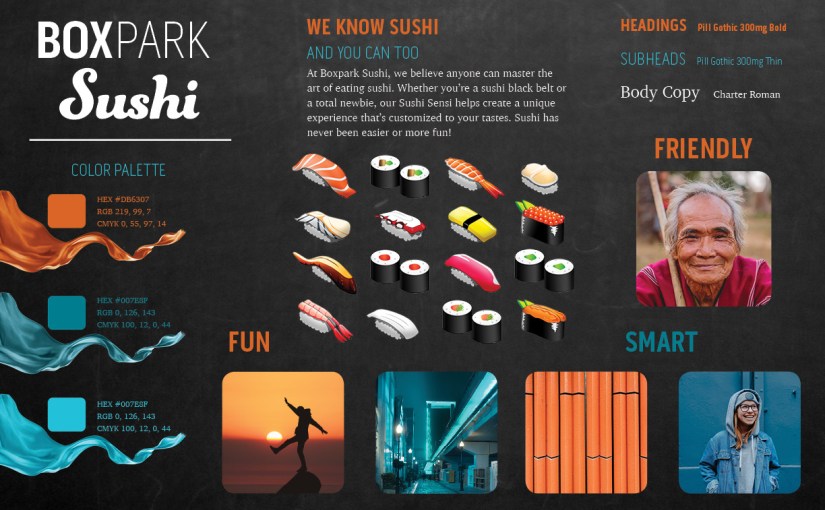
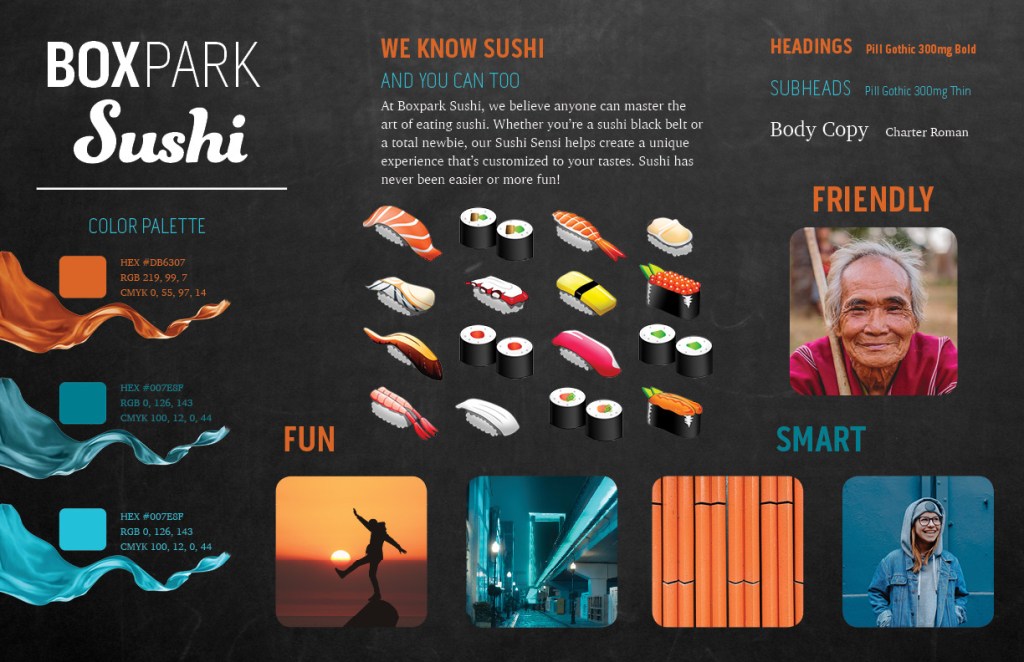
Static Vision Board

This vision board was created for the fictional Boxpark Sushi brand as an assignment for the Design Integration course.

Boxpark Sushi vision board
Boxpark Sushi vision Board

Static Vision Board rationale

NOTE: Many design choices for this project follow the advice of psychologist Nick Kolenda, who compiled information from hundreds of academic studies into easy to read marketing guides about the psychology of colors, fonts, and more.

Typography

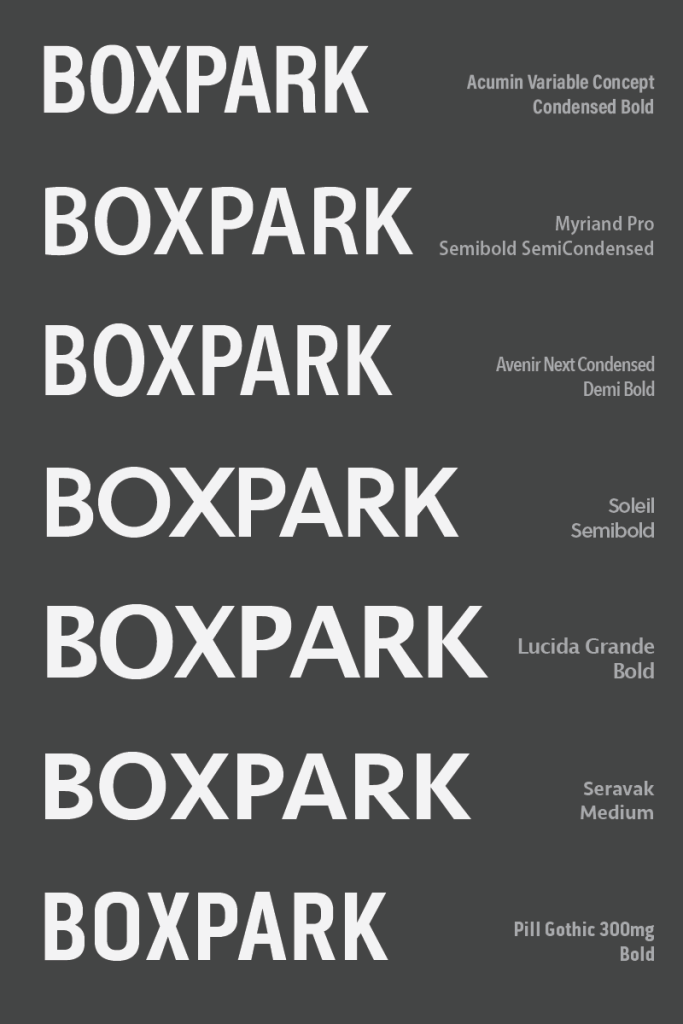
Boxpark Sushi’s primary font is Pill Gothic 300mg using a combination of the Bold and Thin font weights. This strong, modern typeface was selected from a group of sans-serif fonts available with Adobe Creative Cloud.

Typography T
typography test

Pill Gothic 300mg was chosen because it is both strong and condensed. According to Kolenda (2016), condensed fonts convey tightness and precision, traits that are valued in sushi preparation. The combination of the font’s bold and thin weights implies a balance of power and sophistication.

Charter Roman is used for body copy because it is a highly legible serif font that has an academic feel.

Textures

The smart, educated personality is also reflected in the black chalkboard background and orange pencils pattern. The dark slate provides contrast to light text and the brand’s primary colors. The colors are presented as swatches and as blowing waves of fabric that have fun energy and a satin texture.

Color Palette

The brand’s primary color, a reddish orange, was selected because it shares that warm, fun energy. Przybyla (n.d.) also notes that warm reds and oranges can increase one’s appetite. The secondary teal blue color denotes intelligence and competence (Kolenda, 2016) as well as being complementary to the primary orange.’

complementary colors in Adobe Color

Photos and Illustrations

Photos are either very warm or very cool colored to match the contrast of the brand’s primary color palette. Photos include a geometric pattern (orange pencils), an urban environment (blue cityscape), and happy people who express the brand personality traits of fun, smart, and friendly.

There are no photos of raw fish that may turn off consumers who are new to sushi. Instead, the product is presented as cute illustrations that are realistic enough to be identified by sushi eaters.


References:

Kolenda, N. (2016). The Psychology of Color. Retrieved from  https://www.nickkolenda.com/color-psychology/

Kolenda, N. (2016). The Psychology of Fonts. Retrieved from  https://www.nickkolenda.com/font-psychology/

Przybyla, D. (n.d.). How Color Affects Appetite in Marketing. Retrieved from  https://www.colorpsychology.org/color-appetite/

Design Integration – Week 2 Live Session

Case Studies Comparison

Millennial consumers are the primary audience for many of today’s advertising campaigns, so I sought out case studies of designs that successfully targeted this market segment.

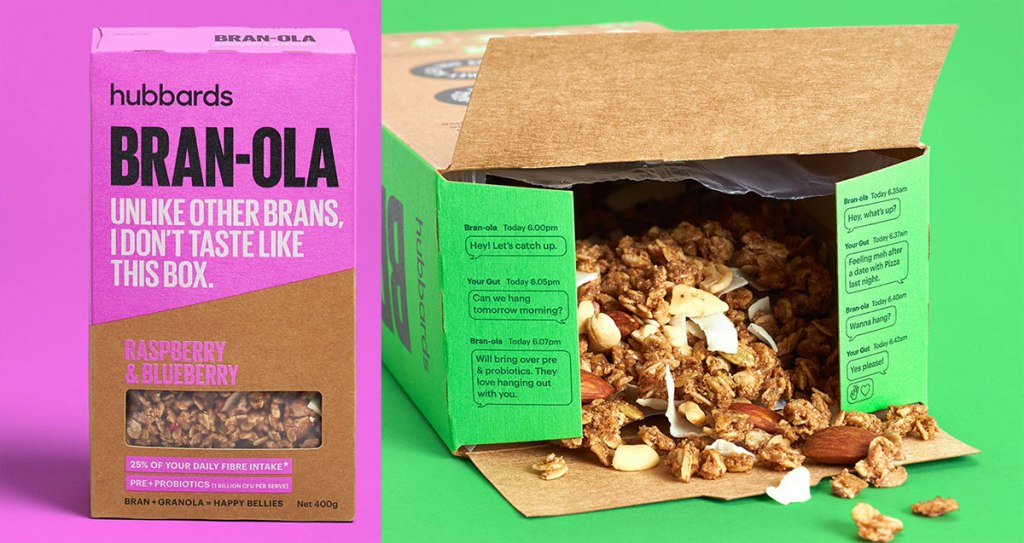
Onfire Design created packaging and advertising for Hubbards cereal brand’s Bran-ola product, using bright colors and a distinctive voice to differentiate from competing bran products (Sanchez, 2019). Copy like “This ain’t your grandma’s bran,” and “They made me wear this box,” gives the brand a sassy personality. The gut health benefits of bran are explained with a whimsical exchange that reads like a text message with a friend. The bright neon colors of the packaging and ads stand out in a category dominated by earth tones.

Bran-ola packaging
Bran-ola packaging

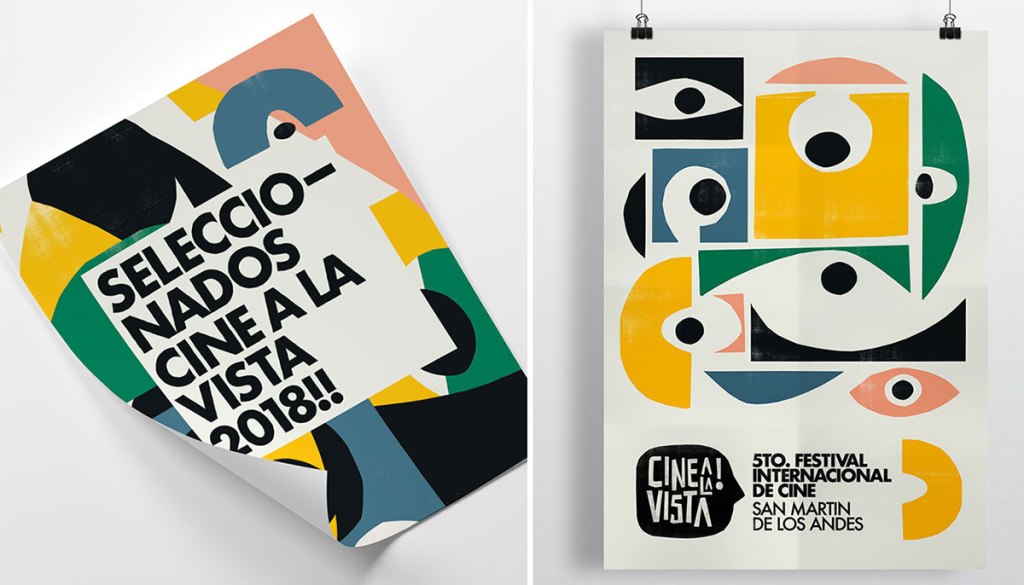
Designer Leo Franchi oversaw the brand designs and animation for the Cine a la Vista international film festival in Argentina. All elements of the designs were cut out from papers of different colors and thicknesses. Franchi used this process to find “the beauty of the texture imperfections in the only way the analog process can provide” (Airey, n.d.).

Cine a la Vista posters

Graphic design is usually displayed on flat, smooth surfaces like screens and paper. However, designs can create the illusion of texture. Even if there is no physical tactile sensation from touching an object, the human brain still reacts and creates meaning from visual textures. Real life textures make a design feel more natural and organic. Textures can be used to create contrast in a design, drawing the eyes to important elements. Theodor (n.d.) notes that textures can also add depth to a design.

The Purpose of Vision Boards

Designers often struggle when trying to describe their ideas and concepts to clients. WDD Staff (2008) notes that “visuals communicate things that words cannot,” and vision boards can help do just that. Vision boards, also called mood boards or inspiration boards, serve several important purposes in the design process:

  1. Faster mockup production: Time is money, and a few hours spent developing the look and feel of a project in a vision board can save many hours later. The visual prototyping process becomes smoother as there a no surprises when presenting design mockups based on previously approved vision boards.
  2. Smoother client buy-in: Vision boards demonstrate the thinking behind your design ideas. Clients feel involved with the process and are less likely to suggest design changes based on personal preferences like a favorite color.
  3. Less frustration, more fun: Vision boards are a creative way to explore design concepts and styles with fewer limitations.
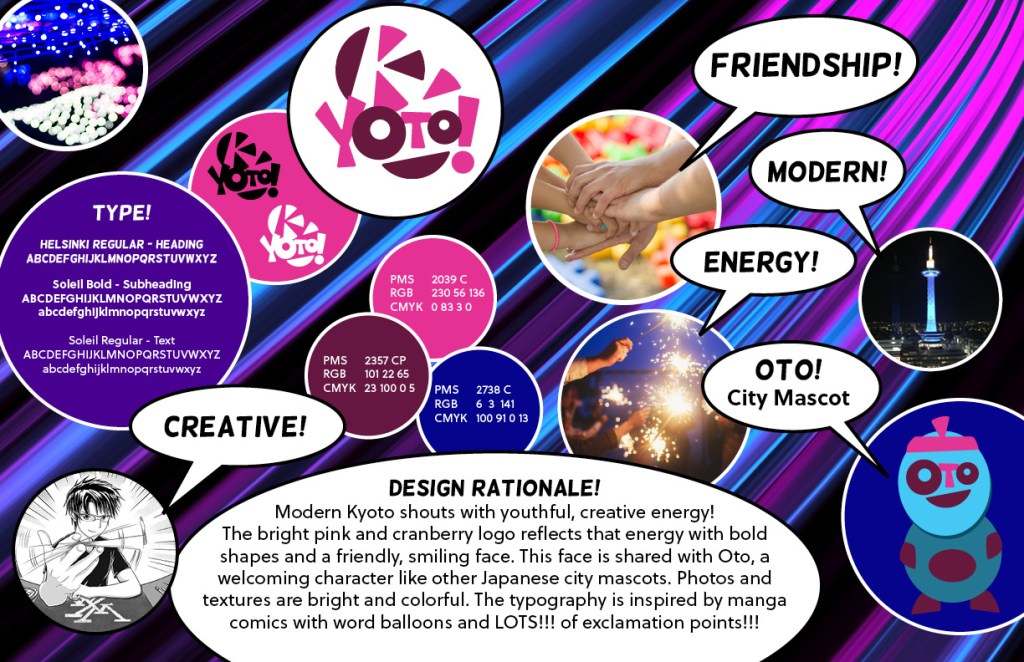
Modern Kyoto brand vision board by Joshua Siegel

Designing Visual Hierarchy

Artists of all visual media use many techniques to draw attention and move the viewer’s eyes through a design. According to Lundgren (n.d.), “Visual hierarchy is the ordering of content in a composition so that you effectively communicate information and create meaning.” This is especially important in marketing and advertising design, where viewer attention is a precious commodity. We can use the following principles of design to create visual hierarchy:

  • Proportion (or Scale) is the size relationship of the design elements to each other and the entire design. The largest elements, like headlines, are usually the most important.
  • Position is where the elements are located within the design. The Gutenberg Principle describes the general movement of the eyes when looking at a design in which elements are evenly distributed (Lundgren, n.d.). The principle states that viewer attention generally starts at the upper left of a design and moves toward the lower right.
  • Direction. If most elements, like type, are in the horizontal direction, vertical or diagonal elements will be noticed first.
  • Contrast between light and dark colors makes visual elements stand out and improves readability.

References:

Airey, D. (n.d.) Cine a la Vista. Retrieved from https://identitydesigned.com/cine-a-la-vista/

Lundgren, A. (n.d.). Applying the Gutenberg Principle in Print and Web Design. Retrieved from https://alvalyn.com/applying-gutenberg-principle-print-web-design/

Lundgren, A. (n.d.). Capture Attention with Visual Hierarchy. Retrieved from https://alvalyn.com/capture-attention-with-visual-hierarchy/

Sanchez, R. (2019, December 4). Onfire Design Uses Bold Colors, Type And Sassy Copy To Make Bran-ola Stand Out. Retrieved from https://thedieline.com/blog/2019/12/4/onfire-design-uses-bold-colors-type-and-sassy-copy-to-make-bran-ola-stand-out

Theodor, V. (n.d.). The role of textures in contemporary graphic design. Retrieved from https://www.canva.com/learn/texture/

WDD Staff. (2008, December 30). Why Mood Boards Matter. Retrieved from https://www.webdesignerdepot.com/2008/12/why-mood-boards-matter/
Voice and Tone

The personality of Boxpark Sushi is that of a friendly teacher who is wise but not aloof or condescending. Good sushi requires a skilled chef, and that professional expertise is reflected in the brand personality. Educating customers and the public about the joys of sushi is a large part of Boxpark Sushi’s mission. The brand’s educated, friendly voice speaks directly to the young professionals and college students of East Side Milwaukee. Statistics from East Side Milwaukee Demographics (n.d.) show that 67% of East Side residents are college educated and 92.27% are white collar employees compared to 7.73% blue collar employees.

Boxpark Sushi’s wise and caring personality also addresses the human need for succorance, the need to receive help from others as described by Settle & Alreck’s “Shopping List of Needs” (Felton, 2013). According to a survey by Pei Wei (Shelby, 2015), 30 percent of first-time sushi eaters had someone help them order. Usually, this is a friend or family member who is already a sushi aficionado. At Boxpark Sushi, this role is filled by an in-store “sushi sensei” who explains the various processes and ingredients to make sushi less intimidating. Boxpark Sushi uses the wise sensei personality across the entire brand. The tagline “Master sushi with the Sushi Sensei” empowers customers while also offering support.

There are other sushi restaurants in East Side Milwaukee, but the Boxpark Sushi bar is a place for Boxpark shoppers to hang out with their friends enjoying good food and drinks. Sushi bars let customers order directly from the chef rather than wait staff. The sushi is prepared in front of customers, providing a personalized interactive experience (Grabianowski, 2005). This is very similar to the way street food is enjoyed across the world. The sushi bar model also fits in well with other small and personable eateries in Boxpark shopping centers. Boxpark Sushi speaks like a friendly neighborhood bartender who happens to know everything about sushi.

Brand Voice Chart

CharacteristicDescriptionDoDon’t
SmartWe know sushi, and we love sharing our knowledge.Be knowledgeable.
Be humble.
Be arrogant or condescending.
Use overly technical words and phrases.
FriendlyOur customers are our friends and neighbors.Use casual language.
Be positive.
Be overly personal.
HelpfulWe help make sushi easy and accessible.Be open and inquisitive.
Be honest.
Be annoying by pushing help on those who don’t need or want it.
FunOur definition of fun is sharing good food and laughter with friends.Be playful.
Emphasize the social aspect of Boxpark Sushi.
Exclude or mock anyone.
Use derogatory language.
Brand Voice Chart

Tagline

Master sushi with the Sushi Sensei.

Mission Statement

  • To create fresh, healthy foods with the highest quality ingredients.
  • To educate our customers and the public about the joys of sushi.
  • To provide exceptional, personal service that elevates the dining experience.
  • To serve our friends and neighbors in East Side Milwaukee.

Introductory Paragraph (tone sample)

At Boxpark Sushi, we believe anyone can master the art of eating sushi. Whether you’re a sushi black belt or a total newbie, our Sushi Sensi helps create a unique experience that’s customized to your tastes. Sushi has never been easier or more fun!

Voice and Tone

The Boxpark Sushi voice is educated but friendly, and the tone is playful.

References:

East Side Milwaukee Demographics. (n.d.) Retrieved from https://www.point2homes.com/US/Neighborhood/WI/Milwaukee/East-Side-Milwaukee-Demographics.html

Felton, G. (2013). Advertising: Concept and Copy (Third). New York: W.W. Norton.

Grabianowski, E. (2005). At the Sushi Bar. How Sushi Works. Retrieved from https://science.howstuffworks.com/innovation/edible-innovations/sushi2.htm

Shelby Food Service. (2015, March 24). Pei Wei Releases Sushi Survey Results, Adds New Rolls. Retrieved from https://www.keltonglobal.com/recognition/pei-wei-releases-sushi-survey-results-adds-new-rolls/

Design Integration – Week 1 Live Session

Voice and Tone

Brands are personalities. Just as people have unique voices, so should a brand. This distinctive brand voice establishes bonds with consumers, developing recognition and trust. Felton (2013) notes that “Consumers are never just buying a product; they’re buying an ethos, too.” Do they like this person and their sensibilities? Speaking to customers in a relatable voice with the appropriate tone can be a powerful form of persuasion.

What is the difference between voice and tone? Voice is consistent, while tone changes with the message. According to Kenny (2017), a brand’s voice is determined by a distinctive personality, vocabulary, and rhythm and pace. In a YouTube video from Stukent (2018) Liza Dunning says that tone is determined by a number of factors including who you are addressing, the situation (or emotional state) the viewer is in, and the topic of your content.

Developing Brand Voice

Dunning also explains her method of developing a brand’s voice (Stukent, 2018).

5 D’s of Developing a Brand Voice

  1. Define your why: Why you exist, why you matter. Why should people care?
  2. Differentiate from the crowd: find brand keywords to use frequently, then find words and phrases you would never use.
  3. Decide who your people are: Understand your audience and how they communicate. Creating a target persona can help.
  4. Develop your personality: Who are you and what do you bring to the table? Create a “this not that” list. For example, “Fun but not childish.”
  5. Dedicate your content’s mission: Your mission is based on your why. Create stories that find information to reinforce that mission.

Translating Strategy to Design

In a YouTube video from The Futur (2014), designers Chris Do and Jose Caballer share their processes of translating design strategy into visual design. Abstract ideas become concrete by using words, so it’s important to make strong word choices. Make a list of visual words and find images that match. Those images can be used for a mood board, or “stylescape”, that communicates your ideas to the client. This is an effective way of scaffolding, the process of showing and collaborating on the design strategy with the client so there are no surprises or uncertainty.

Being a partner with the client during all stages of creative strategy raises your value as a designer. Rosebrook (2017) reaffirms this, noting that “giving insights on how you can solve a business problem with a creative solution will ultimately help you position yourself as more than a pixel pusher.” These problem-solving and communication skills are what separate designers from production artists.


References:

Felton, G. (2013). Advertising: Concept and Copy (Third). New York: W.W. Norton.

Kenny, J. (2017). Know the Difference between Tone and Voice to Set Your Brand Apart. Retrieved from https://gimmemojo.com/2017/11/01/tone-voice-set-your-brand-apart/

Rosebrook, D. (2017). What is Design Strategy? Retrieved from https://read.compassofdesign.com/what-is-design-strategy-497453c9d83a

Stukent, Inc. (2018). Developing Your Brand Voice – Liza Dunning. Retrieved from https://www.youtube.com/watch?v=z9KRWgGYD8E

The Futur. (2014). How to Translate Strategy to Design. Retrieved from https://www.youtube.com/watch?v=TpcaCW85eI0

Design Strategies and Motivation – Mastery Journal

Overview

The critical first step in creating an effective advertising campaign is understanding the brand. In the Design Strategies and Motivation course, we took this a step farther by developing a brand based on our research.

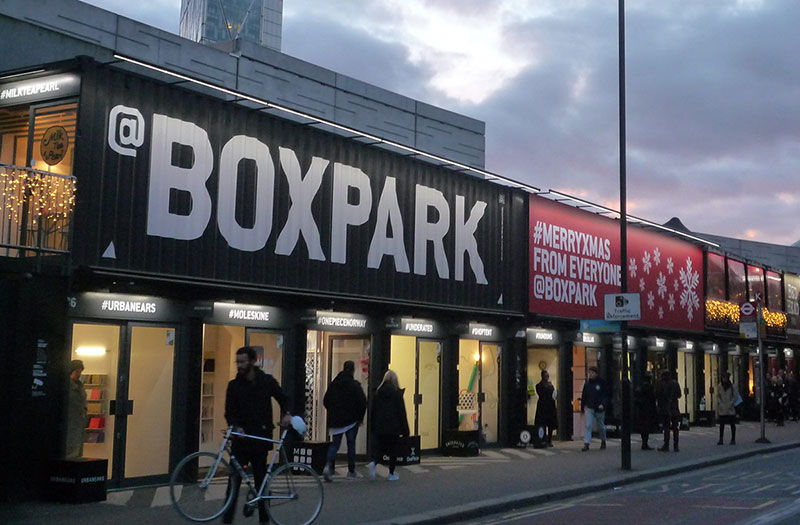
The fictional client is a sushi restaurant located in an imaginary Boxpark container mall in East Side Milwaukee. Boxpark is a food, retail, and entertainment park made of repurposed shipping containers. Roger Wade conceived Boxpark as a “pop up mall,” launching the first park in Shoreditch, England in 2011 (Fry, 2017). Our primary assignment for the class was a Strategic Development project that utilized in-depth research to develop a brand message for Boxpark Sushi and ways to differentiate the brand from competitors.

Boxpark Pop-up Mall photo by Hans Dinkelberg

The combination of primary and secondary research in week one provided several insights about the client’s product, consumer thoughts, and brand category:

  • Sushi quality depends largely on the chef and ingredients, not where it was made.
  • East Side Milwaukee has a young, educated population that may be more accepting of sushi than the average American.
  • Boxpark and other container markets combine modern brands and traditional street food.
  • Negative perceptions of sushi are mainly focused on the raw fish aspect due to health concerns and personal taste.
  • Maki rolls are more popular with Americans than other types of sushi.
  • Sushi bars provide a personal, interactive experience for diners.

This information provided a broad overview of the product and category but needed to be “funneled down” with other data to find a distinctive message for the brand.

Connecting / Synthesizing / Transforming

During the week two live session, we shared our findings and identified several potential obstacles to people who haven’t tried sushi, including unfamiliar ingredients like octopus or the challenge of eating with chopsticks. We also talked about how most people are introduced to sushi by a friend or family member who is already an aficionado. Professor Argo used the term “sushi sensei” for someone who makes a sushi eater’s first time less intimidating by explaining various processes and ingredients to the newcomer. This term stuck with me as I researched ways to overcome the identified obstacles.

I discovered a 2015 survey conducted by strategy consulting firm Kelton Global that examined Americans’ sushi eating attitudes and behaviors (Shelby, 2015). Although the survey was used as a marketing tool for the fast-casual Asian-inspired restaurant Pei Wei, it also provided insight that narrowed my focus for the Boxpark Sushi brand.

Survey Finding Highlights:

  • More than three in five (62 percent) who haven’t tried sushi are willing to try it and 43 percent of these folks would start eating sushi if they were able to take baby steps, such as by not eating raw fish right away.
  • Ninety-four percent of those willing to try sushi would steer clear of raw fish.
  • Sushi newbies felt more comfortable starting with non-raw rolls, and then branched out and tried others. In fact, nearly one-quarter (22 percent) took baby steps when they first sampled rolls and nearly one-third (30 percent) had someone help them order.

This information, combined with the obstacles we discussed in the previous live session, made me realize that sushi could be much more accessible if combined with personalized customer service. At a traditional sushi bar, the chef might have suggestions regarding what is in season or what he thinks you might enjoy (Grabianowski, 2005). However, he or she seldom has the time to find out a customer’s personal tastes and experience with sushi.

I transformed this knowledge into the Sushi Sensei concept, the idea of training Boxpark sushi chefs to make recommendation to customers based on questions like, “Do you prefer salty or sweet?” By sharing knowledge and taking a moment to learn about diners’ tastes, the Sushi Sensei elevates the service level and makes eating at Boxpark Sushi a fun learning experience.

Problem Solving

To stand out from competitors, Boxpark Sushi needs a strong point of differentiation. Why should consumers eat here instead of other nearby sushi restaurants? My research of the primary competition revealed that they served traditional sushi but not modern fusion items like sushi burritos (Gabriele, 2019) or waffle breakfast sushi (Tom, n.d.). Boxpark Sushi could stand out from both primary and secondary competitors by promoting this style of modern sushi.

Another point of differentiation is that competitors have waiters and/or self-serve buffets, but not a casual sushi bar. Sushi bars let customers order directly from the chef rather than wait staff. The sushi is prepared in front of customers, providing a personalized interactive experience (Grabianowski, 2005). Traditional sushi bars can be quite formal, and the chef is more focused on preparing the food than making recommendations based on the customer’s tastes. Having a friendly, casual Sushi Sensei to guide diners is another way to differentiate Boxpark Sushi.

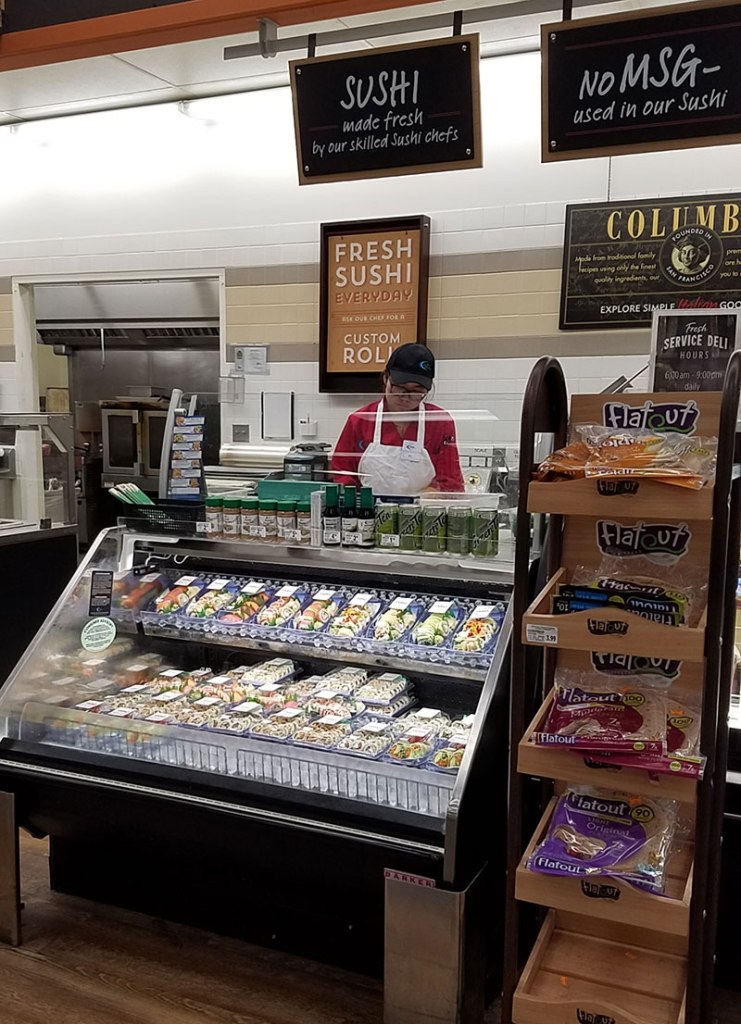
Considering both points of differentiation, I looked at a number of factors. My primary research entailed visits to Chico, California restaurants and supermarkets that serve sushi. Sushi Burrito King offers modern fusion sushi, but during my visit there were very few customers and the food looked and smelled unappetizing. In contrast, the sushi at Raley’s supermarket was being prepared in clear view by a friendly chef who offered to make whatever I liked. This personal experience helped me realize that a quality product and good customer service are more appealing than a novelty product.

I also looked at how each point of differentiation addresses the human needs explained by Maslow’s “hierarchy of needs” and its level in the hierarchy. The highest possible need that modern sushi achieves is Esteem, by making diners feel more sophisticated for trying something new. The Sushi Sensei concept achieves the highest level in the hierarchy, Self-actualization, by comparing the Boxpark Sushi experience to a peaceful form of martial arts. These considerations drove my decision to make the Sushi Sensei the driving “zag” of the Boxpark Sushi creative brief rather than modern sushi, which can still be part of the menu but not the primary point of differentiation.

Innovative Thinking

Many restaurants emphasize their product as a key selling point. Flavor, freshness, and variety of menu items are promoted in order to address the basic human need for good food.

Rather than taking this product-based approach, I decided that a service-based approach would better address the needs of Boxpark Sushi’s customers. Many restaurants offer good food, so elevated service can be an effective way to stand out. Sushi bars are not exclusive to Boxpark Sushi, but the concept of modernizing the sushi chef into a friendly, casual Sushi Sensei specifically addresses the young, urban consumers who shop at Boxpark mall.

Sus Hi Eatstation, a central Florida restaurant chain, has a similar martial arts theme that encourages customers to “be a ninja” by building their own sushi rolls, bowls, and burritos(Sus Hi Eatstation). However, Boxpark Sushi’s sensei theme is targeted toward East Side Milwaukee’s students and young professionals whereas Sus Hi Eatstation’s ninja theme is targeted toward families in Central Florida.

Acquiring Competencies

The following are concepts, skills, or new resources learned in the Design Strategies and Motivation course. They are categorized as Academic (pertaining to schoolwork) or Occupational (pertaining to work in the Media Design field), and Technical (pertaining to software or other design skills) or Conceptual (new terminology, procedures, or ideas).

Academic

ConceptualTechnical
Abstract Thinking: Literal thinking can lead to unoriginal, ineffective designs. Abstract thinking helps us find metaphors that define the essence of a problem in order to solve it in original ways.  

Strategic Design: Creative problem-solving skills separate designers from production artists. By understanding how a brand’s message can connect with consumers, we add value to ourselves as designers.
Synthesis Writing: Combining information from multiple sources can shine new light on a topic and help you examine an issue from a different perspective.
Academic Competencies

Occupational

ConceptualTechnical
Maslow’s Hierarchy of Needs: Psychologist Abraham Maslow described a “hierarchy of needs” in human beings that start with low level physiological needs like hunger that must be met first before ascending to higher-level psychological needs like love and esteem.
 
Settle and Alreck’s Shopping List of Needs: an unranked list of fifteen human needs than can be addressed in a target audience, from achievement to understanding.  

Demographics: Quantitative data about your target audience including gender, age, income, and location.  

Psychographics: Qualitative data about what people think and why, including their personality and habits.  
Buying Behavior: the when, what, and why people are buying a product.  

Direct competitors: brands with similar products that are likely to be used if your client’s product did not exist.  

Indirect competitors: brand with similar products but a strong differentiation from your client or in another market segment.  

Replacement competitors: brands with very different products that are competing for the same customer’s time and money.  

Unique Selling Proposition: sells a benefit unique to the brand. “You should buy a ____ because it’s the only one that _____.” If consumers want this feature or benefit, the only place they can get it is from your brand.  

Emotional Selling Proposition: Instead of looking for the logical benefits of a product, the ESP finds the emotional selling points of the product. How does it make the use feel happier or more attractive?
Attitude Advertising: a brand’s personality, or attitude, can differentiate a brand in very wide categories like smart phones or athletic shoes. When the actual differences from the competition are slight, attitude is everything.  

Brand Image: To stand out from competitors, a brand image should be recognizable and relatable to the target audience, like an old friend they want to spend time with.  

Rhythm in Design: Repeating rhythms create a pattern that the human eye recognizes. Any irregularity stands out, drawing the eye to that element.  

Random Rhythm: Elements repeat with irregular intervals or spacing.  

Regular Rhythm: Elements repeat with the same spacing or intervals.  
Alternating Rhythm: Two or more elements repeat in a regular pattern.  

Flowing Rhythm: Repeated elements follow curves or undulations like those found in nature.  

Progressive Rhythm: Repeated elements change slightly with each repetition.
Occupational Competencies

References:

Felton, G. (2013). Advertising: Concept and Copy (Third). New York: W.W. Norton.

Fry, S. (2017). Boxing clever: The firms based in shipping containers. Retrieved from https://www.bbc.com/news/business-38742250

Gabriele, A. (2019). The Origins of the Sushi Burrito: Q&A with the Inventor. Retrieved from https://www.themanual.com/food-and-drink/sushi-burrito-sushiritto/

Grabianowski, E. (2005). At the Sushi Bar. How Sushi Works. Retrieved from https://science.howstuffworks.com/innovation/edible-innovations/sushi2.htm

Shelby Food Service. (2015, March 24). Pei Wei Releases Sushi Survey Results, Adds New Rolls. Retrieved from https://www.keltonglobal.com/recognition/pei-wei-releases-sushi-survey-results-adds-new-rolls/

Sus Hi Eatstation. (n.d.) Our Story. Retrieved from https://sushieatstation.com/our-story/

Tom, H. (n.d.) 21 Unique Recipes for Sushi Without Raw Fish. Retrieved from: https://spoonuniversity.com/recipe/21-unique-recipes-for-sushi-without-raw-fish

Design Strategies and Motivation – Mastery Journal Reflection

Design Strategies and Motivation, the seventh course in the Media Design MFA program, expanded on the skills and knowledge gained in month five’s Design Research course. Throughout the month we developed a Strategic Development project for a fictional client: a Boxpark sushi shop in East Side Milwaukee. Professor Bartley Argo encouraged us to dive deep into our research of sushi, the East Side Milwaukee neighborhood, and container park malls in order to create a distinctive brand.

In the first week, we read several articles about Design Strategy and two chapters from George Felton’s Advertising: Concept and Copy. Felton (2013) points out the difference between Strategy and Execution in ad campaigns. Strategy is what you’re saying, and execution is how you’re saying it. Before you can plan the execution of a campaign, the strategy must be discovered through research and synthesis of the resulting information. Strategic development is important for discovering insights about the brand and consumer behavior. Those insights help focus your message and develop a narrative that connects with consumers.

The first part of the Strategic Development project was learning about the client’s product. Step one was primary research in the form of firsthand use. I visited two restaurants in Chico, California that serve sushi. I also sampled sushi from two supermarkets, one budget and the other high-end. This primary research resulted in the insight that sushi quality depends largely on the chef and ingredients, not where it was made.

Sushi at Raleys Supermarket

Step two was secondary research of sushi, East Side Milwaukee, and Boxpark malls. Through online searches, I learned that American creations like the California roll helped sushi gain acceptance in American, as ingredients like crab and avocado were considered more palatable to white Americans than raw fish (Bhabha, 2013). Also, statistics from East Side Milwaukee Demographics (n.d.) suggest that East Side Milwaukee residents may be more open to cuisine from non-American cultures than residents of other Midwestern areas. The neighborhood is a good fit for Boxpark Sushi, as many Boxpark restaurants are inspired by regional street food.

The next step was collecting consumer thoughts. I conducted primary research by interviewing personal acquaintances and by collecting social media responses to the question “Do you like sushi? Why or why not?” There was a wide array of responses, but one important insight was that negative perceptions of sushi are mainly focused on the raw fish aspect.

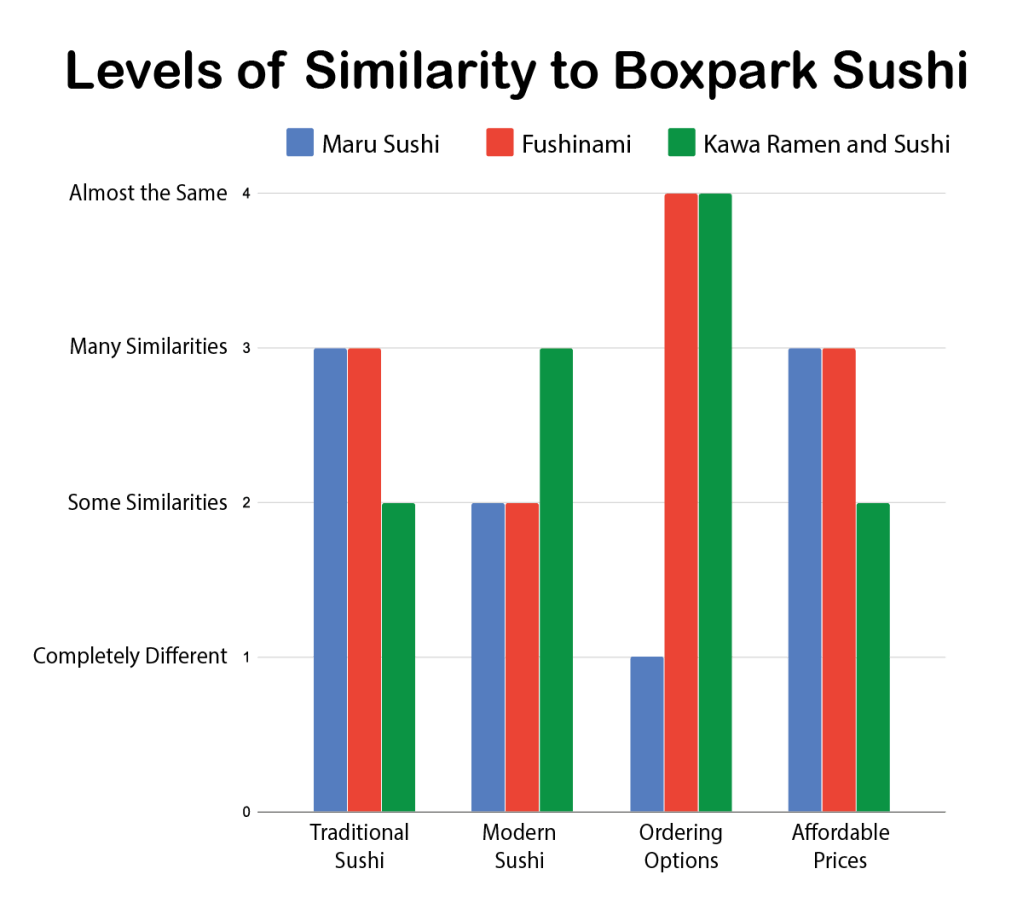
Part two of the Strategic Development project was learning about the competition. I researched the direct competitors, East Side Milwaukee restaurants that served sushi, as well as indirect competitors, nearby Asian restaurants offering something besides sushi. A primary reason for researching a brand’s competition is to find ways to differentiate from competitors, so I created the chart below to represent levels of similarity to Boxpark Sushi for three of the direct competitors. It revealed that serving modern sushi is a good way to differentiate from these competitors.

Levels of Similarity to Boxpark Sushi chart

Competitors chart

Next, I examined consumer behavior to better understand the marketplace for sushi. A good product can solve multiple problems if we understand the human needs that must be addressed. Considering Maslow’s “Hierarchy of Needs,” I found that self-actualization, the need to understand new things and realize one’s inner potential, could be achieved by comparing the Boxpark Sushi experience to a form of martial arts, albeit one that is easily achievable.

Settle & Alreck’s “Shopping List of Needs” were considered next. I found that succorance, the need to receive help from others, could be addressed by guiding customers through their sushi experience. According to a survey by Pei Wei (Shelby, 2015), 30 percent of first-time sushi eaters had someone help them order. Usually, this is a friend or family member who is already a sushi aficionado. But I realized that this role could be filled by an in-store “sushi sensei” who explains the various processes and ingredients to make sushi less intimidating.

Next, I analyzed the marketplace for audience segmentation. I examined the demographics, psychographics, and buying behavior of sushi eaters in East Side Milwaukee. One key point I discovered is that over 55 percent of East Side Milwaukee residents have never married (Point2Homes). This helped narrow the audience segment to younger, single consumers.

The final step of the Strategic Development project was writing a Creative Brief for Boxpark Sushi. A key insight of the project was that inexperienced sushi eaters find it less intimidating if someone helps them decide what to try. Boxpark Sushi can offer high quality, delicious sushi that is freshly prepared by a personal Sushi Sensei. The brand image is a hip, modern sushi bar that makes eating a fun learning experience.

Moving forward, having a focused message for the Boxpark Sushi brand will help me create stronger, more effective designs and copy for the brand.

References:

Bhabha, L. (2013). The History of Sushi in the U.S. Retrieved from https://food52.com/blog/9183-the-history-of-sushi-in-the-u-s

East Side Milwaukee Demographics. (n.d.) Retrieved from https://www.point2homes.com/US/Neighborhood/WI/Milwaukee/East-Side-Milwaukee-Demographics.html

Felton, G. (2013). Advertising: Concept and Copy (Third). New York: W.W. Norton.

Point2Homes. (n.d.). East Side Milwaukee Demographics. Retrieved from: https://www.point2homes.com/US/Neighborhood/WI/Milwaukee/East-Side-Milwaukee-Demographics.html

Shelby Food Service. (2015, March 24). Pei Wei Releases Sushi Survey Results, Adds New Rolls. Retrieved from https://www.keltonglobal.com/recognition/pei-wei-releases-sushi-survey-results-adds-new-rolls/

Design Strategies and Motivation – Week 4 Live Session

Synthesis Writing

Understanding connections and inferring relationships among sources are vital skills for mastery of any field, including design. To develop a strong thesis project, I must demonstrate the ability to synthesize information from multiple sources and transform it in a way that supports my points and insights. Sullivan (2011) explains that “the most successful research paper is one that uses many sources to support an original thesis.” Combining information from multiple sources can shine new light on a topic and help you examine an issue from a different perspective. This is especially important for developing design strategies. The purpose of design research is to find insights that focus your message. Strong designs are developed by finding a key insight and asking, “Does it have a story?” (Baylé, 2018). Therefore, the most effective messages have a narrative that resonates with the viewer.

Rhythm in Design

Rhythm is part of our everyday lives, in sound and motion all around us. Visual rhythm is also a principle of design and can be seen in everything from ads to architecture. Soegaard (2019) notes that designers create rhythm with spacing between visual elements. He goes on to describe five types of rhythm:

  • Random Rhythm: Elements repeat with irregular intervals or spacing.
  • Regular Rhythm: Elements repeat with the same spacing or intervals.
  • Alternating Rhythm: Two or more elements repeat in a regular pattern.
  • Flowing Rhythm: Repeated elements follow curves or undulations like those found in nature.
  • Progressive Rhythm: Repeated elements change slightly with each repetition.

Repeating rhythms create a pattern that the human eye recognizes. Any irregularity stands out, drawing the eye to that element. Repetition of visual elements also allows for a more streamlined user experience (Elmansy, 2016). Rhythm and repetition create a visual continuity that allows users to more easily navigate information.

Attitude Advertising

Part of our design strategy research is finding an appropriate personality, or attitude, for the brand. Percy and Rossiter (1992) describe a brand awareness strategy that utilizes the brand attitude to connect with customers and develop recognition. The Percy and Rossiter model has been used as a marketing strategy for many years because it recognizes the power of emotional connection between the brand and its users. Many of today’s top brands like Apple and Nike use attitude advertising as a means of differentiation in very wide categories like smart phones and athletic shoes (Felton, 2013). When the actual differences from the competition are slight, attitude is everything.


References:

Baylé, M. (2018, May 15). Synthesis: How to make sense of your design research. Retrieved from: https://uxdesign.cc/synthesis-how-to-make-sense-of-your-design-research-d67ad79b684b

Elmansy, R. (2016, June 30). Design Principles: Repetition, Pattern, and Rhythm. Retrieved from: https://www.designorate.com/design-principles-repetition-pattern-and-rhythm/

Felton, G. (2013). Advertising: Concept and Copy (Third). New York: W.W. Norton.

Percy, L., & Rossiter, J. R. (1992). A Model of Brand Awareness and Brand Attitude Advertising Strategies. Psychology & Marketing, 9(4), 263–274. https://doi.org/10.1002/mar.4220090402

Soegaard, M. (2019). Repetition, Pattern, and Rhythm. Retrieved from: https://www.interaction-design.org/literature/article/repetition-pattern-and-rhythm

Sullivan, J. (2011, October 27). Strategies for Synthesis Writing. Retrieved from: http://www.findingdulcinea.com/features/edu/Strategies-for-Synthesis-Writing.html

Strategic Development part 5 – Creative Brief

Client name: Boxpark Sushi

Location: East Side Milwaukee, Wisconsin

Business Type: Japanese restaurant

Short form basics

  • What benefit is being promised?
    High quality, delicious sushi that is freshly prepared by your personal “Sushi Sensei”.
  • To whom is it being promised?
    East Side Milwaukee residents, specifically students and young professionals who shop at the Boxpark mall.
  • Why should they believe you?
    Customer testimonials on social media speak for the food quality and experience of Boxpark Sushi.

Expanded Categories

  • Key Insight: Inexperienced sushi eaters find it less intimidating if someone helps them decide what to try.
  • Advertising Problem: American consumers are confused or intimidated by the many types of sushi and its ingredients.
  • Advertising Objective: Explain the benefits of Boxpark’s Sushi Sensei.
  • Target Consumer: Diners who are open to sushi but are not yet experienced sushi eaters.
  • Competition: Maru Sushi, Fushinami, Kawa Ramen and Sushi
  • Key Consumer Benefit: Personal attention from your Sushi Sensei, who is more like a friendly bartender than a formal sushi chef.
  • Support: Your personal Sushi Sensei makes recommendations based on your tastes and experience, or you can use the Boxpark Sushi app as your virtual sensei for online orders.

Good Enemy Model

  • Up Against: Traditional sushi restaurants with confusing, mysterious menus.
  • Stands For: A modern, personalized sushi experience.
  • Expression: Your friendly neighborhood Sushi Sensei.

Demographics

Gender: Male, Female, or Non-binary

Age: 25-35

Location: East Side Milwaukee, Wisconsin.

Mobility: Car 

Income: $50,000 to $75,00 yearly

Expenditures: $3,400 yearly on food away from home 

Occupation: White collar – technical, sales, and office occupations.

Education: Bachelors or Graduate degree

Race: Any, primarily Caucasian in East Side Milwaukee.

Religion: Any, primarily Christian or non-religious in East Side Milwaukee.

Marital status: Single

Family Status: No children

Psychographics

Attitudes: Multicultural and open to new foods and experiences.

Opinions: Concerned about the environmental impacts of their food choices.

Habits: Exercises regularly and tries to maintain a healthy diet.

Personality Traits: Friendly and outgoing. Interested in new experiences.

Lifestyle: Enjoys travel and trying new foods.

Maslow’s Hierarchy of Needs

What is the highest level possible achieved?

Level 5: Self-actualization needs.

Through what feature (or features)?

The need to understand new things and realize one’s inner potential is achieved by comparing the Boxpark Sushi experience to a form of martial arts, albeit one that is easily achievable. The Sushi Sensei encourages diners to try new things in a fun, educational way.

Settle & Alreck’s Shopping List of Needs

What need (or needs) is being met?

Succorance: the need to receive help from others, be comforted, be encouraged and supported.

Through what feature (or features)?

The Sushi Sensei is like an old friend who happens to know a lot about sushi. This personalized guidance is both comforting and empowering.

Product- Oriented strategies

  • Generic Claim: Sushi can be fun.
  • Product Feature: Personalized recommendations from a Sushi Sensei.
  • USP: Boxpark Sushi is the only Japanese restaurant in Milwaukee with a Sushi Sensei to make recommendations based on your tastes.
  • Positioning: Warm and friendly, not stuffy and formal.

Consumer-Oriented Strategies

  • Brand Image (Personality Traits): The Sushi Sensei is smart and funny, a personality reflected in the brand image.
  • Lifestyle: Healthy and conscientious.
  • Attitude: Friendly and funny.

Design Strategies and Motivation – Week 3 Live Session

This week Professor Argo shifted the focus of the Live Session review to identifying and presenting concepts more than reporting what happened in the meeting. This insight and synthesis is meant to show a logical, critical thinking process by connecting outside sources (including previous work).

Purpose of a Creative Brief

Just as every design agency or in-house design group has a different idea of what a mood board or style guide should contain, there are many different types of creative briefs depending on the project and persons creating the brief. However, all creative briefs serve a similar purpose: to define a singular message that sets the objective of the project. The creative brief is “a blueprint for your project that not only helps the creative team but also will help you as you shape the overall strategy and goals for the project” (Bruun, 2019). No matter how long or short the creative brief, Felton (2013) recommends that it answers the following three questions:

  1. What benefit are you promising?
  2. Who are you making it to?
  3. Why should they believe you?

Other areas can be addressed but answering those three questions should provide a strategy for solving the design problem at hand.

Brand Image

When developing a creative strategy, it’s important to keep in mind the brand image. Felton (2013) credits David Ogilvy with creating the idea of brand-image advertising. When products like shoes, cola, or sushi are very similar to their competitors, customers look to the brand image for differentiation. Brand image is more than a logo or package design, it is the recognizable personality of the brand. This includes not only visual elements and copy style but also the brand reputation built through customer interactions (Thimothy, 2016). To stand out from competitors, a brand image should be recognizable and relatable to the target audience, like an old friend they want to spend time with.

Unique Selling Proposition vs Emotional Selling Proposition

The idea of the Unique Selling Proposition (USP) was conceived in the 1950s by Rosser Reeves as a way to single out a product’s unique benefit to set it apart from competitors (Felton, 2013). This product-oriented strategy is one way of finding brand differentiation, but more recently the USP has given way to the Emotional Selling Proposition (ESP) conceived by John Hegarty. Instead of looking for the logical benefits of a product, the ESP finds the emotional selling points of the product. How does it make the use feel happier or more attractive? McPheat (2019) notes that negative emotions can drive a selling proposition as well by addressing consumer worries and fears. A creative strategy that combines the product-oriented USP and consumer-oriented ESP gives people more reasons to use the brand.


References:

Bruun, K. (2019, June 19). 10 Key Elements of a Successful Creative Brief. Retrieved from https://www.upwork.com/hiring/design/how-to-create-an-effective-creative-brief/

Felton, G. (2013). Advertising: Concept and Copy (Third). New York: W.W. Norton.

McPheat, S. (2019, April 23). What Is An Emotional Selling Proposition & Is It Better Than A Unique Selling Proposition? Retrieved from https://www.mtdsalestraining.com/mtdblog/emotional-selling-proposition-better-than-a-unique-selling-proposition.html

Thimothy, S. (2016, October 31). Why Brand Image Matters More Than You Think. Retrieved from https://www.forbes.com/sites/forbesagencycouncil/2016/10/31/why-brand-image-matters-more-than-you-think/