
Overview
The critical first step in creating an effective advertising campaign is understanding the brand. In the Design Strategies and Motivation course, we took this a step farther by developing a brand based on our research.
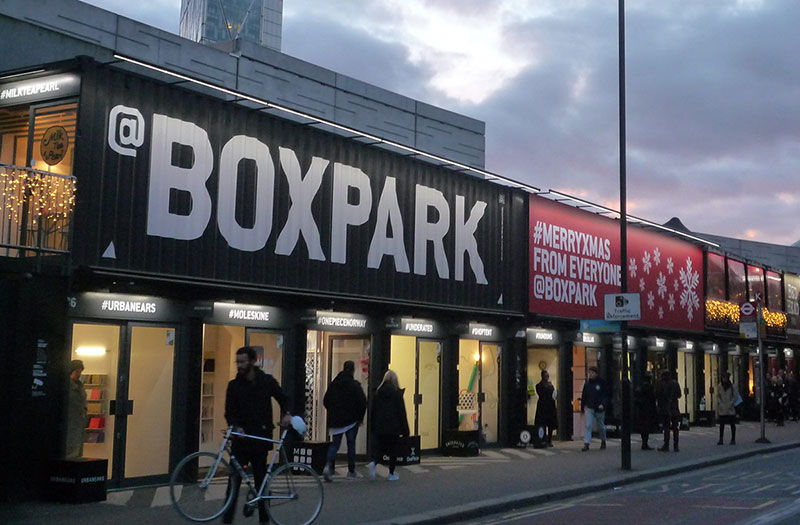
The fictional client is a sushi restaurant located in an imaginary Boxpark container mall in East Side Milwaukee. Boxpark is a food, retail, and entertainment park made of repurposed shipping containers. Roger Wade conceived Boxpark as a “pop up mall,” launching the first park in Shoreditch, England in 2011 (Fry, 2017). Our primary assignment for the class was a Strategic Development project that utilized in-depth research to develop a brand message for Boxpark Sushi and ways to differentiate the brand from competitors.
The combination of primary and secondary research in week one provided several insights about the client’s product, consumer thoughts, and brand category:
- Sushi quality depends largely on the chef and ingredients, not where it was made.
- East Side Milwaukee has a young, educated population that may be more accepting of sushi than the average American.
- Boxpark and other container markets combine modern brands and traditional street food.
- Negative perceptions of sushi are mainly focused on the raw fish aspect due to health concerns and personal taste.
- Maki rolls are more popular with Americans than other types of sushi.
- Sushi bars provide a personal, interactive experience for diners.
This information provided a broad overview of the product and category but needed to be “funneled down” with other data to find a distinctive message for the brand.
Connecting / Synthesizing / Transforming
During the week two live session, we shared our findings and identified several potential obstacles to people who haven’t tried sushi, including unfamiliar ingredients like octopus or the challenge of eating with chopsticks. We also talked about how most people are introduced to sushi by a friend or family member who is already an aficionado. Professor Argo used the term “sushi sensei” for someone who makes a sushi eater’s first time less intimidating by explaining various processes and ingredients to the newcomer. This term stuck with me as I researched ways to overcome the identified obstacles.
I discovered a 2015 survey conducted by strategy consulting firm Kelton Global that examined Americans’ sushi eating attitudes and behaviors (Shelby, 2015). Although the survey was used as a marketing tool for the fast-casual Asian-inspired restaurant Pei Wei, it also provided insight that narrowed my focus for the Boxpark Sushi brand.
Survey Finding Highlights:
- More than three in five (62 percent) who haven’t tried sushi are willing to try it and 43 percent of these folks would start eating sushi if they were able to take baby steps, such as by not eating raw fish right away.
- Ninety-four percent of those willing to try sushi would steer clear of raw fish.
- Sushi newbies felt more comfortable starting with non-raw rolls, and then branched out and tried others. In fact, nearly one-quarter (22 percent) took baby steps when they first sampled rolls and nearly one-third (30 percent) had someone help them order.
This information, combined with the obstacles we discussed in the previous live session, made me realize that sushi could be much more accessible if combined with personalized customer service. At a traditional sushi bar, the chef might have suggestions regarding what is in season or what he thinks you might enjoy (Grabianowski, 2005). However, he or she seldom has the time to find out a customer’s personal tastes and experience with sushi.
I transformed this knowledge into the Sushi Sensei concept, the idea of training Boxpark sushi chefs to make recommendation to customers based on questions like, “Do you prefer salty or sweet?” By sharing knowledge and taking a moment to learn about diners’ tastes, the Sushi Sensei elevates the service level and makes eating at Boxpark Sushi a fun learning experience.
Problem Solving
To stand out from competitors, Boxpark Sushi needs a strong point of differentiation. Why should consumers eat here instead of other nearby sushi restaurants? My research of the primary competition revealed that they served traditional sushi but not modern fusion items like sushi burritos (Gabriele, 2019) or waffle breakfast sushi (Tom, n.d.). Boxpark Sushi could stand out from both primary and secondary competitors by promoting this style of modern sushi.
Another point of differentiation is that competitors have waiters and/or self-serve buffets, but not a casual sushi bar. Sushi bars let customers order directly from the chef rather than wait staff. The sushi is prepared in front of customers, providing a personalized interactive experience (Grabianowski, 2005). Traditional sushi bars can be quite formal, and the chef is more focused on preparing the food than making recommendations based on the customer’s tastes. Having a friendly, casual Sushi Sensei to guide diners is another way to differentiate Boxpark Sushi.
Considering both points of differentiation, I looked at a number of factors. My primary research entailed visits to Chico, California restaurants and supermarkets that serve sushi. Sushi Burrito King offers modern fusion sushi, but during my visit there were very few customers and the food looked and smelled unappetizing. In contrast, the sushi at Raley’s supermarket was being prepared in clear view by a friendly chef who offered to make whatever I liked. This personal experience helped me realize that a quality product and good customer service are more appealing than a novelty product.
I also looked at how each point of differentiation addresses the human needs explained by Maslow’s “hierarchy of needs” and its level in the hierarchy. The highest possible need that modern sushi achieves is Esteem, by making diners feel more sophisticated for trying something new. The Sushi Sensei concept achieves the highest level in the hierarchy, Self-actualization, by comparing the Boxpark Sushi experience to a peaceful form of martial arts. These considerations drove my decision to make the Sushi Sensei the driving “zag” of the Boxpark Sushi creative brief rather than modern sushi, which can still be part of the menu but not the primary point of differentiation.
Innovative Thinking
Many restaurants emphasize their product as a key selling point. Flavor, freshness, and variety of menu items are promoted in order to address the basic human need for good food.
Rather than taking this product-based approach, I decided that a service-based approach would better address the needs of Boxpark Sushi’s customers. Many restaurants offer good food, so elevated service can be an effective way to stand out. Sushi bars are not exclusive to Boxpark Sushi, but the concept of modernizing the sushi chef into a friendly, casual Sushi Sensei specifically addresses the young, urban consumers who shop at Boxpark mall.
Sus Hi Eatstation, a central Florida restaurant chain, has a similar martial arts theme that encourages customers to “be a ninja” by building their own sushi rolls, bowls, and burritos(Sus Hi Eatstation). However, Boxpark Sushi’s sensei theme is targeted toward East Side Milwaukee’s students and young professionals whereas Sus Hi Eatstation’s ninja theme is targeted toward families in Central Florida.
Acquiring Competencies
The following are concepts, skills, or new resources learned in the Design Strategies and Motivation course. They are categorized as Academic (pertaining to schoolwork) or Occupational (pertaining to work in the Media Design field), and Technical (pertaining to software or other design skills) or Conceptual (new terminology, procedures, or ideas).
Academic
| Conceptual | Technical |
| Abstract Thinking: Literal thinking can lead to unoriginal, ineffective designs. Abstract thinking helps us find metaphors that define the essence of a problem in order to solve it in original ways. Strategic Design: Creative problem-solving skills separate designers from production artists. By understanding how a brand’s message can connect with consumers, we add value to ourselves as designers. | Synthesis Writing: Combining information from multiple sources can shine new light on a topic and help you examine an issue from a different perspective. |
Occupational
| Conceptual | Technical |
| Maslow’s Hierarchy of Needs: Psychologist Abraham Maslow described a “hierarchy of needs” in human beings that start with low level physiological needs like hunger that must be met first before ascending to higher-level psychological needs like love and esteem. Settle and Alreck’s Shopping List of Needs: an unranked list of fifteen human needs than can be addressed in a target audience, from achievement to understanding. Demographics: Quantitative data about your target audience including gender, age, income, and location. Psychographics: Qualitative data about what people think and why, including their personality and habits. Buying Behavior: the when, what, and why people are buying a product. Direct competitors: brands with similar products that are likely to be used if your client’s product did not exist. Indirect competitors: brand with similar products but a strong differentiation from your client or in another market segment. Replacement competitors: brands with very different products that are competing for the same customer’s time and money. Unique Selling Proposition: sells a benefit unique to the brand. “You should buy a ____ because it’s the only one that _____.” If consumers want this feature or benefit, the only place they can get it is from your brand. Emotional Selling Proposition: Instead of looking for the logical benefits of a product, the ESP finds the emotional selling points of the product. How does it make the use feel happier or more attractive? | Attitude Advertising: a brand’s personality, or attitude, can differentiate a brand in very wide categories like smart phones or athletic shoes. When the actual differences from the competition are slight, attitude is everything. Brand Image: To stand out from competitors, a brand image should be recognizable and relatable to the target audience, like an old friend they want to spend time with. Rhythm in Design: Repeating rhythms create a pattern that the human eye recognizes. Any irregularity stands out, drawing the eye to that element. Random Rhythm: Elements repeat with irregular intervals or spacing. Regular Rhythm: Elements repeat with the same spacing or intervals. Alternating Rhythm: Two or more elements repeat in a regular pattern. Flowing Rhythm: Repeated elements follow curves or undulations like those found in nature. Progressive Rhythm: Repeated elements change slightly with each repetition. |
References:
Felton, G. (2013). Advertising: Concept and Copy (Third). New York: W.W. Norton.
Fry, S. (2017). Boxing clever: The firms based in shipping containers. Retrieved from https://www.bbc.com/news/business-38742250
Gabriele, A. (2019). The Origins of the Sushi Burrito: Q&A with the Inventor. Retrieved from https://www.themanual.com/food-and-drink/sushi-burrito-sushiritto/
Grabianowski, E. (2005). At the Sushi Bar. How Sushi Works. Retrieved from https://science.howstuffworks.com/innovation/edible-innovations/sushi2.htm
Shelby Food Service. (2015, March 24). Pei Wei Releases Sushi Survey Results, Adds New Rolls. Retrieved from https://www.keltonglobal.com/recognition/pei-wei-releases-sushi-survey-results-adds-new-rolls/
Sus Hi Eatstation. (n.d.) Our Story. Retrieved from https://sushieatstation.com/our-story/
Tom, H. (n.d.) 21 Unique Recipes for Sushi Without Raw Fish. Retrieved from: https://spoonuniversity.com/recipe/21-unique-recipes-for-sushi-without-raw-fish

