Multi-Platform Delivery Mastery Journal

Overview

Multi-platform Delivery, the ninth course in the Media Design MFA program from Full Sail University, continued the development of a brand identity for a fictional client: Boxpark Sushi, located in East Side Milwaukee.

My classmates and I used the design briefs and media delivery plans that we developed in the previous course to create final logos and media assets for the brand. Finally, we collected all the brand details and visual assets into a comprehensive brand guide.


Connecting / Synthesizing / Transforming

This month I was reminded of the importance of proximity and space in graphic design. In an early draft of the Boxpark Sushi logo, the logotype suffered because it was three degrees away from stasis. In other words, the Boxpark and Sushi type were separated by distance as well as font and color differences.
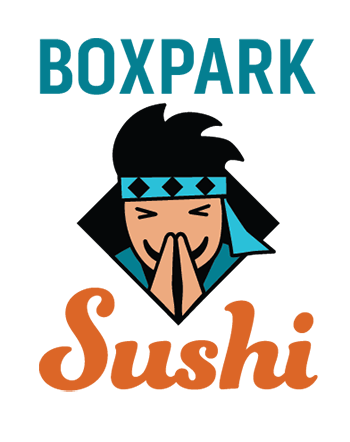
Boxpark Sushi draft logo

To better understand the design principles of proximity and space, I read an article by Matt Smith on graphic design education website Edgee.net and chapters from the book The Elements of Graphic Design: Space, Unity, Page Architecture, and Type by Alex White.

As noted by Smith (2014), close proximity of design elements indicates a relationship or connection between the elements. Things that are unrelated are not grouped together. White (2011) agrees that the proximity of related elements adds unity to a design.

I applied this knowledge to revise the Boxpark Sushi logo. Although the fonts and colors are still different, I shortened the x-height of the Sushi type and overlapped the Boxpark type. Joining the type in this way strengthened the connection between the two elements to form an effective logotype.
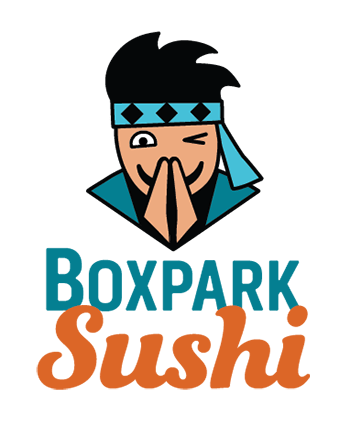
Boxpark Sushi revised logo

Problem Solving

Creating a logo that stood out from other sushi brands was a daunting design problem. Sushi rolls and chopsticks are ubiquitous in the category, so differentiation required thinking of other elements that visually represent the characteristics of Boxpark Sushi.

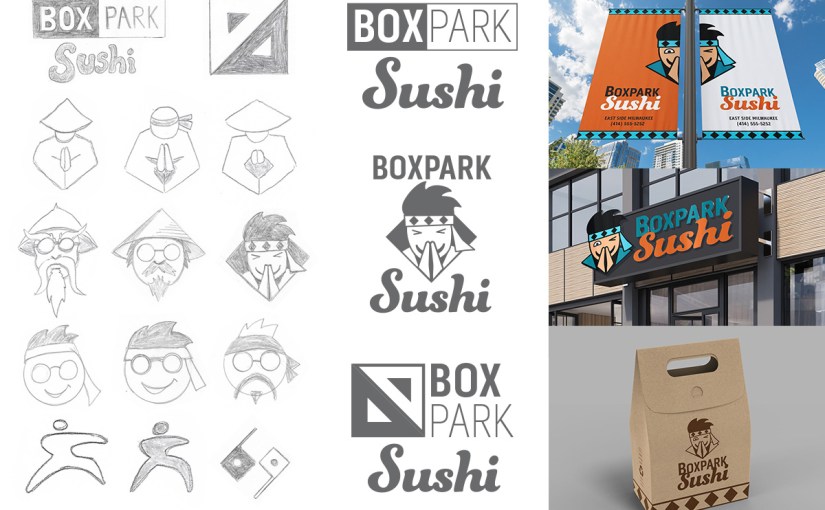
Having established the Sushi Sensei as the personality of the brand, I sketched many logo concepts based on Japanese martial arts or philosophy, such as the Yin-Yang symbol. I also sketched many versions of the Sushi Sensei as a brand mascot.
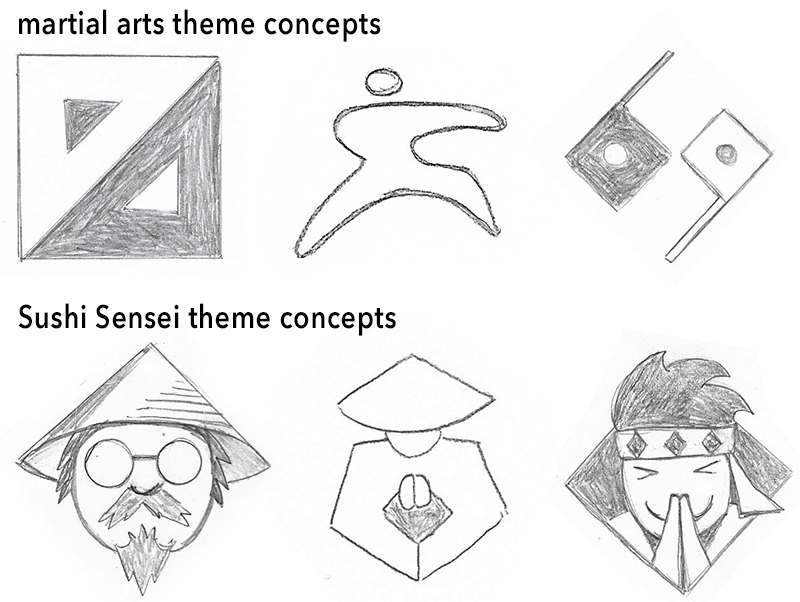
logo concept sketches

The solutions featuring a simplified Sushi Sensei were more successful because they literally put a face on the brand while also expressing the brand’s characteristics (Yalanska, 2019).


Innovative Thinking

Restaurant mascots have become less illustrative over the years as designers recognize the importance of simplicity in logo design.
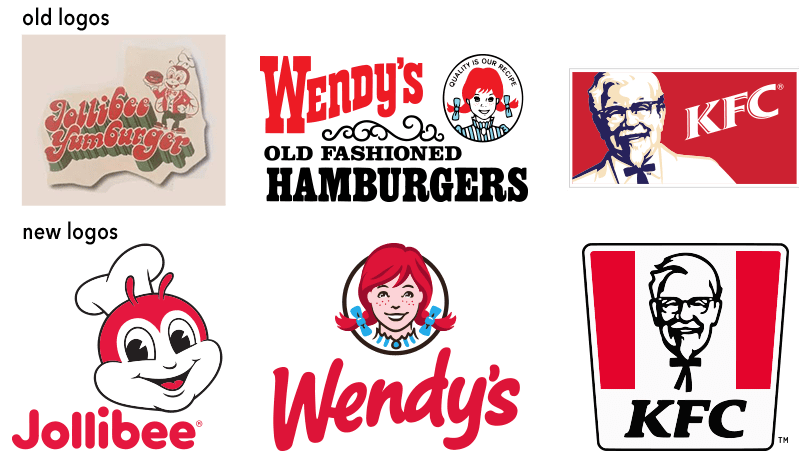
evolution of fast food mascot logos

My own work on the Sushi Sensei mascot followed a similar arc as the design evolved from illustrative concept sketches to an iconified design where every shape serves a communicative purpose.
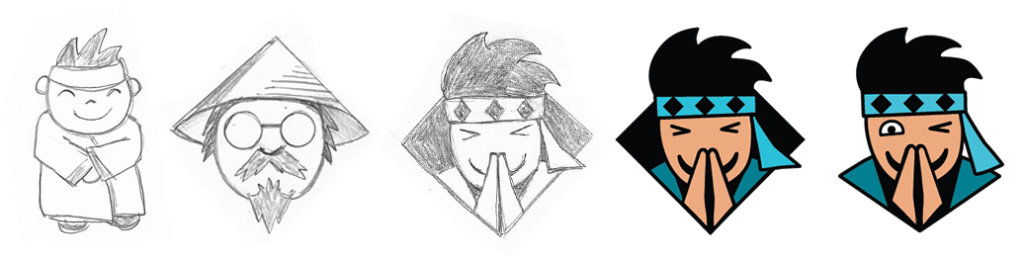
Sushi Sensei concepts, draft logo, and final logo

For example, the first rendered draft of the logo featured the sensei within a diamond shape that mirrored the headband diamonds. However, this design element was decorative rather than communicative, so it was removed. The bottom edge of the design now resembles an open book that reveals the sensei, expressing the brand’s educational aspect. The bowing expression with closed eyes was also changed to a friendly wink, expressing the brand’s fun side.

The final Sushi Sensei logo demonstrates innovative thinking by evolving quickly during the design process rather changing after years of public exposure. The simplified mascot also uses cool colors appropriate to sushi and wisdom rather that the bright red hues used by fast food brands to stimulate hunger.


Acquiring Competencies

The following are concepts, skills, or new resources learned in the Multi-platform Delivery course. They are categorized as Academic (pertaining to schoolwork) or Occupational (pertaining to work in the Media Design field), and Technical (pertaining to software or other design skills) or Conceptual (new terminology, procedures, or ideas).

Brand mascots are a powerful way to connect with a target audience. Mascots provide emotional triggers while supporting the voice of the brand. [occupational, conceptual]

Designers must consider font personality when developing a brand’s typography. The shape, weight, and angles of letterforms all have psychological associations with characteristics like strength or compassion. [academic, conceptual]

A logomark is a simplified symbol that represents a brand but does not include the brand name or other written words. [occupational, conceptual]

A logotype (or word mark) is a brand name that has been visually styled to reflect the brand identity. [occupational, conceptual]

To deconstruct a design means to analyze its separate components in order to understand how it helps communicate a message. [academic, conceptual]

Visual space is used to connect and separate elements in a design. Space also creates hierarchy and improves legibility while conveying a variety of meanings. [occupational, conceptual]

Colors and other design elements have different cultural associations and meanings. When choosing design elements, it is important to research the target market and make appropriate cultural considerations. [occupational, conceptual]

Close proximity of design elements indicates a relationship or connection between the elements. Unrelated elements are space farther apart. [occupational, conceptual]

Carefully organized project file management makes it easier for designers to locate important files and maintain a catalogue of past work. [occupational, technical]

When using design mockups, it is important to consider transparency with clients, appropriateness and inclusivity of the image, and the usage rights. [occupational, conceptual]

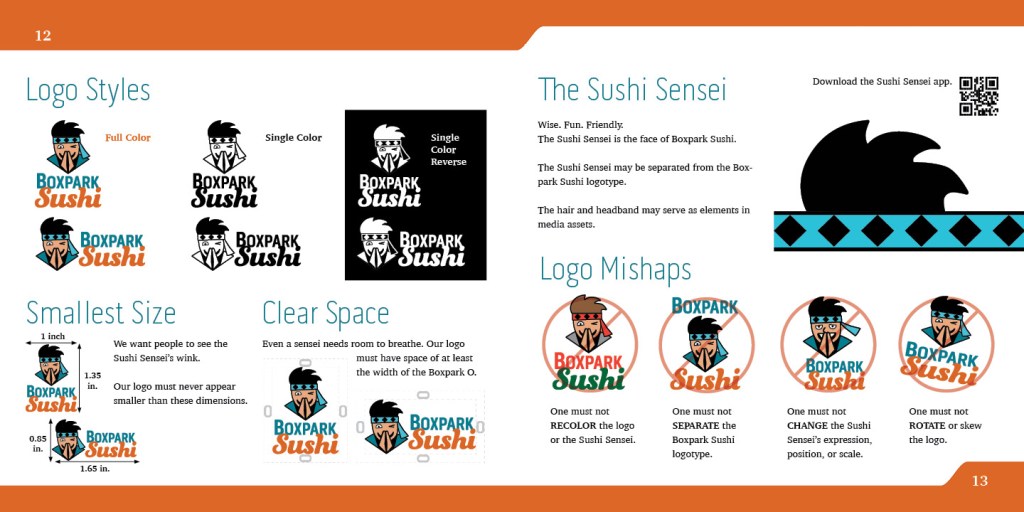
Clear space, also called free space or white space, is the minimum amount of space that a logo must have on each side. Without these guidelines, logo usage will be inconsistent and far less effective. [occupational, conceptual]

Adobe InDesign master pages keep layouts consistent across many pages in a publication. [occupational, technical]

A brand guide ensure that the successful brand identity solution continues to be used effectively and consistently in all all future designs and brand media. [occupational, conceptual]


References:

Smith, M. (2014, September 15). The Principles of Graphic Design: How to Use Proximity Effectively. https://www.edgee.net/the-principles-of-graphic-design-how-to-use-proximity-effectively/

White, A. W. (2011). The Elements of Graphic Design: Space, Unity, Page Architecture, and Type. Allworth Press.

Yalanska, M. (2019, March 13). Design Me Live: The Power of Mascots in UI and Branding. https://blog.tubikstudio.com/design-me-live-the-power-of-mascots-in-ui-and-branding/
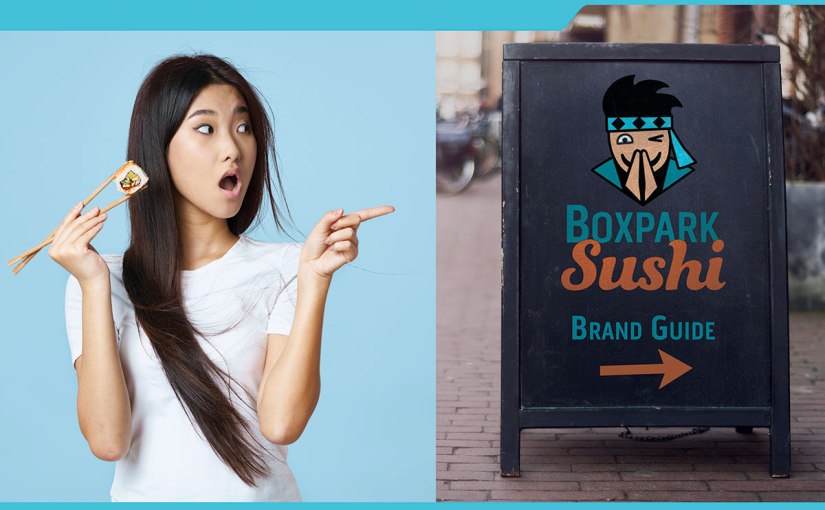
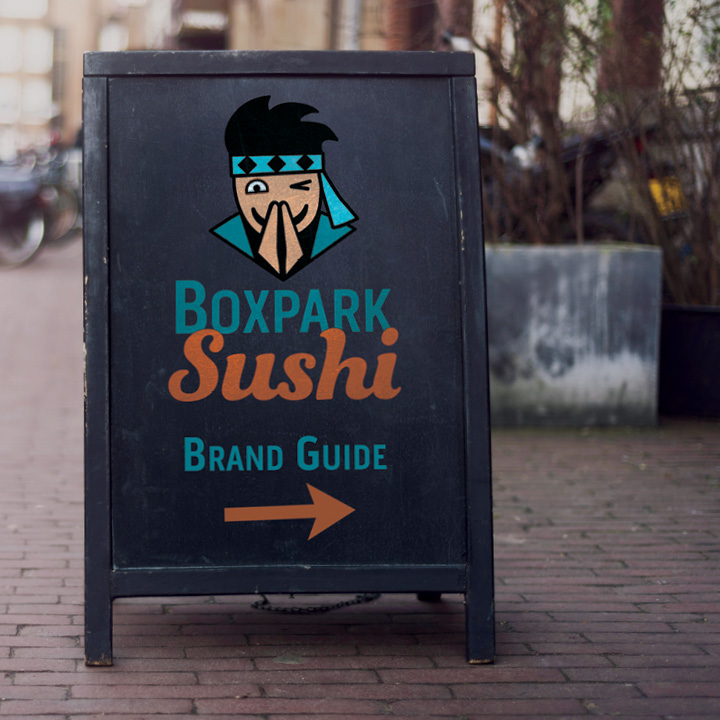
Boxpark Sushi production retrospective

What was the original Problem to be solved by creating new identity branding? Has the purpose of the brand been met in your materials?

The original problem identified in January for the Strategic Development course is that many American consumers are confused or intimidated by sushi and its ingredients. To address this issue, the Boxpark Sushi identity is built around the Sushi Sensei personality. All of the brand’s media assets utilize this wise but fun identity to make customers feel more comfortable about eating sushi. For example, the back of the Boxpark Sushi takeout bag features words of wisdom with a dash of humor. The education aspect of the brand could be further expressed by printing quotes and fun facts about sushi and Japanese culture on other media assets like napkins and in-store décor.

Will the brand identity and asset designs be perceived as appropriate to the brand attributes? What aspect(s) of the design, specifically, make it so?

Boxpark Sushi is wise, fun, friendly, and helpful. One way the brand identity reflects this is in the Sushi Sensei design. The sensei communicates wisdom and helpfulness with a bowing pose, demonstrating fun with a wink and friendliness with a smile. In addition, the logotype fuses the brand’s strong and precise side with its fun and organic side, like a well-trained sushi chef preparing a maki roll.

Does the design convey the intended message? If so, explain how. If not, how might this be corrected?

My biggest concern is that the Sushi Sensei will be mistaken for a sushi chef or just a random character used to make Boxpark seem like the KFC of sushi. After feedback from professor Argo, I tried to be sure that every shape and line in the logo served a communicative purpose. However, it’s difficult to know how successfully the logo conveys Boxpark Sushi’s message without any means of measuring the success. I’m hopeful that the next course in the Media Design MFA program will help in that area.

Are the media choices effective in sharing the community’s brand? Explain how the design leads to increased interest or better visibility.

East Side Milwaukee residents in the target audience are young and educated. They are open to new experiences, and Boxpark Sushi provides a stress-free way to learn while sharing a great meal. Assets like the “Official Sushi Black Belt” magnet help build the Boxpark Sushi tribe and expand brand awareness. Furthermore, street advertising like pole banners visually introduce the brand to the local community more effectively than radio, television, or internet ads.

Is the design expected or unexpected? Is that good or bad? Explain why.

Boxpark Sushi’s logo and media asset designs stand out from competitors because they are unexpected. After all, sushi restaurant logos are more likely to feature chopsticks and sushi rolls than brand mascots, which are normally associated with fast food. However, mascots are an effective way to literally put a face on a brand, making it easier to connect with the target audience. The Sushi Sensei mascot expresses the brand personality without cheapening it or making it seem too childish.

Is there anything about the design that should be finessed, adjusted, or reconsidered?

Even after researching color theory and the psychological associations of colors, I still don’t feel confident in my choice of color palette for the Boxpark Sushi logo. There is a strong rationale for using orange and blue to depict fun and wisdom, but something about the pairing or my choice of hues doesn’t feel right. Maybe I’m too dependent on tools like Coolors and Adobe Color. On future projects, I plan to use mood boards to find inspiration in colors from images that capture the brand characteristics.

Boxpark Sushi final media assets

Signage

Boxpark Sushi signage
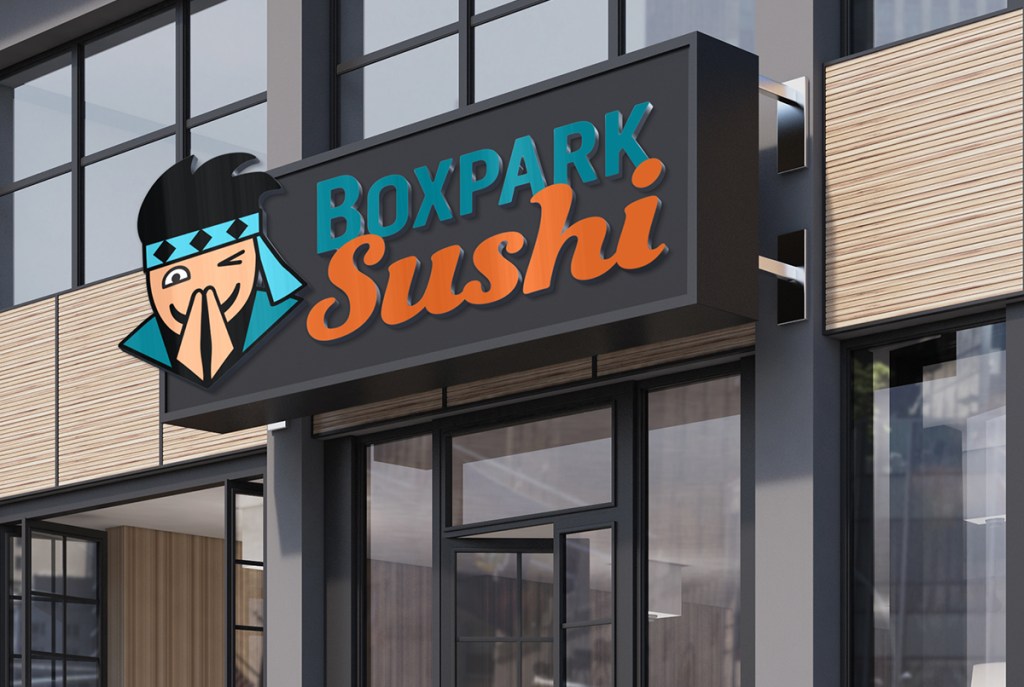
Boxpark Sushi signage mockup

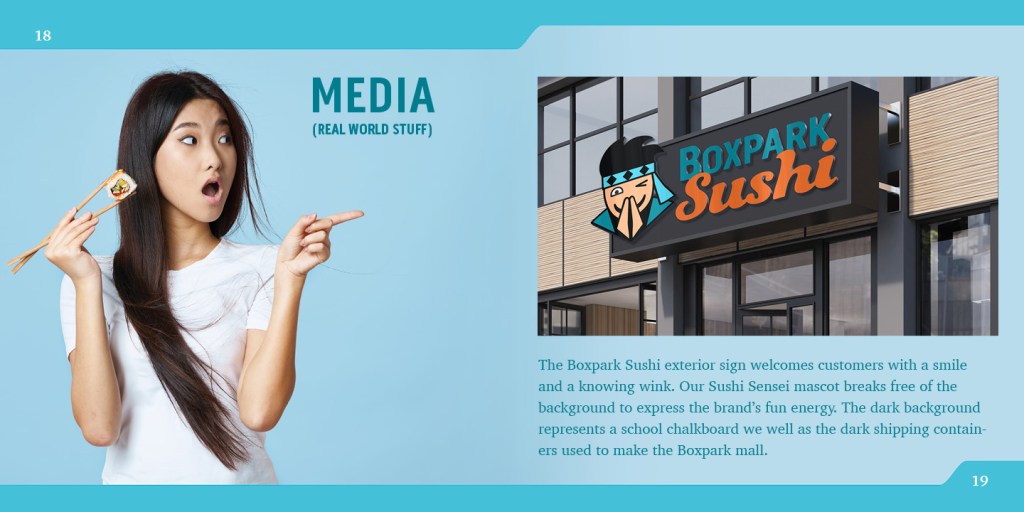
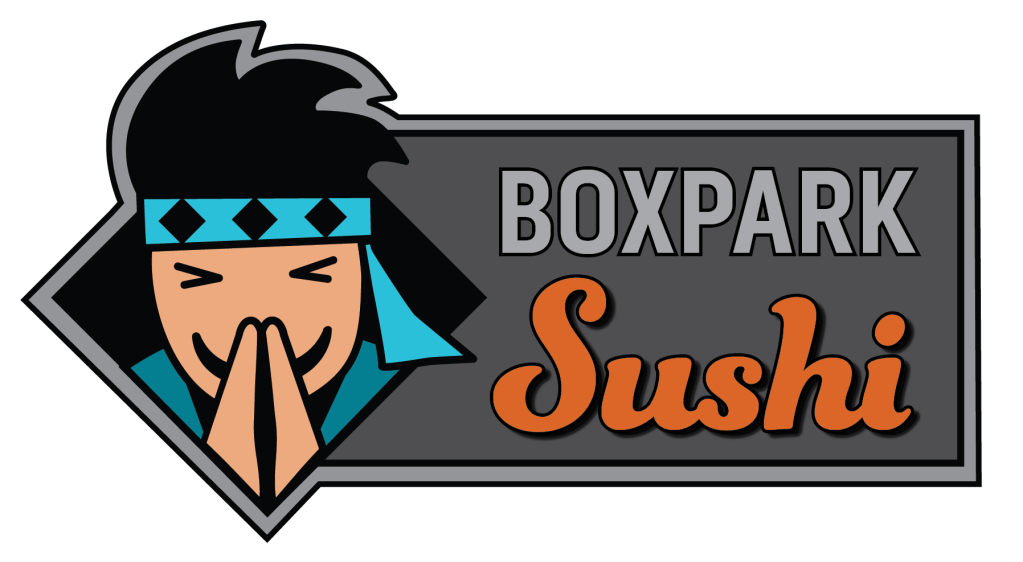
The strategic purpose of the Boxpark Sushi exterior sign is to capture the attention of shoppers and visually explain the brand. A dark gray background and its border represent a chalkboard, evoking the educational aspect of the brand. At the same time, the background mimics the dark shipping containers that constitute the architecture of the Boxpark mall.

The Sushi Sensei mascot breaks free of the background, demonstrating the brand’s fun energy and welcoming customers with a bow, a smile and a wink. This simplified facial expression communicates the wise yet friendly nature of Boxpark Sushi. Wisdom and competence are also expressed in the aqua blue colors in the headband and darker teal color of the Boxpark text and the Sensei’s karate gi (Kolenda, 2016).

In contrast, the orange color Sushi text communicates the brand’s warm, fun energy (Kolenda, 2016). Furthermore, studies show that warm reds and oranges can increase one’s appetite (Przybyla, n.d.). Because Boxpark shoppers already know where they are, the Boxpark text does not stand out on the sign as much as the bright orange Sushi text that tells them what the restaurant serves.


Pole Banners

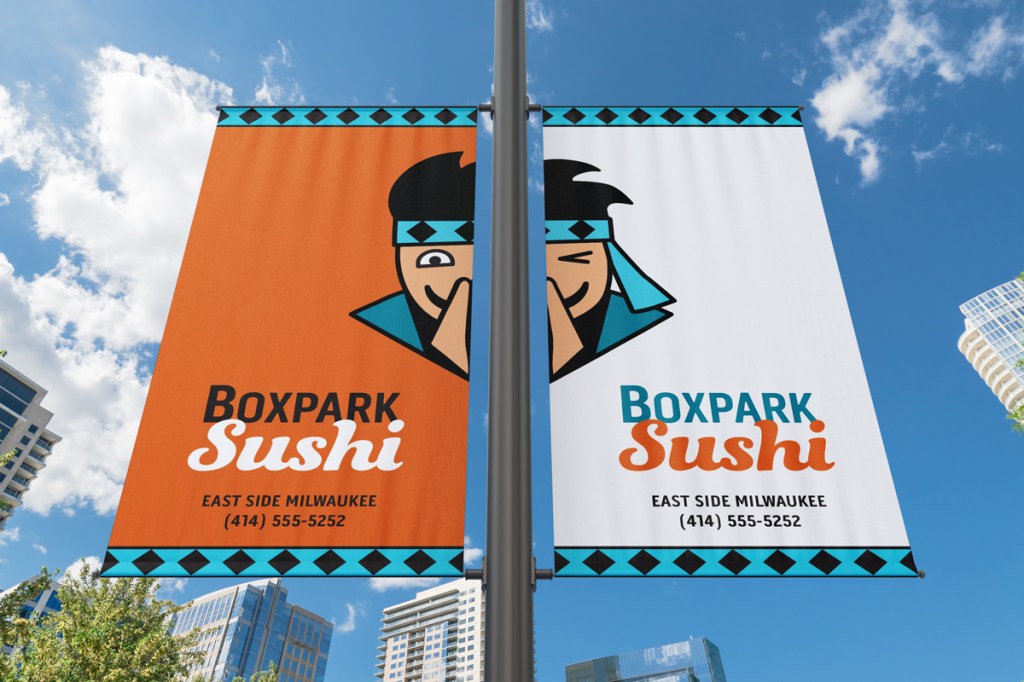
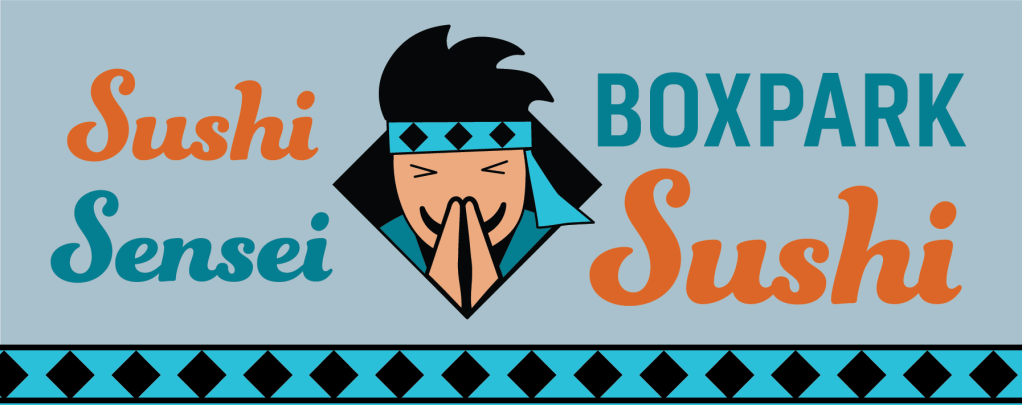
Boxpark Sushi pole banners
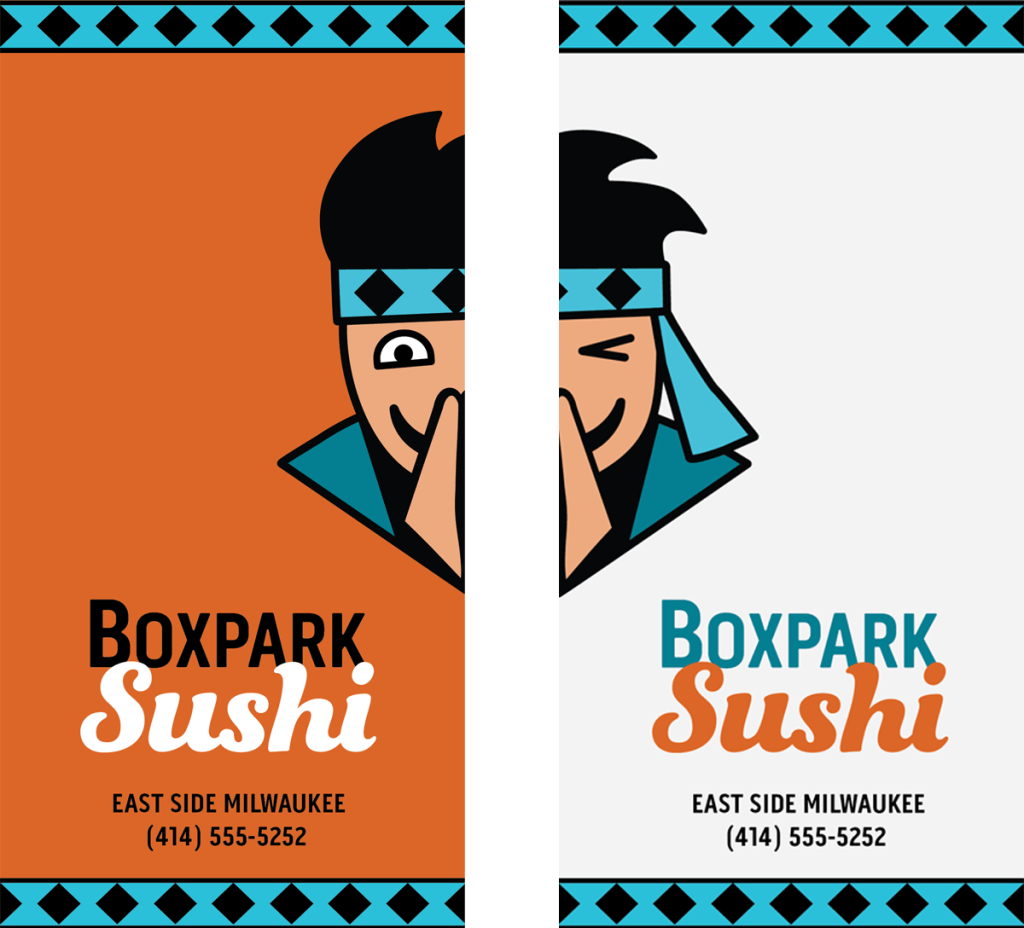
Boxpark Sushi pole banners mockup

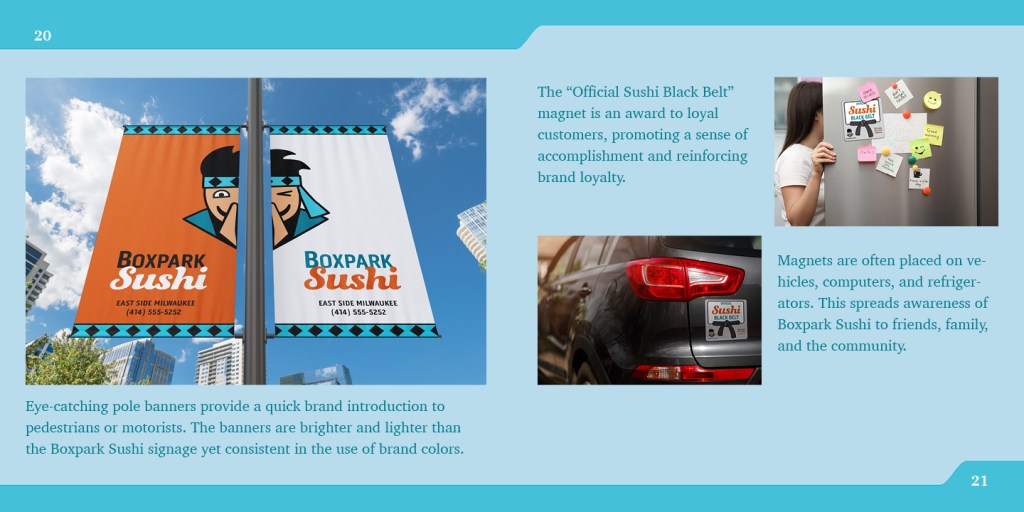
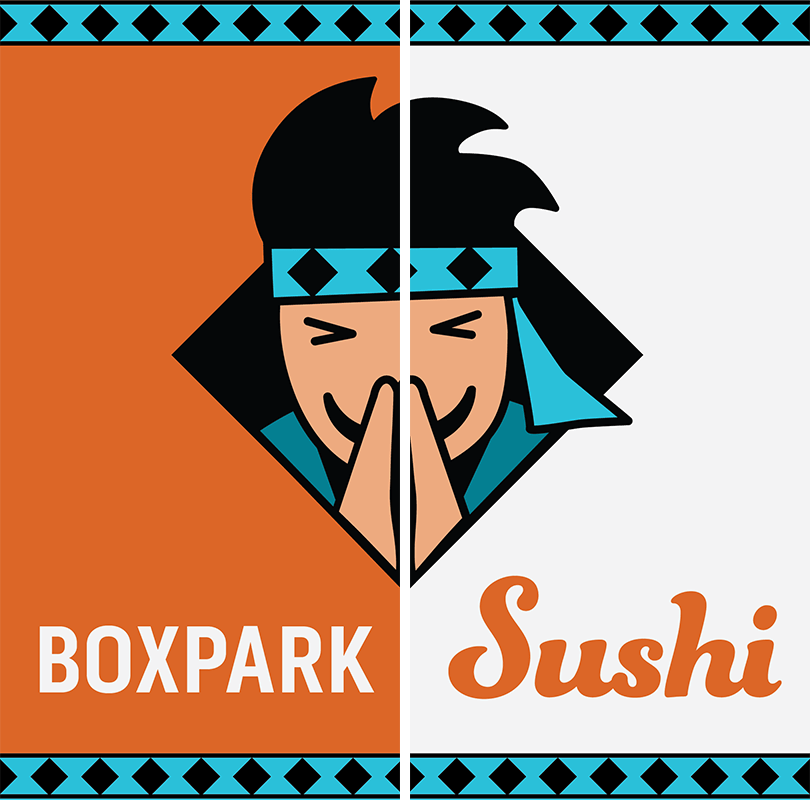
Eye-catching pole banners provide a quick brand introduction to passers-by, whether they are pedestrians or motorists. Demographic data shows that a large majority of East Side Milwaukee residents drive to work (Point2Homes, n.d.), so it is vital that the banners attract attention and communicate clearly to motorists who may have only seconds of attention to spare.

For that reason, the banners are brighter and lighter than the Boxpark Sushi signage while remaining consistent in the use of brand colors. The orange color stands out against the sky and other urban backgrounds as well as representing the brand’s association with “energy, ambition, and enthusiasm” (Cousins, 2012).

Paired side by side, the two banners have an abundance of negative space that communicates openness and freedom (White, 2011). The Sushi Sensei once again breaks free of the background, expressing the fun side of the brand.


Magnet

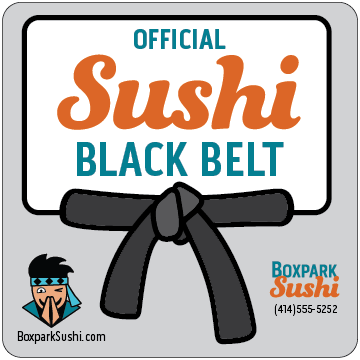
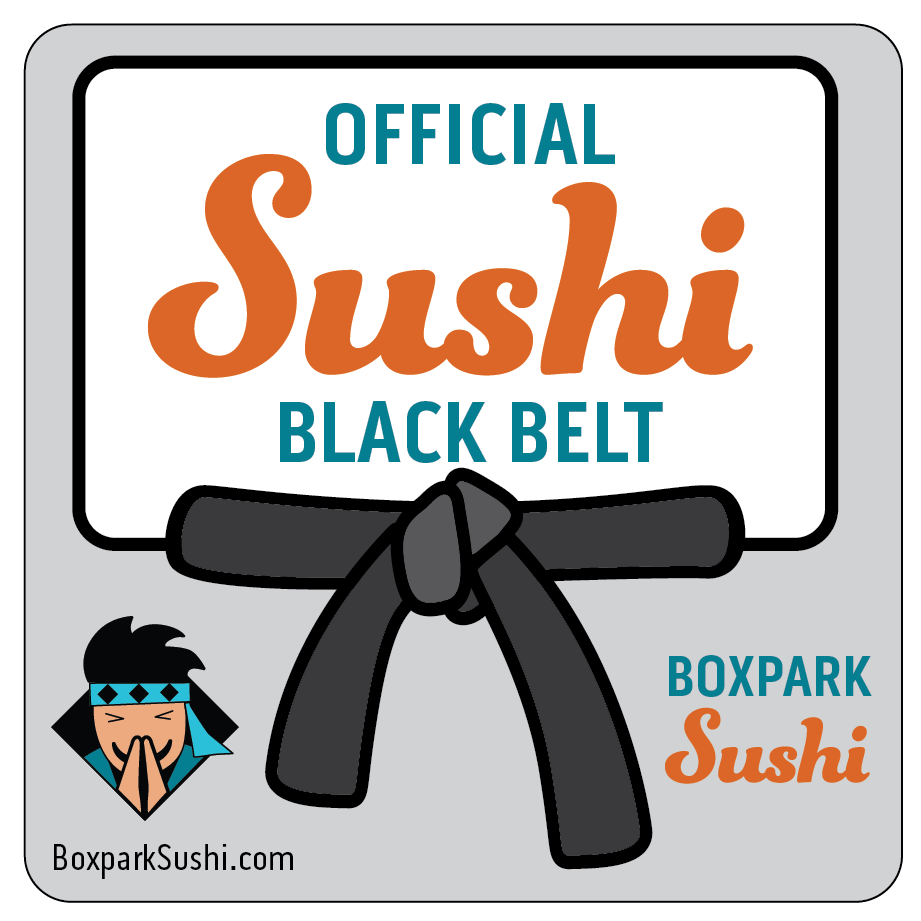
Boxpark Sushi magnet
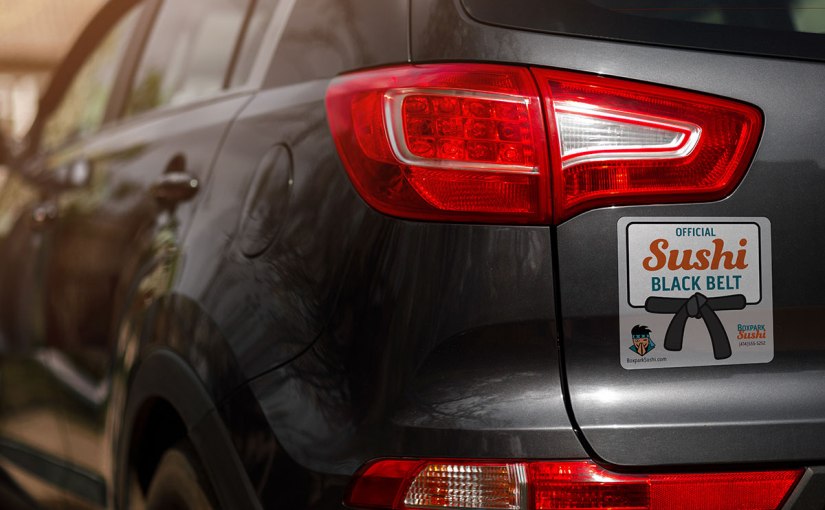
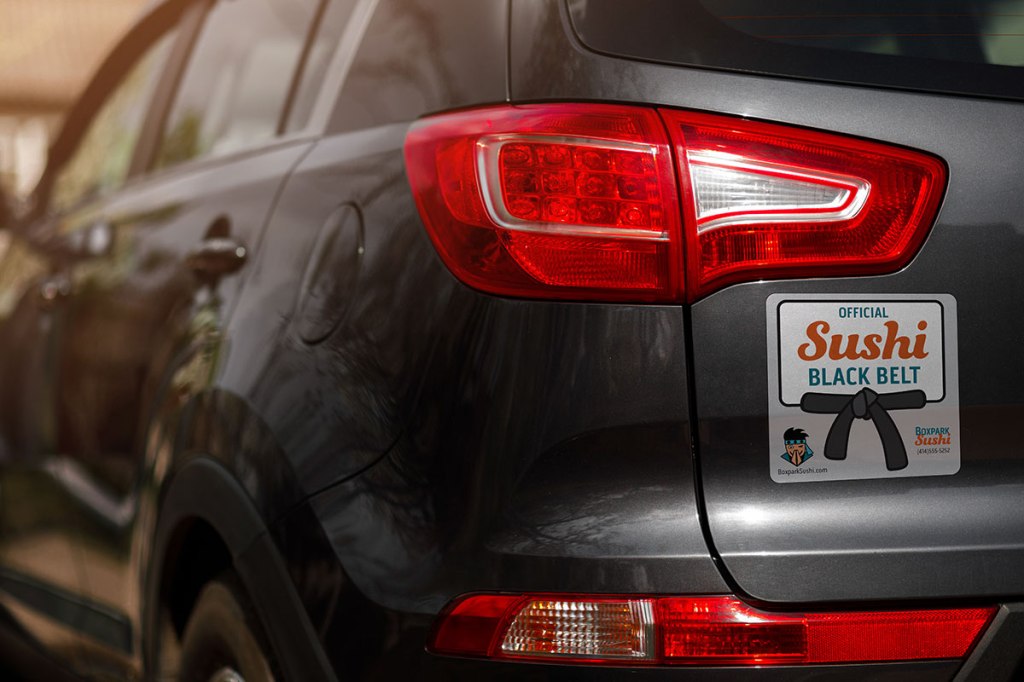
Boxpark Sushi magnet on car
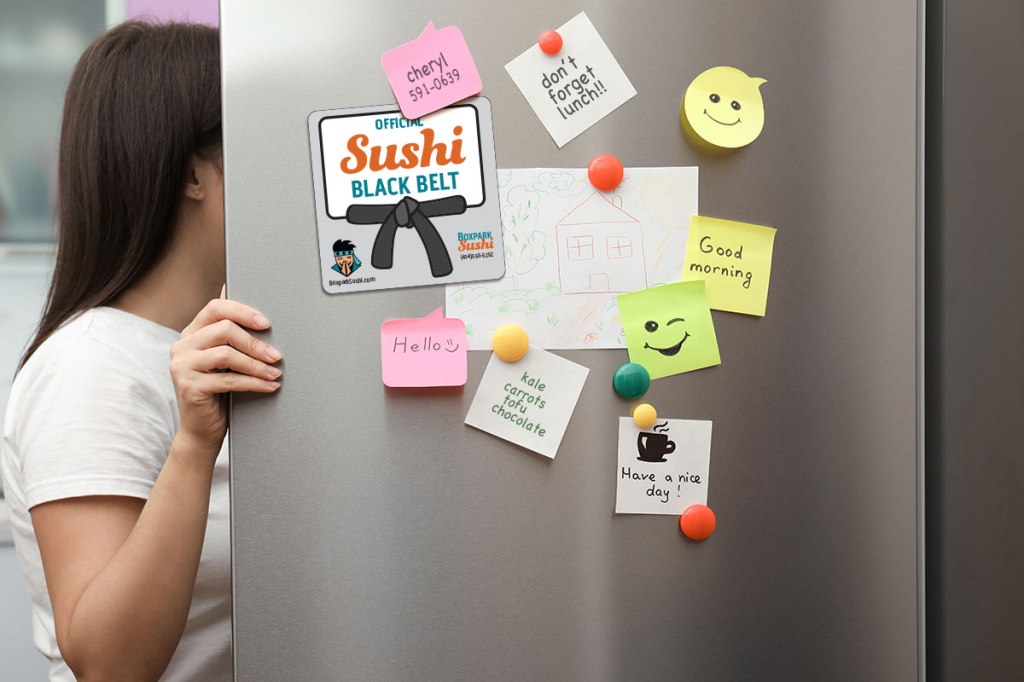
Boxpark Sushi magnet on refrigerator

Printed magnets are an inexpensive promotional item that reinforce loyalty to the Boxpark Sushi tribe and spread brand awareness. The “Official Sushi Black Belt” magnet is an award to loyal customers, promoting a sense of accomplishment and addressing self-actualization needs. Felton (2013, p. 22) lists self-actualization as the highest level in Maslow’s hierarchy of needs. This helps the brand rise above competitors who only address the lower needs.

Although magnets do not stick on the back of all vehicles, they are mobile advertisements when used to replace bumper stickers. Magnets are also popular decorations for laptops, spreading the brand message to the customer’s workplace and social hangouts.

In addition, magnets are often placed on a refrigerator. Zee (2017) refers to a Purdue University study which found that people open their refrigerators an average of ten to twelve times per day. Numerous visual impressions with a hungry audience can lead to more sushi orders from home.


Takeout Bag

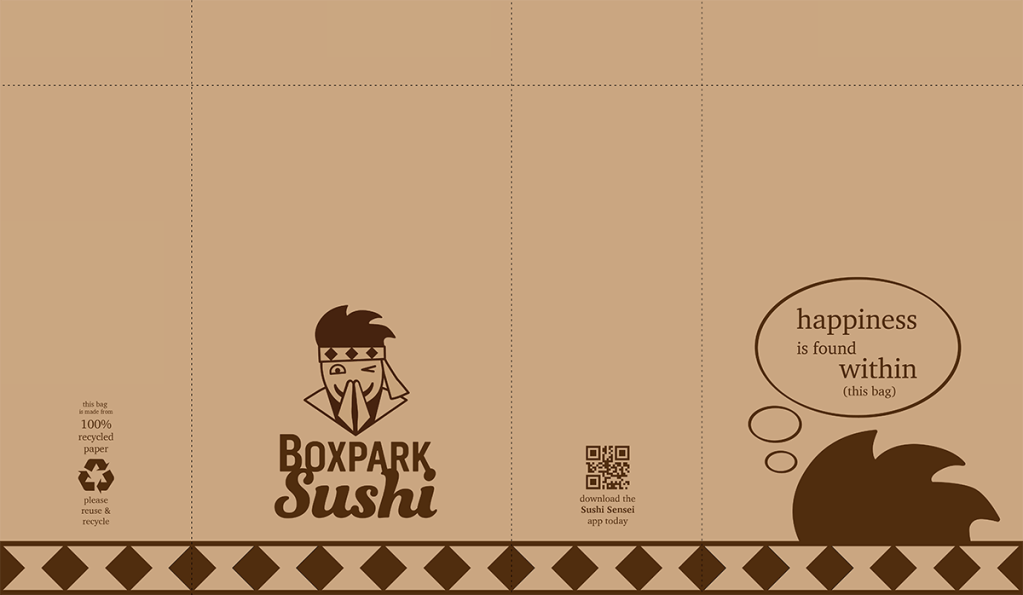
Boxpark Sushi takeout bag design
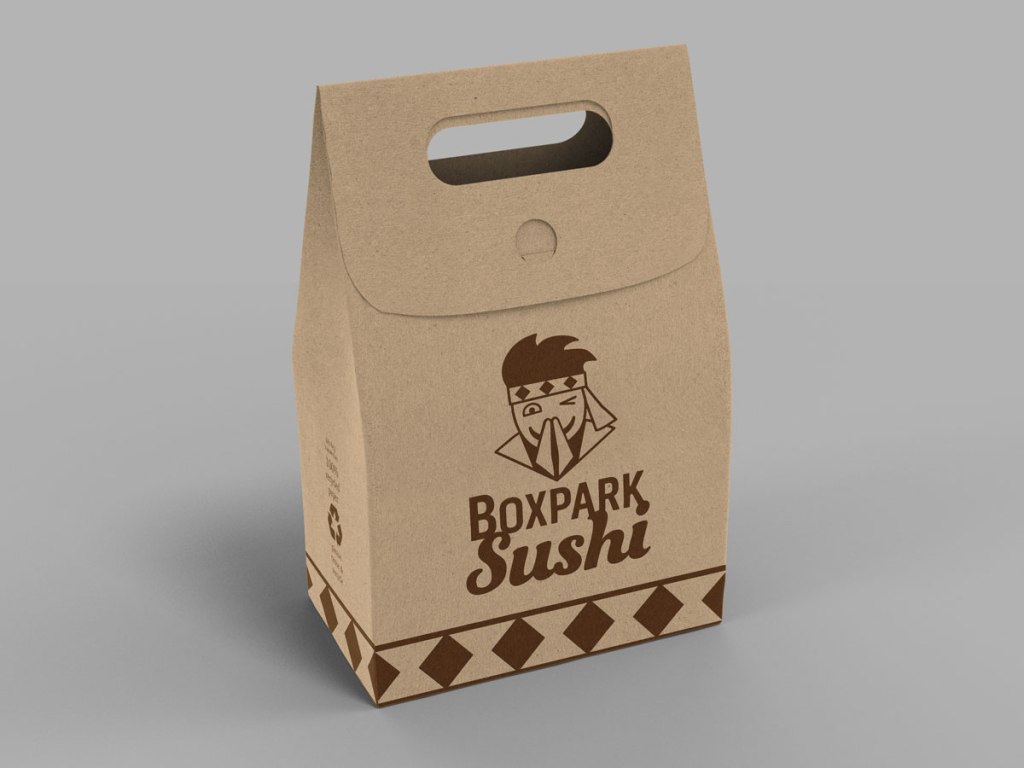
Boxpark Sushi takeout bag mockup front
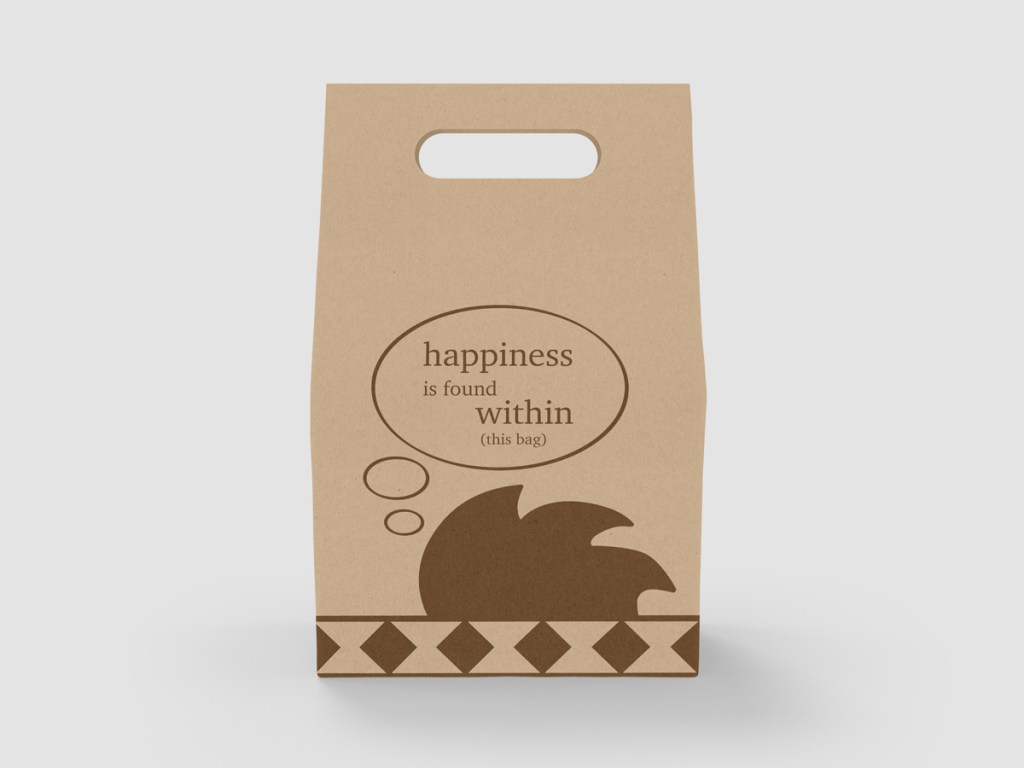
Boxpark Sushi takeout bag mockup back

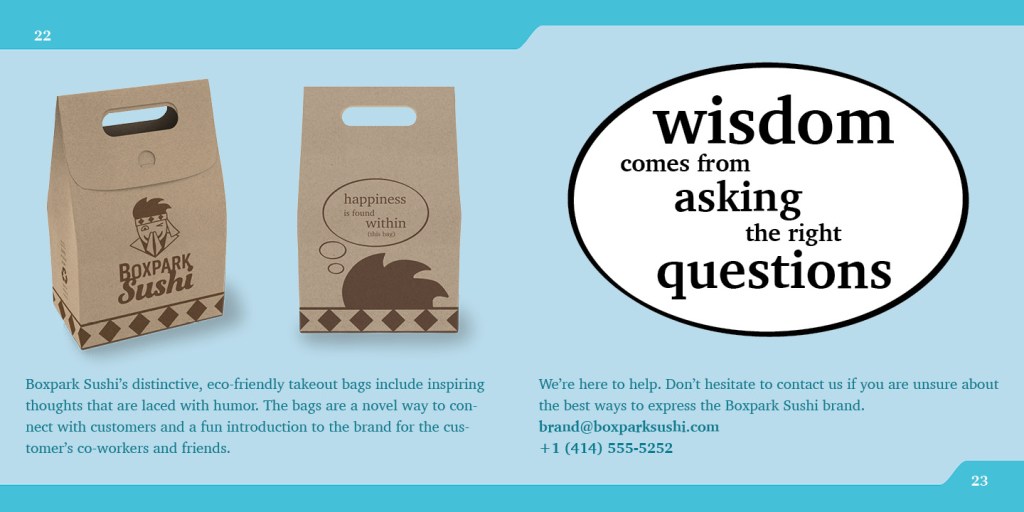
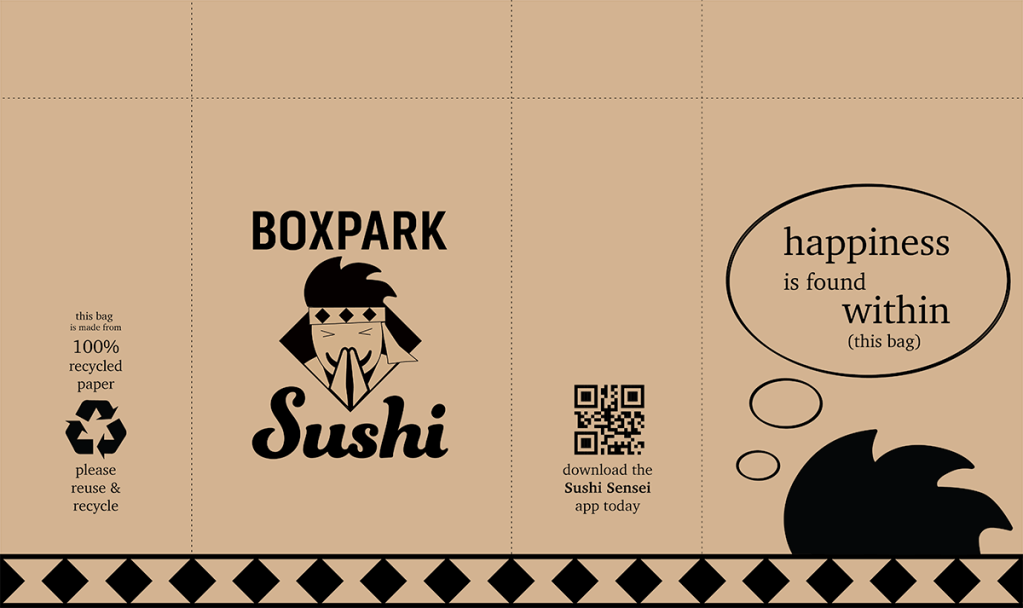
Boxpark Sushi’s distinctive, eco-friendly takeout bags have several strategic purposes. Branded packaging for take-out orders turn customers into walking advertisements as they carry their meal to work, school or home (McQuarrie, 2014). The bags include inspiring thoughts that are laced with humor, providing a novel way to connect with customers and a fun introduction to the brand for the customer’s co-workers and friends. New quotes can be added on a regular basis, adding to the novelty.

The Boxpark Sushi takeout bag also contains space to promote social media accounts, the Sushi Sensei app, and other ways of staying connected with customers. Plant-based ink on recycled unbleached paper give the packaging an organic feel while supporting the brand’s wise and conscientious nature. Multiple logo elements, like the diamond headband pattern, provide brand cohesion despite the lack of color. The quotes on the back of the bag reinforce the brand’s wise but fun personality.


References:

Cousins, C. (2015, February 12). How Color, Type and Space Can Impact Mood. https://designshack.net/articles/graphics/how-color-type-and-space-can-impact-mood/

Felton, G. (2013). Advertising: Concept and Copy (Third). W.W. Norton.

Kolenda, N. (2016). The Psychology of Color. https://www.nickkolenda.com/color-psychology/

McQuarrie, L. (2014, July 11). 38 Take-Out Packaging Designs. https://www.trendhunter.com/slideshow/take-out-packaging

Point2Homes. (n.d.). East Side Milwaukee Demographics. Retrieved from: https://www.point2homes.com/US/Neighborhood/WI/Milwaukee/East-Side-Milwaukee-Demographics.html

Przybyla, D. (n.d.). How Color Affects Appetite in Marketing. https://www.colorpsychology.org/color-appetite/

White, A. W. (2011). The elements of graphic design: space, unity, page architecture, and type. Allworth Press.

Zee, B. (2017, July 21). Discover Why You Should Be Using Magnets to Promote Your Brand. https://stickerbeat.com/discover-why-you-should-be-using-magnets-to-promote-your-brand/

Boxpark Sushi media assets drafts

Signage

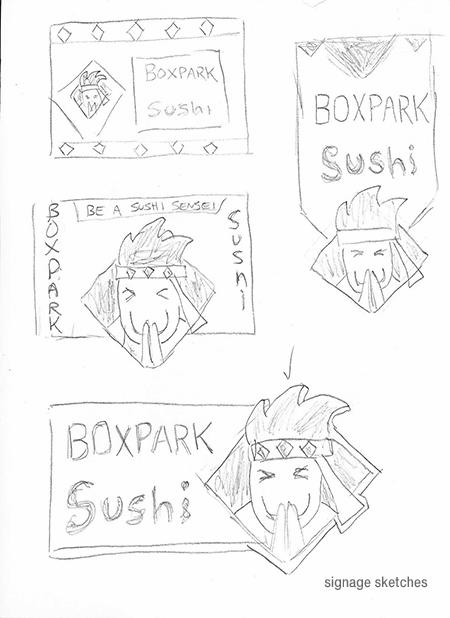
signage sketches
signage draft
signage draft

Boxpark Sushi’s exterior signage is appropriate for the Boxpark container mall, yet distinctive enough to draw the attention of busy shoppers. The Sushi Sensei mascot logo welcomes people with a friendly smile. The orange color of the sushi text communicates the brand’s warm, fun energy and the secondary teal blue color of the sensei headband denotes intelligence and competence (Kolenda, 2016).

This asset utilizes more grays than the brand logo for several reasons. The neutral gray background and Boxpark text are reminiscent of a chalkboard, representing the brand’s intelligent aspect as well as tying with the dark container architecture of the Boxpark mall. The border and neutral background also help the brand colors stand out.

A study quoted by Designhill (2019) says “A majority of people notice a local business by seeing its signage while passing by.” Therefore, the strategic purpose of the sign is to capture the attention of shoppers and visually explain the brand. Because Boxpark shoppers already know where they are, the Boxpark text is not as important on the sign as the bright orange Sushi text that tells them what the restaurant serves.

Pole Banners

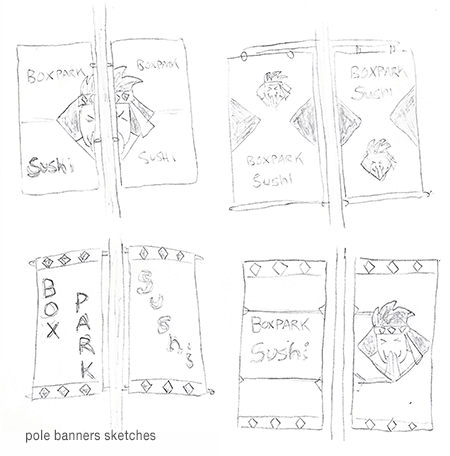
pole banners sketches
pole banners draft
pole banners draft

Strategically placed pole banners can effectively increase Boxpark Sushi’s visibility in the community. However, Commerce Color (n.d.) notes that most drivers will look at a pole banner for only two to four seconds. For that reason, the Boxpark Sushi banners are bold and easy to read with no unnecessary elements. Depending on where the banners are located, additional information like an address or website can be added.

The two banners are meant to be paired side by side, providing more visual space and openness to the design. Spreading the Sushi Sensei mascot logo across both banners adds cohesion to the design, as do the repeated headband pattern borders on the top and bottom.

To capture the brief attention of drivers, the banners are brighter and lighter than the Boxpark Sushi signage while remaining consistent in the use of brand colors. The orange color stands out against the sky and other urban backgrounds as well as representing the brand’s association with “energy, ambition, and enthusiasm” (Cousins, 2012).

Sticker / Magnet

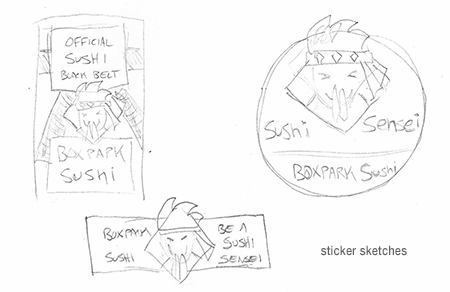
sticker sketches
sushi sensei sticker
sushi black belt magnet

Printed stickers and magnets are relatively inexpensive promotional items that can reinforce loyalty to the Boxpark Sushi tribe and spread brand awareness. Watson (n.d.) notes that sticker marketing helps turn customers into brand advocates by building a personal relationship with the product. The “Official Sushi Black Belt” magnet is a reward for loyal customers, promoting a sense of accomplishment and addressing self-actualization needs.

Felton (2013, p. 22) lists self-actualization as the highest level in Maslow’s hierarchy of needs. This helps the brand rise above competitors who only address the lower needs. Other sticker designs were considered (see above), but a slightly higher cost magnet that is exclusive to frequent Boxpark Sushi diners adds the higher level of prestige.

In addition, magnets last longer than stickers and are often placed on a refrigerator. Zee (2017) refers to a Purdue University study which found that people open their refrigerators an average of ten to twelve times per day. Numerous visual impressions with a hungry audience can lead to more sushi orders.

Takeout Bag

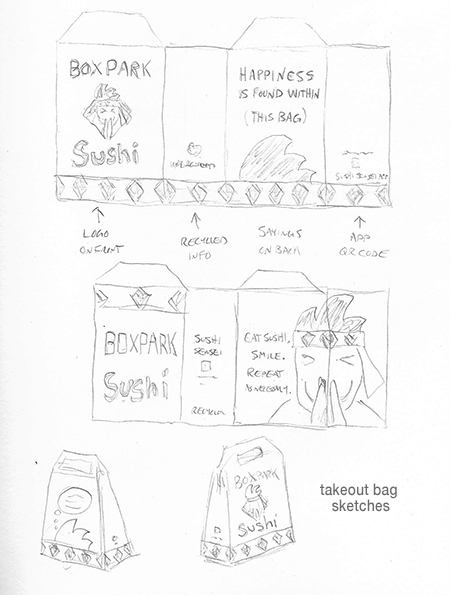
takeout bag sketches
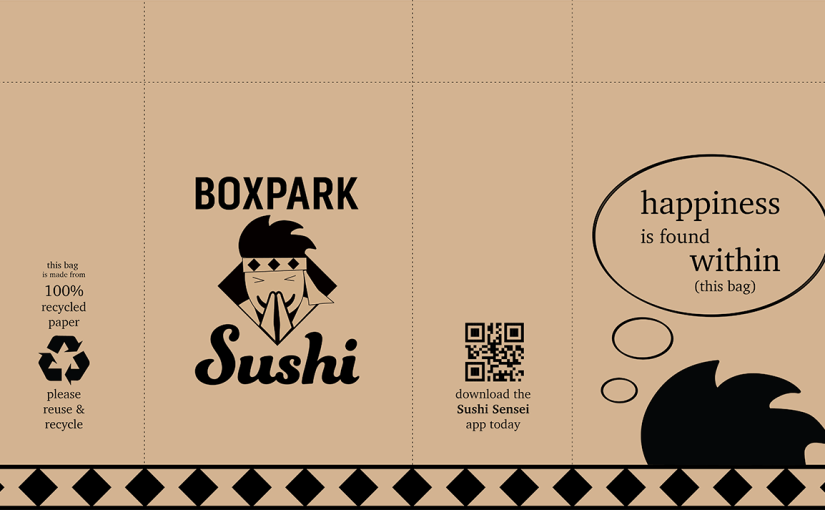
takeout bag draft
takeout bag draft

All restaurants need take-out packaging, so it only makes sense to use that packaging as a media asset. Branded packaging for take-out orders turn customers into walking advertisements as they carry their meal to work, school or home (McQuarrie, 2014). Boxpark Sushi’s distinctive, eco-friendly takeout bags include inspiring thoughts that are laced with humor. The quotes on the back of the bag reinforce the brand’s wise but fun personality.

Plant-based ink on recycled unbleached paper give the packaging an organic feel while supporting the brand’s wise and conscientious nature. Multiple logo elements, like the diamond headband pattern, provide brand cohesion despite the lack of color.

In addition to being a cost effective way of marketing, the Boxpark Sushi takeout bag design contains space to promote social media accounts, the Sushi Sensei app, and other ways of staying connected with customers. Instead of a plain white box or blank paper bag, Boxpark Sushi’s take-out bag is a novel way to connect with customers and a fun introduction to the brand for the customer’s co-workers and friends.


References:

Commerce Color. (n.d.). 5 Ways You Can Supercharge Your Pole Banner Promotions. https://www.commercecolor.com/blog/5-ways-you-can-supercharge-your-pole-banner-promotions

Cousins, C. (2015, February 12). How Color, Type and Space Can Impact Mood. https://designshack.net/articles/graphics/how-color-type-and-space-can-impact-mood/

Designhill. (2019, December 12). 3 Tips to Design Memorable Signage to Attract Customers in 2020. https://www.designhill.com/design-blog/design-memorable-signage/

Felton, G. (2013). Advertising: Concept and Copy (Third). W.W. Norton.

Kolenda, N. (2016). The Psychology of Color. https://www.nickkolenda.com/color-psychology/

McQuarrie, L. (2014, July 11). 38 Take-Out Packaging Designs. https://www.trendhunter.com/slideshow/take-out-packaging

Watson, H. (n.d.). The Forgotten Advantages of Sticker Marketing. https://thefridgeagency.com/blog/discover-the-stickiest-method-of-advertising/

Zee, B. (2017, July 21). Discover Why You Should Be Using Magnets to Promote Your Brand. https://stickerbeat.com/discover-why-you-should-be-using-magnets-to-promote-your-brand/

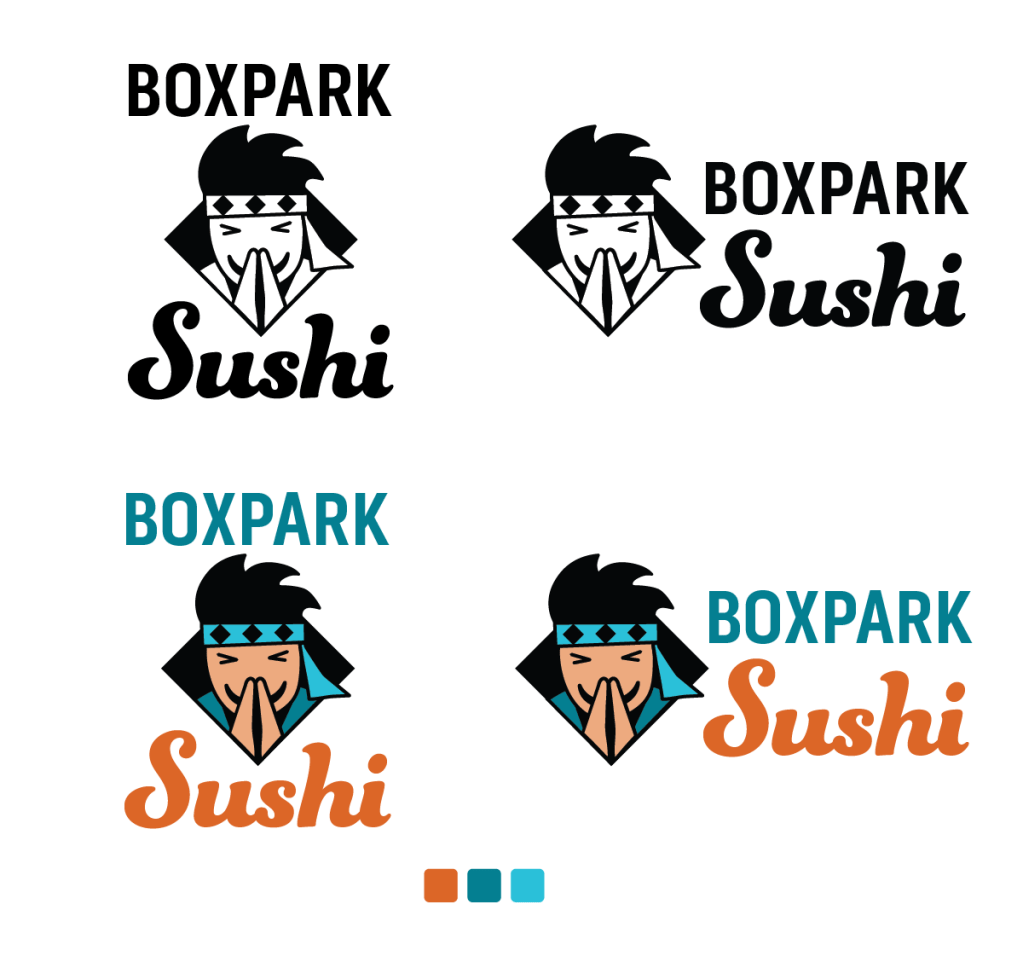
Boxpark Sushi final logo

Boxpark Sushi final logos

Rationale

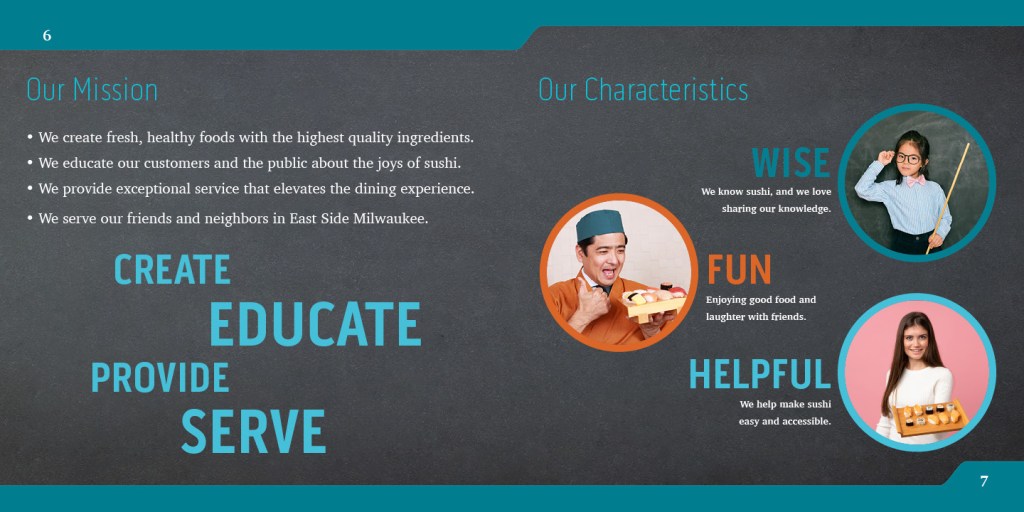
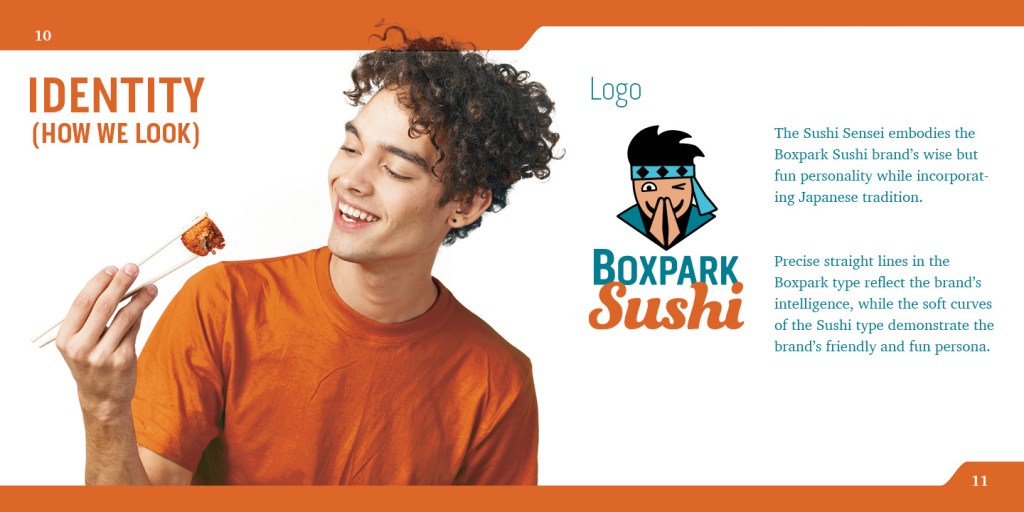
The Sushi Sensei embodies the Boxpark Sushi brand’s wise but fun personality while incorporating Japanese tradition. The simplified mascot in the logo is friendly and hip but not gender specific. Its skin color is a lighter tint of the sushi orange, and the headband’s light blue color helps it stand out against the black background and hair. Its smile and bowing pose demonstrate both friendliness and respect for our customers.

Precise straight lines and sharp corners in the Boxpark type and diamond shapes reflect the brand’s intelligence, while the soft curves of the Sushi type demonstrate the brand’s friendly and fun sides. The type’s curves and rounded corners are repeated in face, hands, and hair of the sushi sensei. Together, the mark and type convey the Boxpark Sushi’s fun, friendly, and wise personality.

Media Asset Production Plan

WEEK 2
Wednesday, March 11
Signage sketches Pole Banner sketches
Magnet sketches
Takeout Box sketches
Friday, March 13 Signage drafts
Pole Banner drafts Magnet drafts
Takeout drafts
Sunday, March 15
Signage drafts submission
Pole Banner drafts submission Magnet drafts submission
Takeout Box drafts submission  
WEEK 3
Wednesday, March 18 Review of Peer workFriday, March 20
Signage final version Pole Banner final version
Magnet final version
Takeout Box final version  
Sunday, March 22
Signage final version submission
Pole Banner final version submission Magnet final version submission
Takeout Box final version submission  

Boxpark Sushi logo refinements

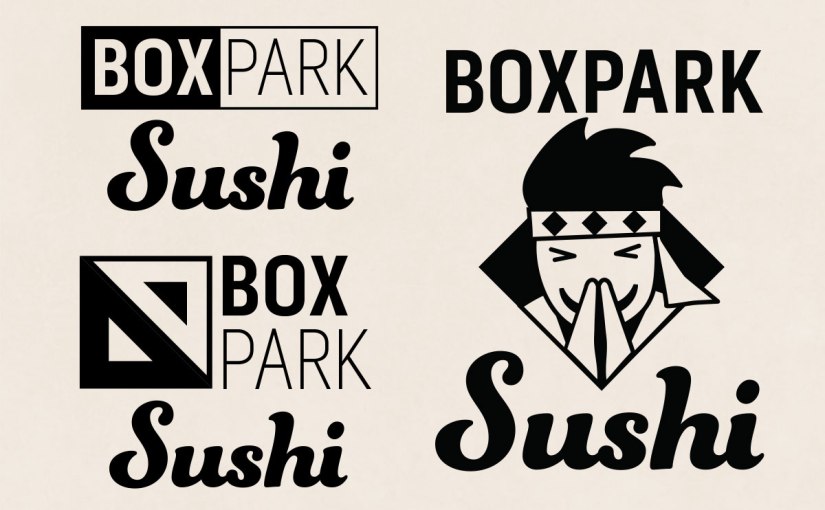
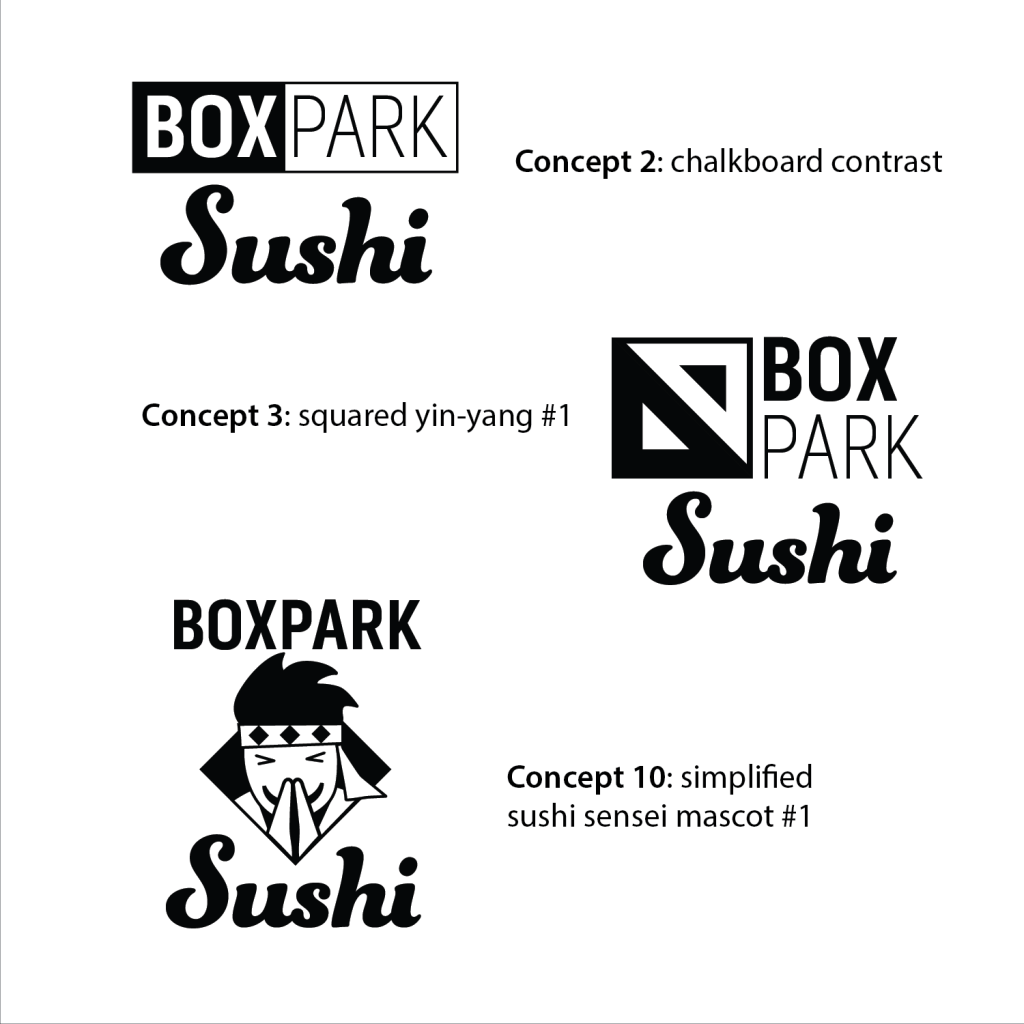
The top three concept sketches for the fictional Boxpark Sushi brand were developed into vector graphics in Adobe Illustrator.

Concept 2: Chalkboard Contrast

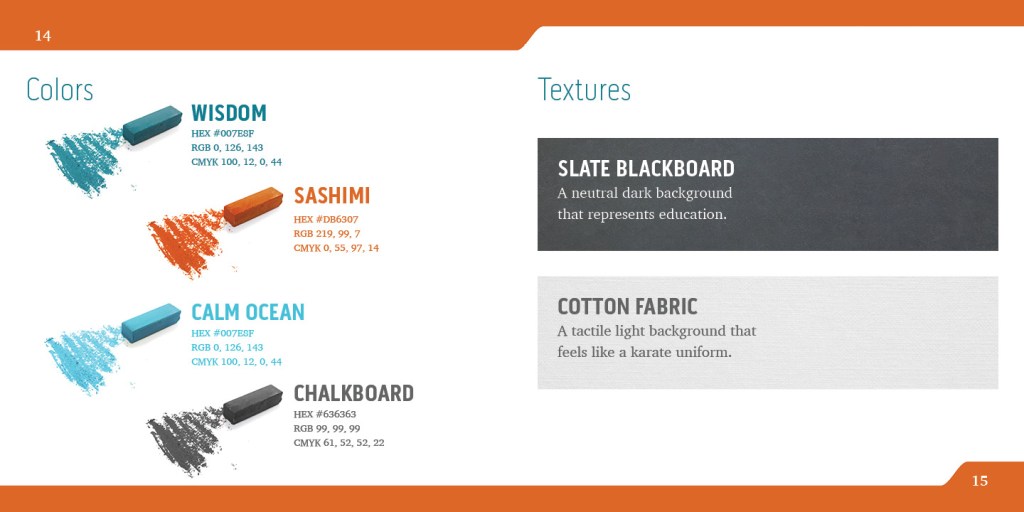
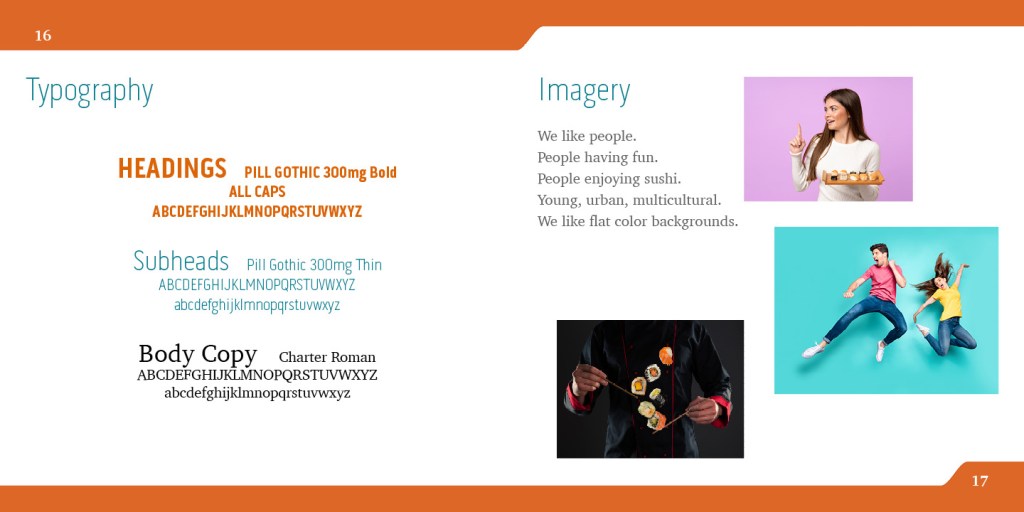
The Boxpark Sushi brand is educational but fun, with the personality of a wise and friendly Sushi Sensei. Logo concept sketch 2 is based on a logotype developed previously for the Boxpark Sushi static vision board. The Pill Gothic 300mg typeface was chosen for the “Boxpark” type because it is both strong and condensed. According to Kolenda (2016), condensed fonts convey tightness and precision, traits that are valued in sushi preparation. The combination of the font’s bold and thin weights implies a balance of power and sophistication.

The idea of balance in continued by using the script typeface Funkydori for the word “Sushi”. The gentle curves of this font reflect the organic nature of the product and provide a feminine balance to the straight lines and hard angles of Pill Gothic 300mg. This logo concept uses the idea of an old-fashioned school blackboard to frame the Boxpark type, representing the brand’s wise characteristic as well as recalling the rectangular shapes of Boxpark shipping containers and providing visual contrast to the logo.

This solution is the simplest of the three presented logos. As noted by Airey (2014), the simplest solution is often the most effective because it helps meet other requirements of iconic design like “think small” and “focus on one thing”. However, this logo is also the least distinctive of the three solutions.

Concept 3: Squared Yin-Yang

Research of other sushi brand logos confirmed that the most overused logo elements are chopsticks, sushi rolls, and Asian script fonts. Therefore, none of my concept sketches contains those elements. Instead, I focused on imagery inspired by Karate, a Japanese martial art whose teachers are called “sensei”. Several of the concept sketches were in inspired by the yin-yang symbol, which represents the balance of light and dark or feminine and masculine.

This solution is the simplest of yin-yang inspired concepts. The squared yin-yang logo is a fun, modern take on the traditionally round symbol. It visually represents the box aspect of Boxpark as well as the wisdom and balance associated with the symbol. The squared yin-yang can also be utilized for brand patterns used in marketing, merchandise, and in-store decoration.

The squared yin-yang solution incorporates tradition in a simple yet distinctive logomark that is easy to commit to memory and works even at small sizes. For these reasons, the logo meets many of the elements for iconic design (Airey, 2014). This solution is also more innovative and distinctive than the simple logotype of Concept 2. A Google image search for “square yin yang symbol” revealed nothing too similar, which means other brands are probably not using the same design.

Concept 10: Simplified Sushi Sensei Mascot

The Boxpark Sushi brand is built around the concept of a friendly Sushi Sensei who helps customers become a “sushi black belt”. This persona helped shape the fun and wise characteristics of the brand and was the inspiration for many Mascot style logo concepts.

Mascots are a strong way to transfer and support a brand’s voice and tone (Yalanska, 2019). Custom characters like the Sushi Sensei reflect the brand qualities while adding emotional appeal and more personalized interaction with customers. Mascots can be simple like the Twitter blue bird or more complex cartoon characters like Tony the Tiger, a mascot designed for Kellog’s Frosted Flakes in 1952.

Many variations of the Sushi Sensei mascot were sketched, including sensei-inspired emoji and more detailed renderings. Several simplified sensei were sketched, but the first stood out because it best captured the fun aspect of the brand. The character is smiling, and the visual balance of light and dark in the logo is reminiscent of the yin and yang symbolism.

Curves in the mascot’s hair mimic the sushi type, while the black diamond framing and headband elements represent the box part of Boxpark. Although this logo is the least simple of the three solutions, it still works at small sizes and is very distinctive.

References:

Airey, D. (2014, August 20). Logo Design Love, Annotated and Expanded Edition, Second Edition. Peachpit Press.

Kolenda, N. (2016). The Psychology of Fonts. https://www.nickkolenda.com/font-psychology/

Yalanska, M. (2019, March 13). Design Me Live: The Power of Mascots in UI and Branding. https://blog.tubikstudio.com/design-me-live-the-power-of-mascots-in-ui-and-branding/


Multi-Platform Delivery Week 1 Live Session

The Efficacy of Brand Mascots

A study by Malik and Guptha (2014) indicates that brand mascots can represent a brand as efficiently as a celebrity with the added benefit of being more cost efficient and loyal to the brand. Mascots also have higher recall value and consistently represent the brand’s values. Furthermore, the study deduces that the attributes of a brand mascot that most influence a customer are:

  1. Emotional touch
  2. Attractiveness
  3. Trustworthiness
  4. Friendliness
  5. Uniqueness

Yalanska (2019) agrees that emotional touch and appeal are large parts of the consumer decision-making process, and a mascot is a powerful method of providing emotional triggers and feedback to users. In addition, mascots are “a strong way to transfer and support the general tone and voice” of the brand (Yalanska, 2019).

Whether it is human-based, animal, or other, a mascot provides a human touch to a brand. It makes the brand more user-centered while presenting multiple avenues for visual marketing in branded merchandise and other media assets.

Font Psychology in Logo Design

Fonts have personalities, and it is important to consider the psychology behind that personality when using type for a brand logo. Does the typeface accurately represent the brand’s personality and voice? Fonts display certain characteristics because the human mind makes visual associations.

Oosterhout (2013) examined the perceptual characteristics of letter forms and the personality characteristics associated with them by study participants. The study found that uppercase letters are effective for brands that “convey qualities related to energy, courageousness, and focus”. Conversely, lowercase letters are appropriate for brands that promote compassion and altruism.

Fonts can also have associations with specific tastes. A study by the University of Oxford reports that soft, rounded typefaces are associated with sweet foods while angular typefaces are associated with bitter, salty, or sour foods (Velasco et al., 2015). These associations are especially useful when choosing fonts for food brands.

Combining Logomark and Logotype

Words and imagery can work hand-in-hand to communicate a brand identity. This is especially true with logos. A logomark is a simplified symbol that represents a brand but does not include the brand name or other written words. Logomarks can create a strong visual identity but usually work best for established brands (Murray, 2017).

A logotype (or word mark) is a brand name that has been visually styled to reflect the brand identity. Murray (2017) notes that a strong logotype helps new businesses introduce themselves to the public by putting the brand name out front. Osterer (2015) agrees that unique letterforms combined with bold colors create wordmarks that are memorable and soon become associated with the brand.

Combination marks use both a logomark and logotype to represent a brand, offering the best of both worlds. They offer an opportunity to establish the brand name in the public consciousness while allowing for the freedom to drop the logotype in the future once the brand identity is well established.


References:

Malik, G., & Guptha, A. (2014). Impact of Celebrity Endorsements and Brand Mascots on Consumer Buying Behavior. Journal of Global Marketing, 27(2), 128–143. https://doi-org.oclc.fullsail.edu/10.1080/08911762.2013.864374

Murray, J. (2017, April 19). Logo, Logomark, Logotype – What’s the Difference and What Do You Need? https://blog.designcrowd.com/article/997/logo-logomark-logotype-whats-the-difference-and-what-do-you-need

Oosterhout, L. (2013) Word marks: a helpful tool to express your identity: an empirical study regarding fonts of word marks as a tool for transmitting an archetypal identity. http://purl.utwente.nl/essays/64348

Osterer, I. (2015). Logos and Wordmarks. Arts & Activities, 157(2), 23.

Velasco, C., Woods, A. T., Hyndman, S., & Spence, C. (2015). The Taste of Typeface. I-Perception. https://doi.org/10.1177/2041669515593040

Yalanska, M. (2019, March 13). Design Me Live: The Power of Mascots in UI and Branding. https://blog.tubikstudio.com/design-me-live-the-power-of-mascots-in-ui-and-branding/
Design Integration Mastery Reflection

Design Integration, the eighth course in the Media Design MFA program from Full Sail University, expanded on the skills and knowledge gained in previous courses. Throughout the month, my classmates and I continued developing our design strategies for a fictional client: Boxpark Sushi, located in East Side Milwaukee.

Voice and Tone

In the first week, we read three chapters from George Felton’s Advertising: Concept and Copy and several articles about developing a brand’s voice and tone. Felton (2013) describes a brand’s voice as its personality. In contrast, the tone is the way a message is expressed. While a brand’s voice should be consistent across all media, its tone changes depending on a number of factors. In a YouTube video from Stukent (2018), Liza Dunning says that tone is determined by who you are addressing, the situation (or emotional state) the viewer is in, and the topic of your content.

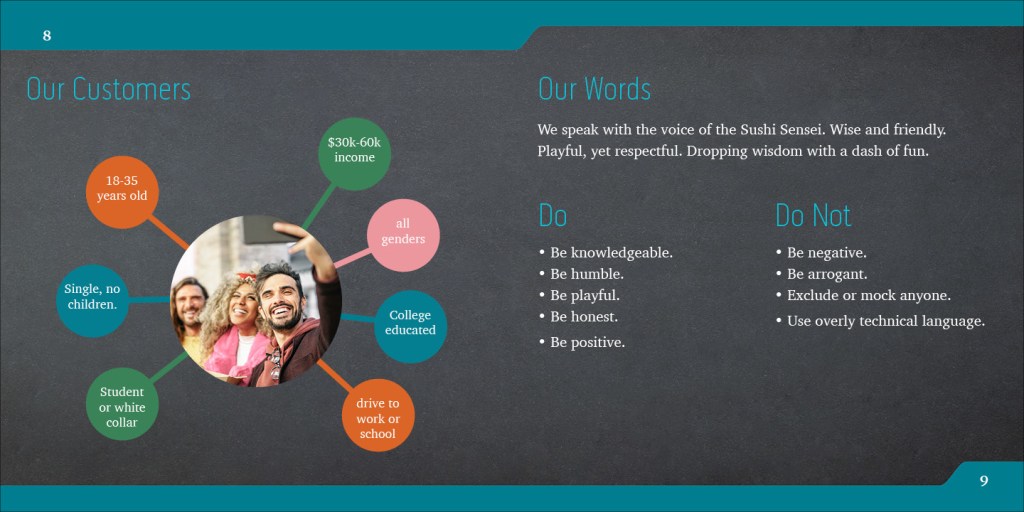
The personality of Boxpark Sushi is that of a friendly teacher who is wise but not aloof or condescending, embodied by the “Sushi Sensei” persona. This wide, friendly voice speaks directly to the young professionals and college students of East Side Milwaukee. Once the brand personality and characteristics were established, we created a Brand Voice Chart as suggested by Heald (2018). This chart helped illustrate how to use the brand’s voice consistently in written content.

Brand Voice Chart

CharacteristicDescriptionDoDon’t
SmartWe know sushi, and we love sharing our knowledge.Be knowledgeable.
Be humble.
Be arrogant or condescending.
Use overly technical words and phrases.
FriendlyOur customers are our friends and neighbors.Use casual language.
Be positive.
Be overly personal.
HelpfulWe help make sushi easy and accessible.Be open and inquisitive.
Be honest.
Be annoying by pushing help on those who don’t need or want it.
FunOur definition of fun is sharing good food and laughter with friends.Be playful.
Emphasize the social aspect of Boxpark Sushi.
Exclude or mock anyone.
Use derogatory language.

Static Vision Board

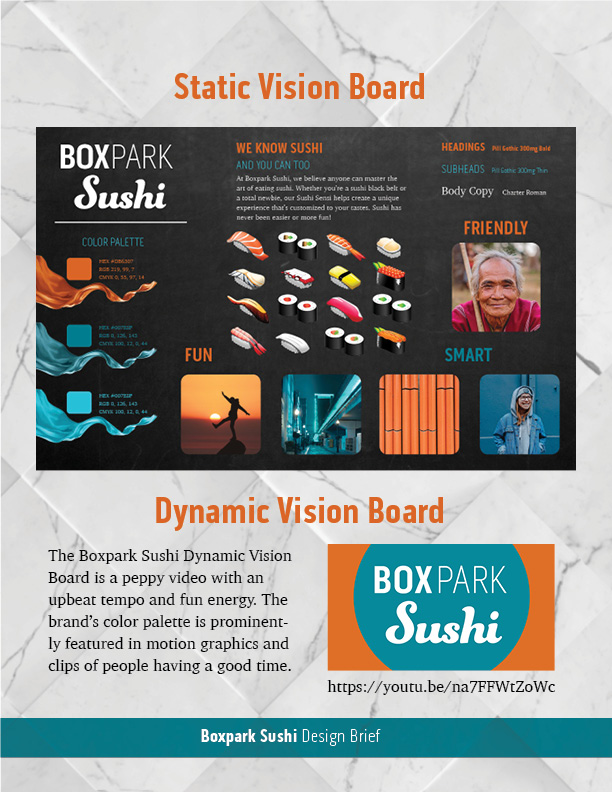
Explaining design strategies to clients without visuals can be challenging. Vision boards, also called mood boards or inspiration boards, help communicate ideas when words aren’t enough. WDD Staff (2008) notes that vision boards demonstrate the thinking behind your design ideas and help clients feel involved with the process. This leads to less “I’ll know it when I see it,” and fewer design changes based on personal preferences like a favorite color.

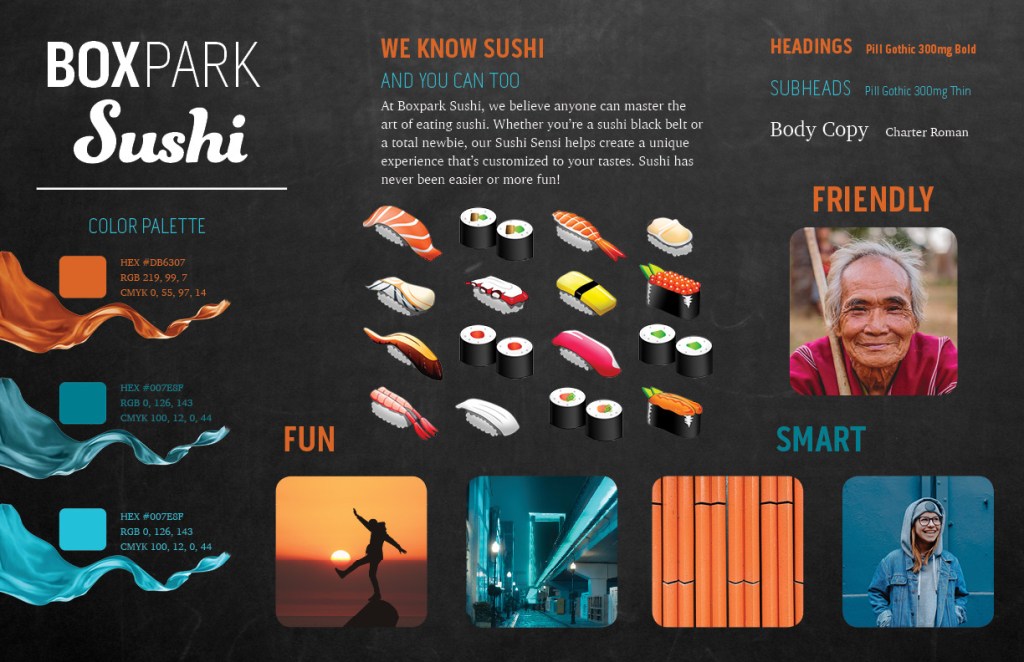
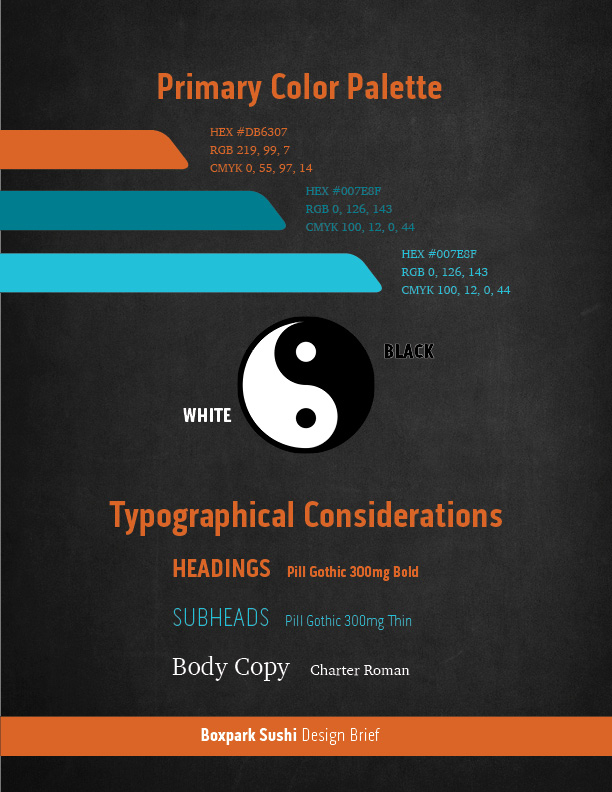
Color and typography choices were instead guided by the brand characteristics and studies into the psychology of colors and fonts. A reddish orange was selected as a primary color because it communicates the brand’s warm, fun energy (Kolenda, 2016). Przybyla (n.d.) also notes that warm reds and oranges can increase one’s appetite. The secondary teal blue color denotes intelligence and competence (Kolenda, 2016) as well as being complementary to the primary orange.

Boxpark Sushi static vision board by Joshua Siegel

Pill Gothic 300mg was chosen as a header font because it is both strong and condensed. According to Kolenda (2016), condensed fonts convey tightness and precision, traits that are valued in sushi preparation. Funkydori, a thick script font, was also used to represent the organic nature of sushi. The vision board has no photos of raw fish that may turn off consumers who are new to sushi. Instead, the product is presented as vector illustrations that are realistic enough to be identified by sushi eaters yet cute to sushi newcomers.

Several days after submitting our static vision boards, classmate Jose Caceres and I conducted our first video critique to discuss the project. Feedback from Caceres and Dr. Adam Baldowski informed the next project, dynamic vision boards for Boxpark Sushi.

Dynamic Vision Board

While a static vision board helps communicate a brand identity’s voice and tone, adding sound and motion creates new ways to express the brand’s characteristics. A dynamic vision board for Boxpark Sushi was created in Adobe After Effects using royalty-free stock video clips. The music bed was selected because of its upbeat tempo and fun energy. The musical frequencies of the piece were also considered, as midrange to high frequencies can convey happiness and forward thinking (Gillespie, 2019). These qualities help convey the brand’s fun and friendly personality.

The video’s transitions are smooth and organic with no hard cuts, and the motion is energetic yet fluid like a martial art. These traits are reflective of the Sushi Sensei persona who represents the Boxpark Sushi brand. Selected video clips show fun and playful imagery and sushi illustrations but no clips of sushi being prepared or eaten. This decision was made in order to make the dynamic vision board feel more like a demonstration of the brand’s personality and less like a commercial promoting the brand’s product.

https://youtu.be/na7FFWtZoWc

Media Plan and Final Design Brief

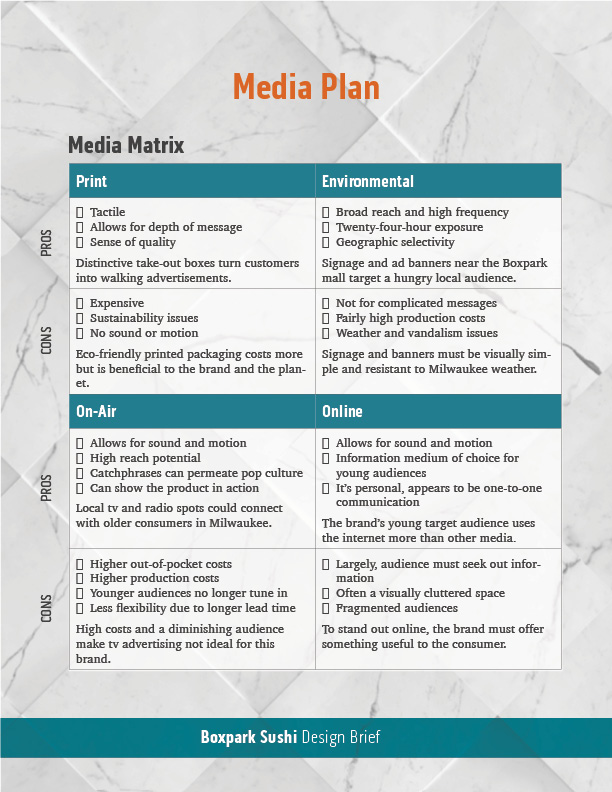
In the fourth and final week of Design Integration, we developed a media plan and utilized it to create a final design brief for our brand identity. In order to determine the best way to reach Boxpark Sushi’s audience, a media matrix was used to consider the pros and cons of advertising in four categories of media: print, environmental, on-air, and online (Stone, 2010). Boxpark Sushi will utilize each of the categories except on-air due to the high costs and diminishing audience of television advertising. Reporting for Ad Age, Crupi (2019) notes that 27% of 18 to 49-year-old viewers stopped watching broadcast television in 2016 to 2017, tuning in to streaming services or social media instead. This means that the advertising budget for Boxpark Sushi is better spent on social media campaigns and content to engage the target audience of college students and young professionals.

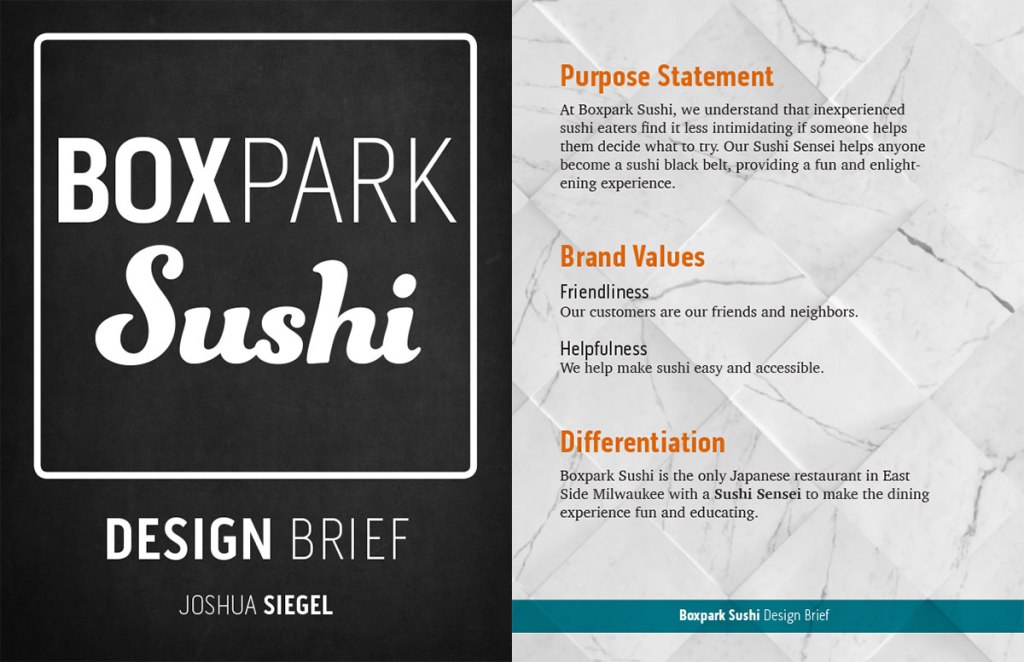
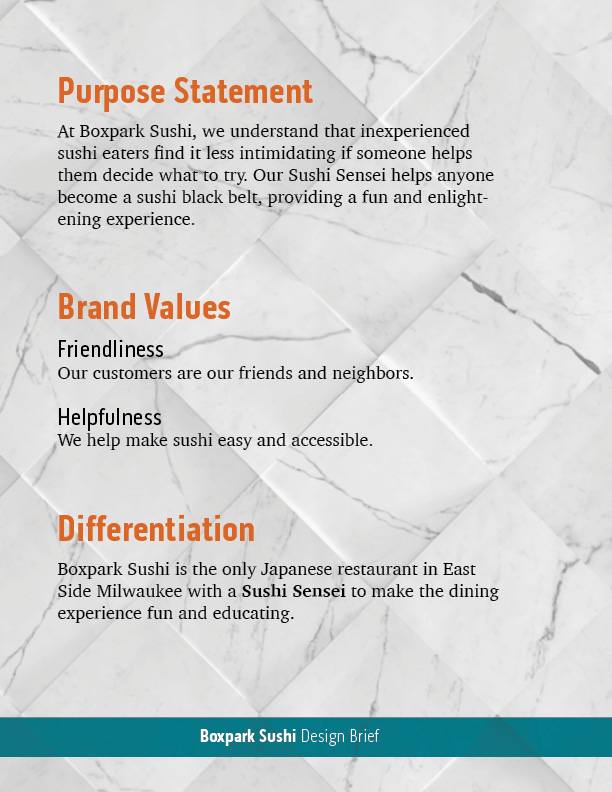
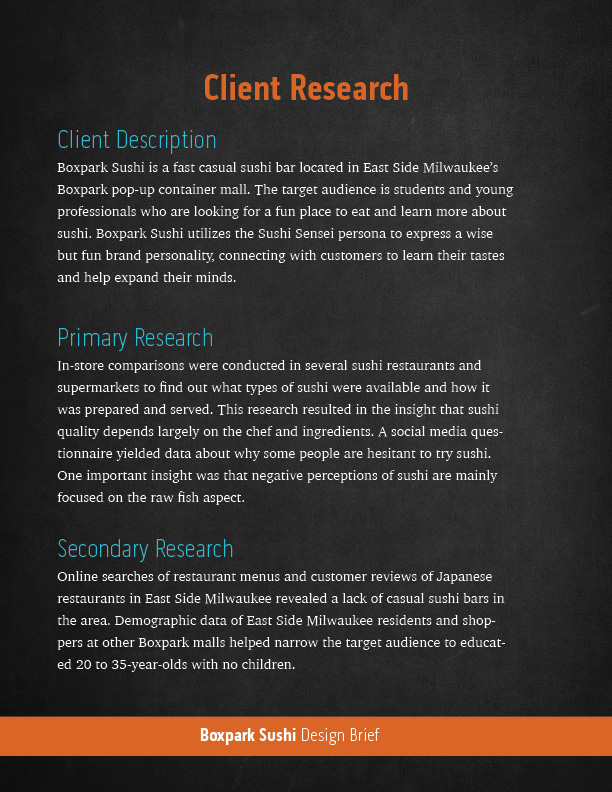
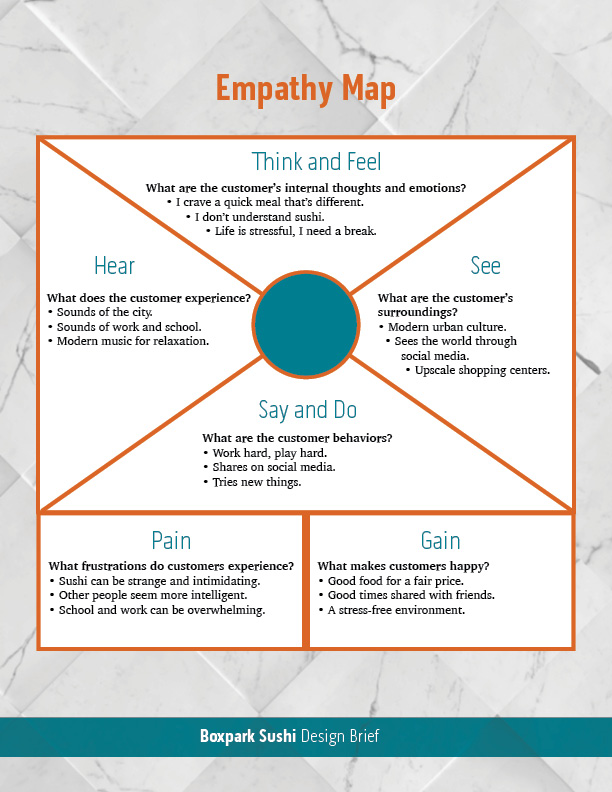
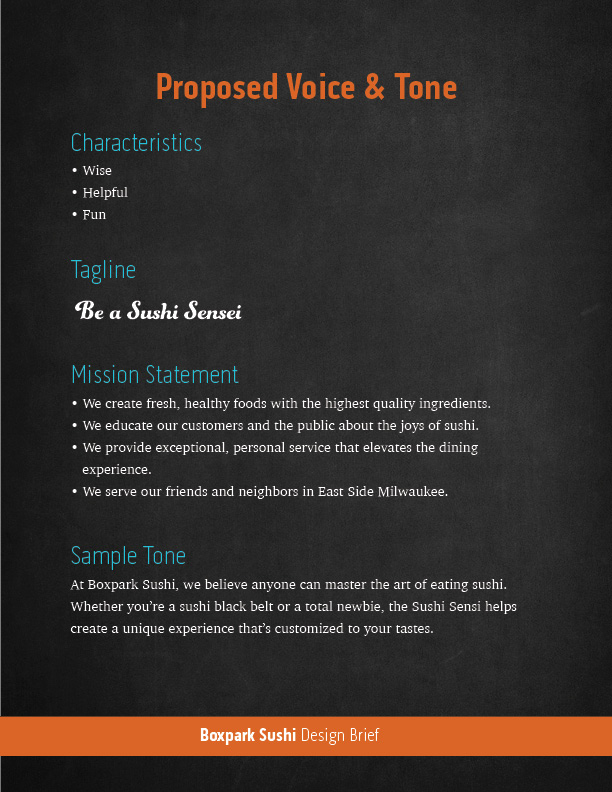
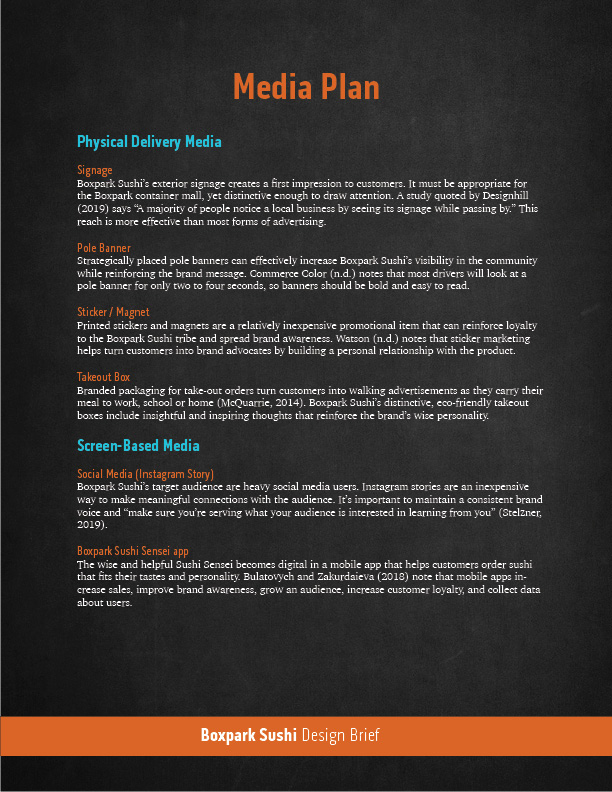
Boxpark Sushi design brief by Joshua Siegel

The final design brief for Boxpark Sushi integrated all the previous research and strategies related to the brand’s identity including color palette and typographical considerations, voice and tone samples, and media strategies. This brief will serve as a blueprint when designing media assets and content for the brand in future classes.


References:

Crupi, A. (2019, January 28). Ratings Bombshell: In Two Years, Network TV Demos Plummeted 27 Percent. Ad Age. https://adage.com/article/media/c3/316390

Gillespie, C. (2019). Background Music for Video: How to Pick the Perfect Track. https://www.vidyard.com/blog/background-music-for-video/
Heald, E. (2018). 5 Steps to Find Your Brand Voice. https://contentmarketinginstitute.com/2018/04/find-brand-voice/

Kolenda, N. (2016). The Psychology of Color. https://www.nickkolenda.com/color-psychology/

Kolenda, N. (2016). The Psychology of Fonts. https://www.nickkolenda.com/font-psychology/

Przybyla, D. (n.d.). How Color Affects Appetite in Marketing. https://www.colorpsychology.org/color-appetite/

Stone, L.T. (2010, July 01). Managing the Design Process-Concept Development: An Essential Manual for the Working Designer. Rockport Publishers.

Stukent, Inc. (2018). Developing Your Brand Voice – Liza Dunning. https://www.youtube.com/watch?v=z9KRWgGYD8E

Boxpark Sushi Design Brief

Over the past month, the Boxpark Sushi brand has been more clearly defined by research and critiques that support many design strategies but question other previous choices. The research also informed the creation of a media delivery plan which describes the best ways to connect with a target audience (Stone, 2010). The final design brief is an overview of the key information regarding this design project, including the media delivery plan.

Previous design research and strategies for Boxpark Sushi determined that the brand voice is wise and friendly, and the tone is playful. These adjectives, along with the brand’s fun and helpful personality traits, provided directive words used to find appropriate images, colors, and typography for the brand. Many of these design choices and directive words were established in the brand’s static vision board but were adjusted after critiques from Jose Caceres and Dr. Adam Baldowski. For example, the word “smart” was changed to “wise” to project a softer and kinder image rather than an arrogant or condescending form of intelligence.

The brand narrative is based on the concept of a “Sushi Sensei” helping customers decide what to order with the ultimate goal of helping them become masters in the art of sushi eating. This narrative and the Sushi Sensei persona are designed to appeal to the primary target audience of East Side Milwaukee college students and young professionals who are educated and aspire to learn more.

An effective ad strategy involves using media that targets the primary audience and repeatedly exposes that target demographic to a persuasive message that keeps the featured brand visible (Gordon, 2017). In order to determine the best way to reach Boxpark Sushi’s audience, a media matrix was used to consider the benefits and drawbacks of each media outlet. A media matrix is a graphical media planner that explains the pros and cons of advertising in four categories of media: print, environmental, on-air, and online (Stone, 2010). Boxpark Sushi will utilize each of the categories except on-air. The high production costs for television commercials make this medium cost prohibitive for a small, local brand. Broadcast television is also a fading medium. Reporting for Ad Age, Crupi (2019) notes that 27% of 18 to 49-year-old broadcast television viewers stopped watching over a period of just two years (2016-2017), tuning in to streaming services or social media instead.

The Boxpark Sushi media delivery plan describes six media assets and explains the strategic purpose of each. Three of the media assets were class requirements, but the other three were developed from the brand’s media matrix. All six of the assets utilized research to explain the proposed application and determine its strategic purpose. For example, research of pole banners revealed that although drivers will look at a pole banner for only two to four seconds, effective banners can reinforce your brand message by repeatedly exposing it to a localized audience (Commerce Color, n.d.). Boxpark Sushi can clearly benefit from this type of physical delivery media advertising near the Boxpark shopping center in East Side Milwaukee.

In terms of screen-based media, a Sushi Sensei app is one way for the brand to stand out in an already cluttered online environment. A mobile app can help customers order sushi that fits their tastes and personality, even if they are not eating at Boxpark. This provides a useful benefit to users while also helping Boxpark Sushi increase sales, improve brand awareness, grow the audience, increase customer loyalty, and collect data (Bulatovych & Zakurdaieva, 2018). The app can also be used in-store to help staff fill the Sushi Sensei role.

Learning to develop a media delivery plan was a new and valuable lesson. Vision boards and creative briefs were created for previous classes, but the final design brief for the Boxpark Sushi brand integrated all the strategies and creative decisions that were developed in the past few months. Brand differentiation, user behaviors, and advertising strategies all came into play while developing the media delivery plan and design brief. In the coming months, the knowledge acquired in this project will inform further design of the Boxpark Sushi brand logo and media assets.


References:

Commerce Color. (n.d.). 5 Ways You Can Supercharge Your Pole Banner Promotions. https://www.commercecolor.com/blog/5-ways-you-can-supercharge-your-pole-banner-promotions

Crupi, A. (2019, January 28). Ratings Bombshell: In Two Years, Network TV Demos Plummeted 27 Percent. Ad Age. https://adage.com/article/media/c3/316390

Gordon, E. (2017). Marketing and Advertising Strategies. https://medium.com/inkbot-design/marketing-and-advertising-strategies-45242269f5ee

Stone, L.T. (2010, July 01). Managing the Design Process-Concept Development: An Essential Manual for the Working Designer. Rockport Publishers.