

Design Strategies and Motivation, the seventh course in the Media Design MFA program, expanded on the skills and knowledge gained in month five’s Design Research course. Throughout the month we developed a Strategic Development project for a fictional client: a Boxpark sushi shop in East Side Milwaukee. Professor Bartley Argo encouraged us to dive deep into our research of sushi, the East Side Milwaukee neighborhood, and container park malls in order to create a distinctive brand.
In the first week, we read several articles about Design Strategy and two chapters from George Felton’s Advertising: Concept and Copy. Felton (2013) points out the difference between Strategy and Execution in ad campaigns. Strategy is what you’re saying, and execution is how you’re saying it. Before you can plan the execution of a campaign, the strategy must be discovered through research and synthesis of the resulting information. Strategic development is important for discovering insights about the brand and consumer behavior. Those insights help focus your message and develop a narrative that connects with consumers.
The first part of the Strategic Development project was learning about the client’s product. Step one was primary research in the form of firsthand use. I visited two restaurants in Chico, California that serve sushi. I also sampled sushi from two supermarkets, one budget and the other high-end. This primary research resulted in the insight that sushi quality depends largely on the chef and ingredients, not where it was made.
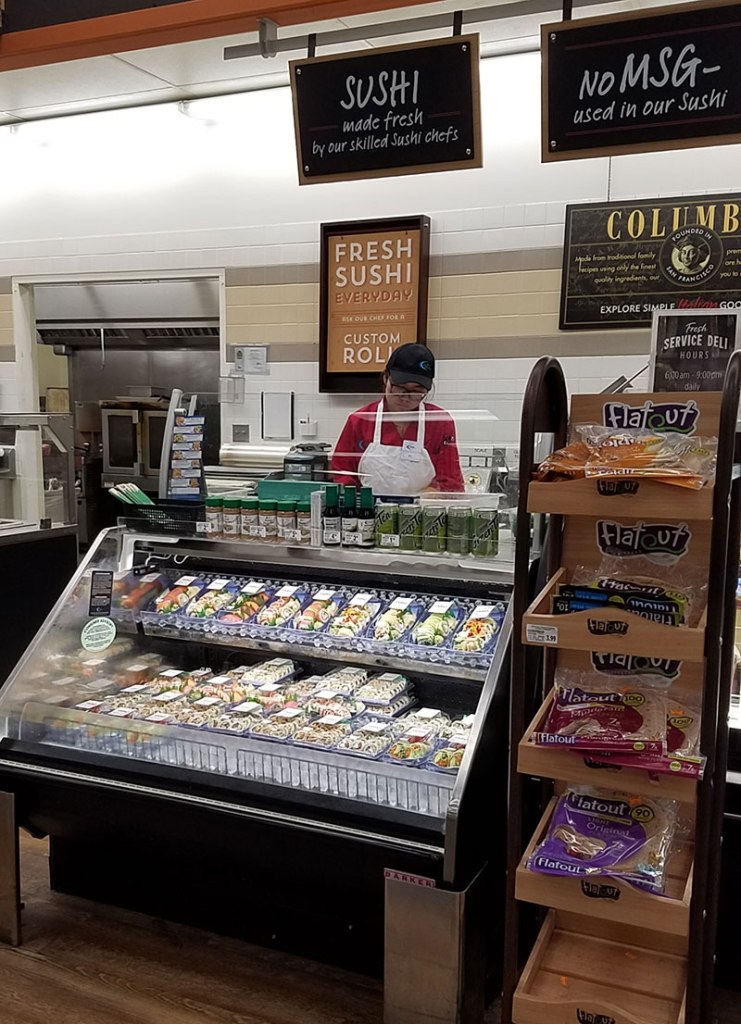
Step two was secondary research of sushi, East Side Milwaukee, and Boxpark malls. Through online searches, I learned that American creations like the California roll helped sushi gain acceptance in American, as ingredients like crab and avocado were considered more palatable to white Americans than raw fish (Bhabha, 2013). Also, statistics from East Side Milwaukee Demographics (n.d.) suggest that East Side Milwaukee residents may be more open to cuisine from non-American cultures than residents of other Midwestern areas. The neighborhood is a good fit for Boxpark Sushi, as many Boxpark restaurants are inspired by regional street food.
The next step was collecting consumer thoughts. I conducted primary research by interviewing personal acquaintances and by collecting social media responses to the question “Do you like sushi? Why or why not?” There was a wide array of responses, but one important insight was that negative perceptions of sushi are mainly focused on the raw fish aspect.
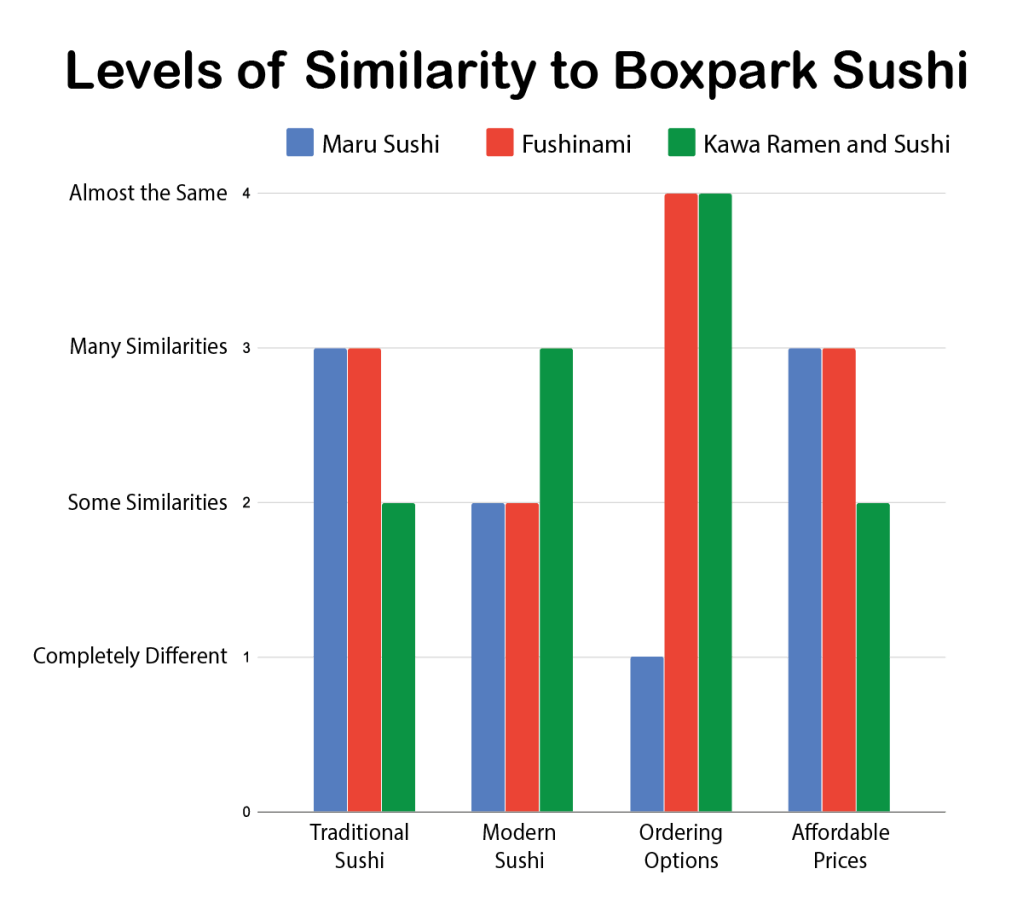
Part two of the Strategic Development project was learning about the competition. I researched the direct competitors, East Side Milwaukee restaurants that served sushi, as well as indirect competitors, nearby Asian restaurants offering something besides sushi. A primary reason for researching a brand’s competition is to find ways to differentiate from competitors, so I created the chart below to represent levels of similarity to Boxpark Sushi for three of the direct competitors. It revealed that serving modern sushi is a good way to differentiate from these competitors.
Competitors chart
Next, I examined consumer behavior to better understand the marketplace for sushi. A good product can solve multiple problems if we understand the human needs that must be addressed. Considering Maslow’s “Hierarchy of Needs,” I found that self-actualization, the need to understand new things and realize one’s inner potential, could be achieved by comparing the Boxpark Sushi experience to a form of martial arts, albeit one that is easily achievable.
Settle & Alreck’s “Shopping List of Needs” were considered next. I found that succorance, the need to receive help from others, could be addressed by guiding customers through their sushi experience. According to a survey by Pei Wei (Shelby, 2015), 30 percent of first-time sushi eaters had someone help them order. Usually, this is a friend or family member who is already a sushi aficionado. But I realized that this role could be filled by an in-store “sushi sensei” who explains the various processes and ingredients to make sushi less intimidating.
Next, I analyzed the marketplace for audience segmentation. I examined the demographics, psychographics, and buying behavior of sushi eaters in East Side Milwaukee. One key point I discovered is that over 55 percent of East Side Milwaukee residents have never married (Point2Homes). This helped narrow the audience segment to younger, single consumers.
The final step of the Strategic Development project was writing a Creative Brief for Boxpark Sushi. A key insight of the project was that inexperienced sushi eaters find it less intimidating if someone helps them decide what to try. Boxpark Sushi can offer high quality, delicious sushi that is freshly prepared by a personal Sushi Sensei. The brand image is a hip, modern sushi bar that makes eating a fun learning experience.
Moving forward, having a focused message for the Boxpark Sushi brand will help me create stronger, more effective designs and copy for the brand.
References:
Bhabha, L. (2013). The History of Sushi in the U.S. Retrieved from https://food52.com/blog/9183-the-history-of-sushi-in-the-u-s
East Side Milwaukee Demographics. (n.d.) Retrieved from https://www.point2homes.com/US/Neighborhood/WI/Milwaukee/East-Side-Milwaukee-Demographics.html
Felton, G. (2013). Advertising: Concept and Copy (Third). New York: W.W. Norton.
Point2Homes. (n.d.). East Side Milwaukee Demographics. Retrieved from: https://www.point2homes.com/US/Neighborhood/WI/Milwaukee/East-Side-Milwaukee-Demographics.html
Shelby Food Service. (2015, March 24). Pei Wei Releases Sushi Survey Results, Adds New Rolls. Retrieved from https://www.keltonglobal.com/recognition/pei-wei-releases-sushi-survey-results-adds-new-rolls/
 Joshua Siegel's Mastery Journal