This video editing project was completed for the Organizational Structures course in the Media Design MFA program from Full Sail University. Edited from footage provided by Adobe.com.
Connecting, Synthesizing, Transforming
I’ve been editing with Adobe Premiere since 2008, but there’s always something new to learn. Every update has new features. The November 2019 release (version 14.0) includes graphics and audio enhancements, plus the new Auto Frame tool that applies intelligent framing to footage, keeping the action inside different aspect ratios like square or vertical video. Although I didn’t use the Auto Frame tool in this project, I can see how it could be useful when converting aspect ratios for posting videos to social media.
Solving Problems
The “Going Home” video used by Maxim Jago as an example in the Adobe tutorials was a good demonstration of Premiere’s tools, but the pacing of the edit felt slow. I decided to cut a shorter version using the same music, voiceover, and footage.
On this project, I started by editing the audio. The first step was to remix the music to be a shorter duration. The music Remix tool in Adobe Audition’s Essential Sound panel works like magic, retiming music to your desired duration with the need to manually cut and apply crossfades to clips. Unfortunately, this tool is not currently available in Premiere’s Essential Sound panel. After retiming the music to 40 seconds, I imported it to Premiere and dropped it in the timeline. Next, I dropped in the voiceover and cut it with the Razor tool into separate clips. I moved these clips around until the pacing felt right.
After editing the audio, I started adding video clips. When editing to music or voiceover, I tend to set both in and out points on the timeline to match beats. In the source panel, I will set only an in or out point, then use the Overwrite edit shortcut to drop the clip in place. Following the tutorials, I added transitions and type. One interesting thing I learned was that Premiere is very good at Time Remapping, changing playback speed. I have always used After Effects for speed changes, but Premiere can now time remap up to 20,000 percent. Wow.
Innovative Thinking
This design challenge demonstrated my ability to edit with Adobe Premiere, but unfortunately, I don’t think I did anything particularly innovative in the project. If I had more time this week, I would have liked to learn about Character Animation or more about the visual effects tools built into Premiere.
Acquiring Competencies
For many years I’ve used Audition for audio and After Effects for the majority of my motion designs and visual effects work, but many of the tools are now integrated into Premiere. Using the Essential Sound panel for audio improvements and Lumetri Color panel for color grading will speed up my workflow on future editing projects.
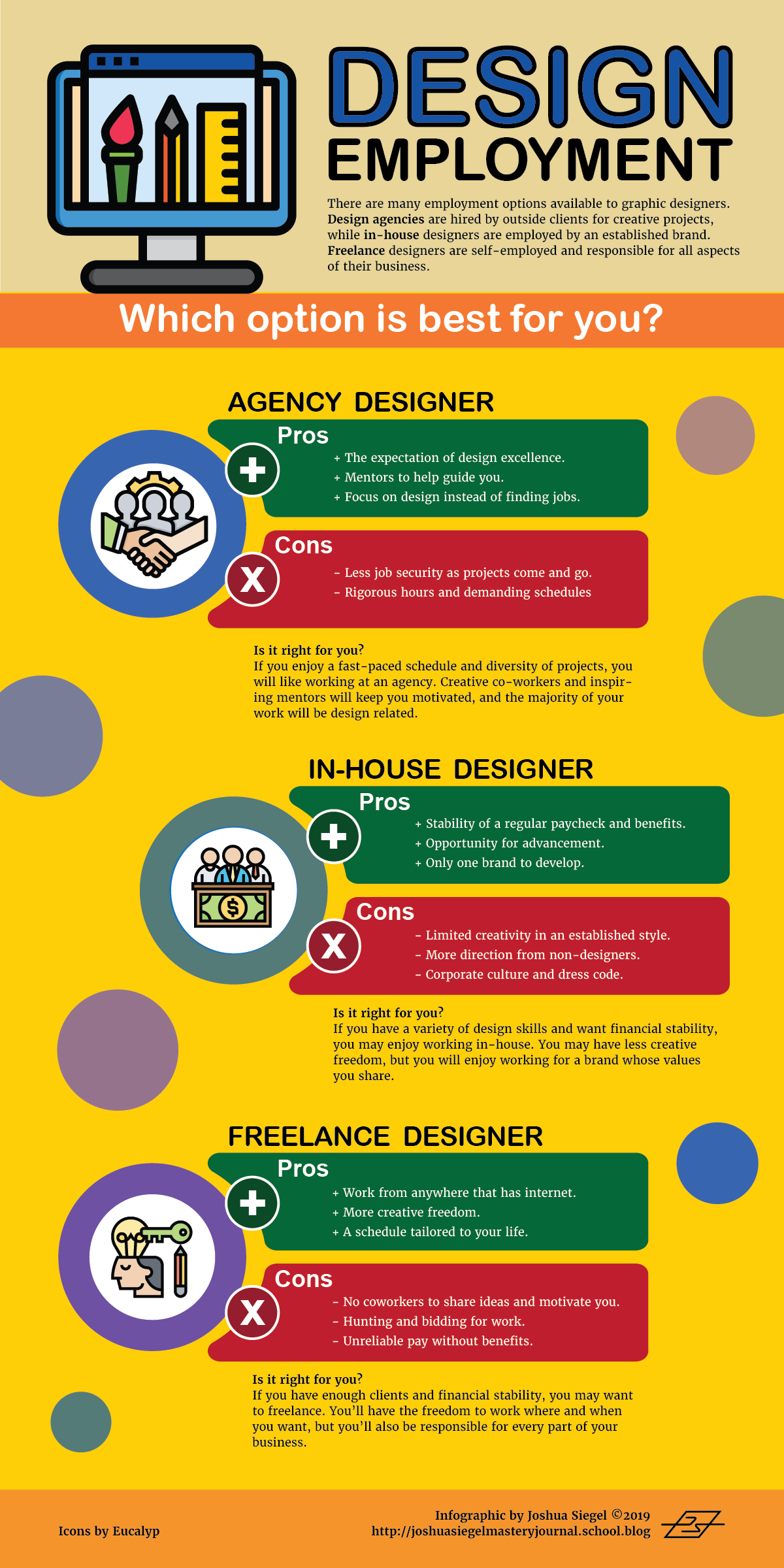
There are many employment options available to graphic designers. Design agencies are hired by outside clients for creative projects, while in-house designers are employed by an established organization or brand. Freelance graphic designers are self-employed and responsible for all aspects of their business.
Which option is best for you? This infographic can help you decide.
Overview
Information in the Design Employment infographic was gleaned from learning materials presented in week three of the Organizational Structures course. This week we learned about the different employment options for designers, from freelance to in-house and agency work. Flavin (2017) discussed the benefits and drawbacks of each option, noting that it’s important for a designer to “find the perfect work environment to cultivate your creativity”.
In-house designers know a brand intimately by working with it day after day and enjoy a steady paycheck. However, this can lead to monotony and creative stagnation. Most of my experience is with in-house design, often as a one-man team responsible for everything from copy writing to web design. Depending on the employer and how closely you align with their values, working in-house can be a joy or a nightmare. Björk (2010) notes many ins (upsides) and outs (downsides) of working in-house. The most important to me is the stability of a regular paycheck, especially now that I have a wife and child.
Working at a design agency is a great way to learn and gain experience with other design professionals. The fast-paced and demanding schedule drives creativity, but there is less job security as clients come and go. Working with other creative thinkers is one of my favorite aspects of film production, and I would love to work at an established design agency.
Freelance designers enjoy the freedom to work when and where they please but have added responsibility of managing a business, from bookkeeping to office supplies. It’s important to have enough clients and financial stability before trying to go freelance. There are many downsides to freelancing: constantly looking for work, no co-workers for critiques, and unreliable pay just to name a few. Offering freelance services to a design agency can be an ideal situation. Rassom (2011) lists five things an agency looks for when hiring freelancers:
Creativity that goes beyond technical skills.
Experience that shows you’re reliable.
Time to finish a project on schedule.
Rates that reflect what you’re worth.
Communication skills and availability.
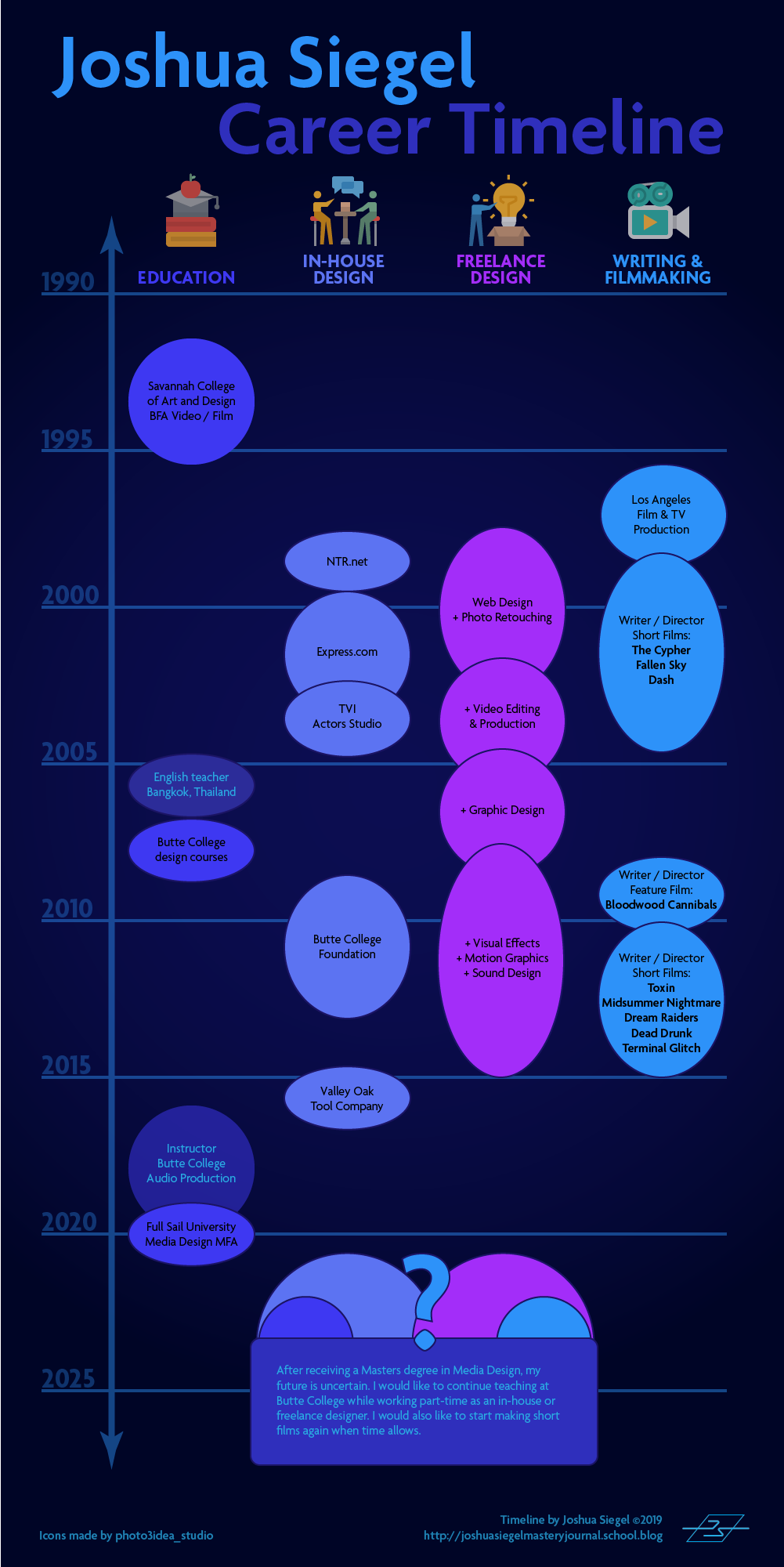
Since graduating from the Savannah College of Art and Design, I’ve worked in a wide variety of design and entertainment jobs. The timeline below demonstrates just how long a journey it has been.
Acquired Competencies
The following are concepts, skills, or new resources learned in the third week of the Organizational Structures course. They are categorized as Academic (pertaining to school work) or Occupational (pertaining to work in the Media Design field), and Technical (pertaining to software or other design skills) or Conceptual (new terminology, procedures, or ideas).
Academic
Technical
Conceptual
A creative portfolio is not about showing 20 decent pieces, it’s about showing 5 great pieces.
BENSOUND is an excellent resource to find royalty-free music for motion graphics and video presentations.
AIGA: the professional association for design offers resources for students and professional designers.
Designs can be “hacked” by repurposing existing images and ideas.
Communication skills and availability are essential for freelancers.
Mentors can often be found at design agencies.
Occupational
Technical
Conceptual
It’s important to be aware of current designtrends and knowledgeable of graphic design from the past.
Lumetri Color panel allows for easy color grading within Adobe Premiere.
Essential Sound panel lets you improve sound quality within Adobe Premiere.
In-house designers must be proactive, otherwise they are just following orders.
The primary role of in-house designers is explaining the brand to consumers.
Freelance designers can often pick up jobs from overloaded design agencies.
In the second week of the Organizational Structures course, we researched the Structure of Storytelling in Design. The title of this course finally made sense to me through the readings about developing effective stories that are structured in a specific, mindful way. Like the research and copywriting skills learned in previous courses, storytelling is an important tool for a master designer. Huber (2017) remarks “Being able to understand your client, garner their attention, and leave them with a message that is clear, purposeful, and inspiring has never been more critical.” Strong knowledge of storytelling concepts and processes will help me develop more effective design solutions.
The first project this week was an After Effects Challenge to review our motion design technical skills. After watching tutorials from Adobe and LinkedIn Learning, I created a short animation that demonstrated the basic concepts and features of After Effects CC. This project took more time that it should have, but I picked up several new skills and learned more about motion design. Robinson (2019) describes how the After Effects graph editor allows designers to “take true ownership” of animation by customizing the speed between keyframes. This creates more natural, organic movements than linear keyframes.
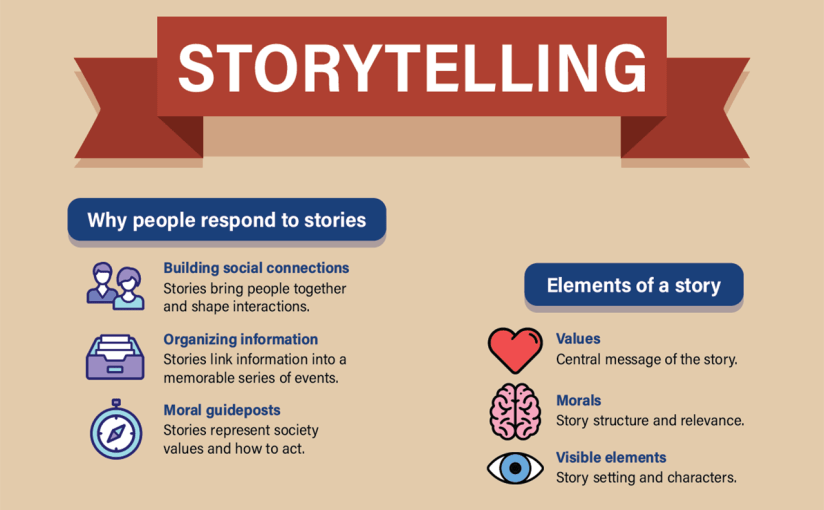
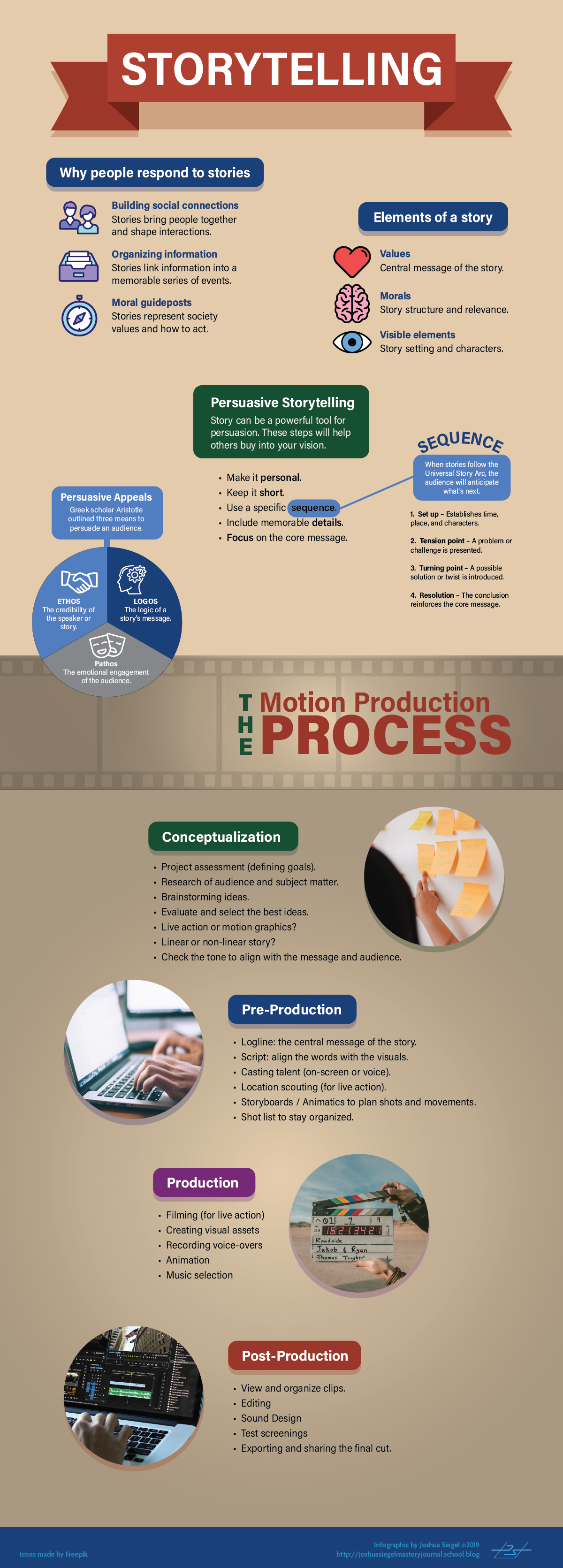
The second project was an Infographic outlining what I learned this week (see above). Infographics are another Organizational Structure for communicating with an audience. This project helped me sort through many pages of notes, organize what I learned, and translate it into a visual design. Even though I have produced videos for over twenty years, this week’s lessons provided new insights into the conceptualization stage of production. Krasner (2013) notes “Regardless of tools and delivery format, concept development is critical to all forms of graphic communication.” Ideas must be formulated, evaluated, and refined at a very early stage. This reinforces what we learned in last month’s Design Research course.
Acquired Competencies
The following are concepts or skills learned in the second week of the Organizational Structures course. They are categorized as Academic (pertaining to school work) or Occupational (pertaining to work in the Media Design field), and Technical (pertaining to software or other design skills) or Conceptual (new terminology, procedures, or ideas).
Academic
Technical
Conceptual
A story’s theme is its underlying message.
A story’s tone should align with its audience, its values, and its message.
Story Elements: Values: central message of the story. Morals: story structure and relevance. Visible elements: story setting and characters.
Logline: a one sentence summary that conveys the central message of the story.
Aristotle’s Three Persuasive Appeals: Ethos – The credibility of the speaker or story. Logos – The logic of a story’s message. Pathos – The emotional engagement of the audience.
Synaesthesia: a merging of senses (ie: hearing colors).
Causal Reasoning: the process of identifying relationships between a cause and a corresponding event.
Occupational
Technical
Conceptual
Materials: real-world textures, materials, and found objects can provide inspiration and add authenticity to design.
Audience Segmentation: analyzes audience characteristics including demographics, psychographics (i.e., personality), and firmographics (or business setting).
Affective Primer: the process of manipulating the emotions of an audience before the message is delivered.
Universal Sequence or story arc: Set up – Establishes time, place, and characters. Tension point – A problem or challenge is presented. Turning point – A possible solution or twist is introduced. Resolution – The conclusion reinforces the core message.
Pictorial Continuity: cohesion in content and style of visuals.
Sequential Continuity: logical flow of events between frames.
This week we learned more about the Storytelling process and how stories are used in design.
Beard’s design experiment
Critiques from twenty-three designers demonstrated how many approaches there are to design. One consistent theme is that inspiration can be found through explorations of different materials and real life interactions. For example, Jason Munn states that “A lot of stuff I do is trying to combine imagery to make something new,” (Beard, 2013). Munn encourage Beard to play with the interactions between letterforms and soap bubbles. Beard’s experiments demonstrated how natural patterns and geometric shapes provide inspiration for new ways to mix type and objects in design.
Furthermore, Skolos and Wedell (2012) combine found objects, sculpture, photography, and digital media in a process that is more exploration than design. Collage techniques and material experimentation can drive inspiration for Motionographers as well. If I were presented with this design challenge, a motion poster could be very effective. One possible approach is using imagery of soft, white soap bubble washing over a filthy texture to reveal the message.
Static vs. Dynamic media
During the week 2 live session, Dr. Baldowski remarked that motion designers must speak the languages of film, design, and animation. Static media like print ads convey a message with a single image, utilizing research and multiple iterations to find the most effective design solution. Dynamic media uses similar processes but requires additional planning to address the structure and pacing of the narrative over time. Storyboards are “a cohesive succession of frames that establishes a concept’s basic narrative structure” (Krasner, 2013). Animatics (animated storyboards) can also be used to resolve motion and timing issues when static storyboards aren’t enough.
Making images meaningful
According to Wujec (2009), there are three components to making images meaningful. First is to clarify ideas by visualizing them. This activates the ventral stream on the left side of the brain which visually identifies what something is. The second component is making the images interactive to engage the viewer. This activates the dorsal stream in the brain which helps create mental maps. The third component is creating visual persistence. Recognizing familiar objects and detecting patterns activates the limbic system, a very primal part of the brain. By visualizing ideas, making them interactive, and making them persistent a designer can engage three areas of the human brain for more meaningful communication.
I started using Adobe After Effects in 2009 to create titles and visual effects for my independent films. Websites like Creative Cow and Video Copilot taught me the basics, but there’s always something new to learn.
Step 1 – Concept: I wanted to create a nature-inspired animation that leads the viewer through a scene. First, I found a peppy music bed called “Little Tiny Song” by Matai on freeadmusic.com and used Adobe Audition to edit a 20 second remix of the song. The childlike cheerfulness of the music inspired me to use simple cardboard cutout style shapes to create most of the graphic assets.
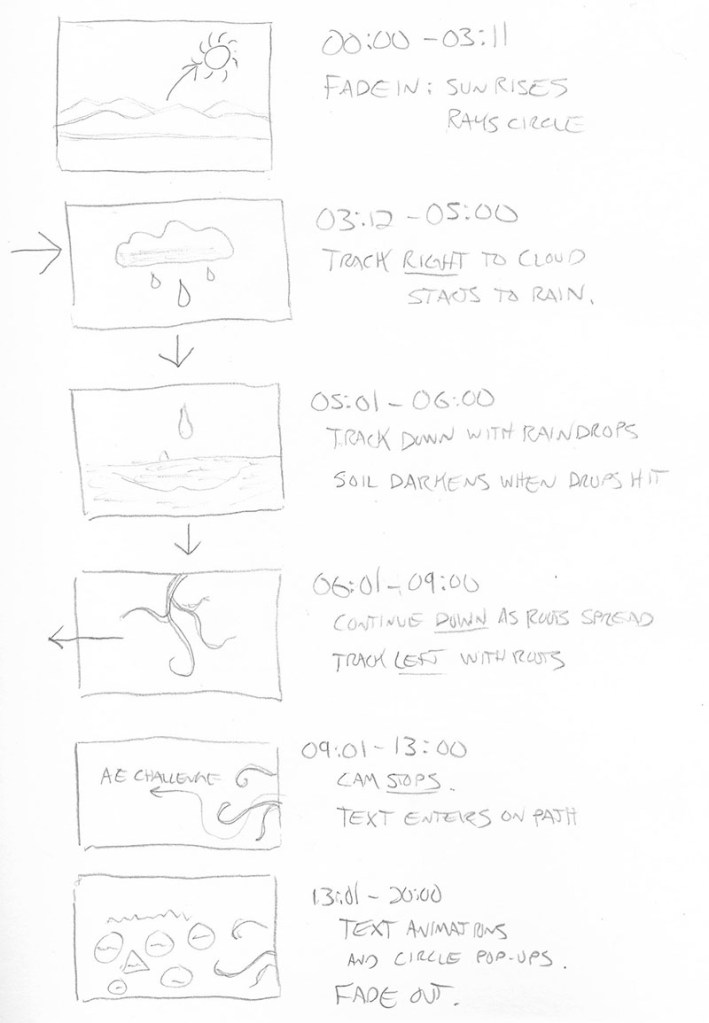
Step 2 – Storyboarding: After marking the music beats, I drew Storyboards with rough timing.
animation storyboard
Step 3 – Animation timing: I created a 1920 x 1080 Composition and drew several Shape Layers to represent the ground, mountains, sun, cloud, and raindrops. I added a Camera to the composition and made the shape layers 3D. I parented the camera to a Null Object and Keyframed the null object’s position to move it through the scene.
Step 4 – Details and refinement: After roughly timing the layer animations and camera movements to sync with the music, I added details like Textures, a Repeater animation on the sun rays, Write-on Effects for the roots and darkening the wet dirt with a feathered animated Mask set to the Multiply Blending Mode. The roots and text animations were Precomposed, and I used the Graph Editor to fine-tune animation keyframes.
Step 5 – Rendering: Finally, I turned on Motion Blur for all layers and Rendered the final composition using Adobe Media Encoder rather than the After Effects render queue.
Innovative Thinking
This design challenge pushed my Adobe After Effects skills in new directions. The project demonstrated my ability to create complex motion graphics using the tools within After Effects and the concepts of animation and storytelling. Tutorials from Adobe and LinkedIn Learning helped me apply previously unknown features and effects to the project.
The final composition moves the audience through the scene along with the music. If I had more time for the project, there are many details I would adjust. But overall, it shows that I can create complex motion graphics in a short time.
Acquiring Competencies
The most important skill I learned was using the Graph Editor to adjust motion keyframes for more realistic, organic animations. Instead of just applying Easy Ease to keyframes, I used the Graph Editor on the majority of keyframes in the design challenge timeline. This tool will help all my future motion designs feel more natural and realistic.
I also gained experience using other apps and features of Adobe Creative Cloud including Color for palette creation, Photoshop and Illustrator for asset creation, Audition for editing audio, Bridge for previewing animation presets, and Media Encoder for rendering.
The Structure of Motion in Design Its history, theory, and application
Overview
The majority of this week’s information comes from the book Motion Graphic Design, 3rd Edition by Jon Krasner (2013). Krasner provides a brief but thorough review of the history, inventions, and innovators of Motion Graphics. He describes the many applications of Motion Design in film, television, interactive media, and public spaces.
Furthermore, Krasner explains the basic theories and principles of animation. These principles were established by Disney animators and described in the book The Illusion of Life by Frank Thomas and Ollie Johnston (1995). The online article “Understand Disney’s 12 Principles of Animation” by Tammy Coron (2019) summarizes the book and provides sample animations for each principle.
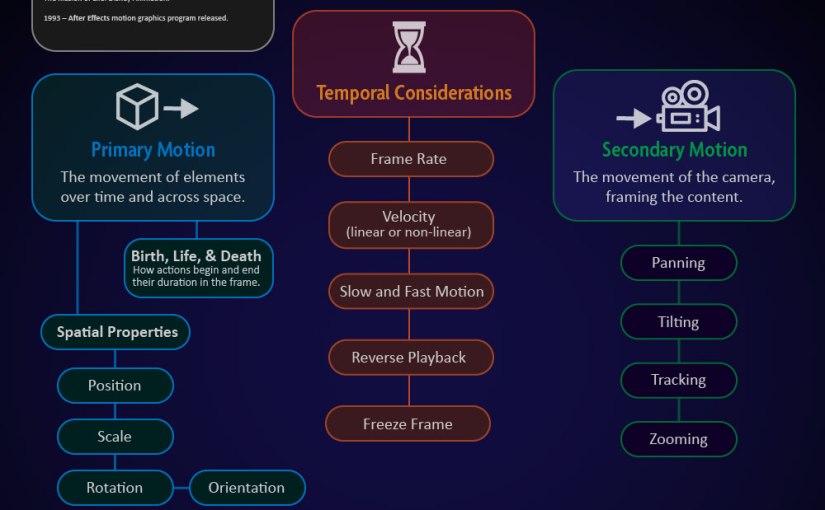
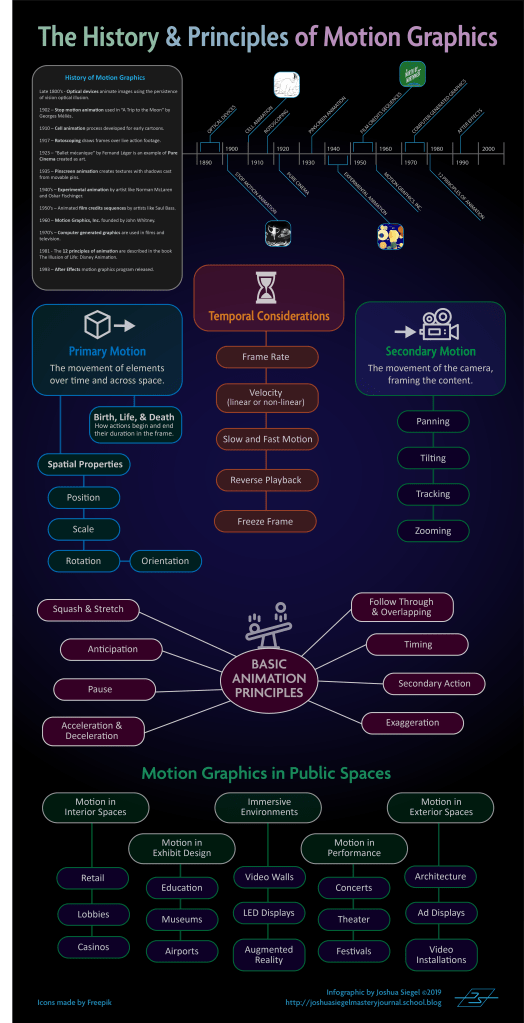
The concepts learned from these books and articles were displayed in an infographic created in Adobe Illustrator. Prior to creating the infographic, I completed the LinkedIn Learning course “Illustrator Infographics” by Tony Harmer (2019).
Certificate – Creating Illustrator Infographics
Acquired Competencies
The following are concepts or skills learned in the first week of the Organizational Structures course. They are categorized as Academic (pertaining to school work) or Occupational (pertaining to work in the Media Design field), and Technical (pertaining to software or other design skills) or Conceptual (new terminology, procedures, or ideas).
History of Motion Graphics (academic, conceptual)
Precursors of Animation: Multiple optical devices used the persistence of vision phenomenon to achieve early forms of animation.
Early Cinematic Inventions: Animation evolved with motion pictures in many forms including stop-motion and cell animation.
Experimental Animation and Innovators: Animators create new techniques for motion design and pure artistic expression.
Motion Literacy (occupational, technical)
Primary (Object) Motion: Animation of an element’s spatial properties and how it moves over time and across space.
Secondary (Camera) Motion: Movement of the camera and how it frames the content.
Temporal Considerations: Linear movements mimic mechanical devices, while non-linear movements are more natural. Techniques such as slow motion and reverse playback can alter the sense of time.
Principles of Animation: The basic language of how objects move was established by Disney animators and described in the book The Illusion of Life by Frank Thomas and Ollie Johnston (1995).
Motion Graphics in Public Spaces: LED technology makes large public displays more interactive and purpose driven.
Motion Graphics in Film, Television, and Interactive Media: Animation can entertain, inform, and drive audience participation by combining traditional graphic design with the visual language of film.
Infographics Design (occupational, technical)
Creating Adobe Illustrator Infographics: Adobe Illustrator, Microsoft Excel, and other programs provide many tools for creating data-driven illustrations.
Week One of the Organizational Structures course was an introduction to Motion Design. The Live Session video was prerecorded because of the Thanksgiving holiday. This week’s instructional materials introduced motion graphics foundations like the principles of animation and offered insights from several industry leaders.
Motion Design Insights
Brandon Parvini of Ghost Town Media remarks “When everyone else is getting trained by the exact same teachers, everyone’s work starts looking the same” because designers are learning techniques from the same online tutorials (Cox & Parvini, 2014). To differentiate from competitors, inspiration should be found outside of the motion design field. Explore music, architecture, nature, anything that stretches the mind in new directions. Research should be fun. Alberto Scirocco (2014) supports this methodology by advising designers to explore different aspects of their creativity and bring those lessons back to their designs.
Alberto Scirocco and the Motion Graphics of leftchannel
Scirocco states that “Good design connects a message with a person” (Scirocco, 2014). Motion Designers use variety of techniques that require trial & error, exploring how things move and elements interact. It’s important to know typography, color theory, animation principles, and more. Specialization is good, but you should at least know the terminology of other disciplines. Scirocco notes that leftchannel designers rotate through roles on different projects. Having a balance between technical skill and creativity is important. “The more experience you have, the more complexity to you as an individual, the more interesting your work is going to be” (Scirocco, 2014). Furthermore, Jeremy Cox (2014) recommends looking outside the art world to things like data visualization in the tech world.
Diegetic and Non-diegetic Sound
Sound is often the last thing considered when creating motion designs and films. But as Star Wars creator George Lucas once noted, “Sound is half the experience.” A skillfully crafted soundscape immerses the audience in the experience. When talking about sound design, Josh Hanson (2014) describes the difference between Diegetic Sound and Non-diegetic sound.
Diegetic: Sounds that on-screen character(s) would hear such as dialogue and sounds occurring within the film.
Non-diegetic: Sounds that on-screen characters won’t hear such as the soundtrack music or narration.
The fifth month of Full Sail University’s Media Design MFA
program was focused on Design Research. Design research is different than the pure
research or applied research conducted in other professional fields. Rather, it
is a research-driven design process that explores how a problem is solved, then
communicates the value of the solution. This goes beyond learning about design
elements like typography or color theory. Design research requires looking at a
design problem from multiple angles to uncover new ideas and solutions.
We learned the concepts and methodologies of design research
through place branding assignments. The readings and videos established a strong
basic knowledge, and the assignments put this newly acquired knowledge into practice.
Over a three week period, students were
tasked with choosing a local neighborhood, then conducting a brand analysis and
comparative analysis. We conducted primary research by exploring and
photographing the chosen neighborhoods, then used secondary research to discover
the current brand equity and find ways to differentiate it from similar neighborhoods.
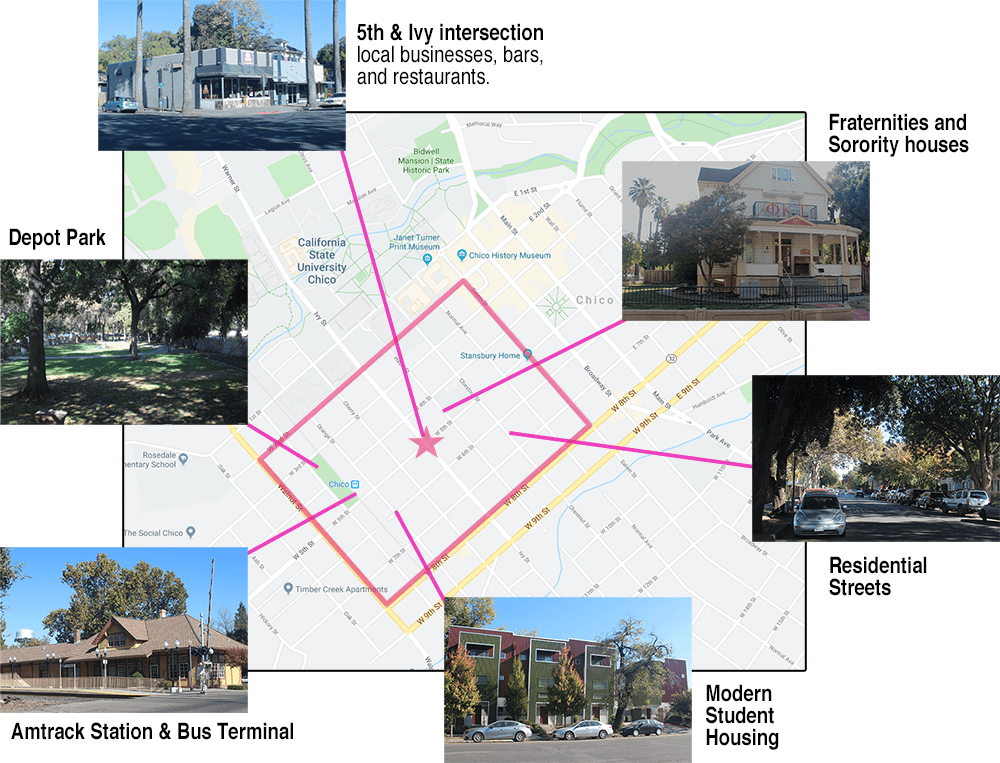
I chose the “U-Town” area in Chico, California. As the oldest residential neighborhood in the city, it has many positive qualities that have often been overshadowed by a reputation for college house parties. For an overview of how each assignment contributed to the learning process, read “Learning Design Research Through Place Branding”.
Prior to each assignment, Professor Argo provided links to
multiple online articles and videos related to the assignment. These
instructional materials established strong knowledge of Place Branding, Brand
Equity, Design Research, and Differentiation. Each week built on previous
lessons in a logical progression. For example, the article “5 Place Branding
Principles for Successful Brand Development and Management” detailed the principles
inherent to effective place branding: distinctiveness, authenticity,
memorability, co-creation, and a sense of the place that drives emotional connections
(Editorial Team, 2019). These principles were reinforced by research into the
current brand equity of the U-Town neighborhood (its authenticity, memorability,
and sense of the place) and a comparative analysis to find its differentiation
(or distinctiveness).
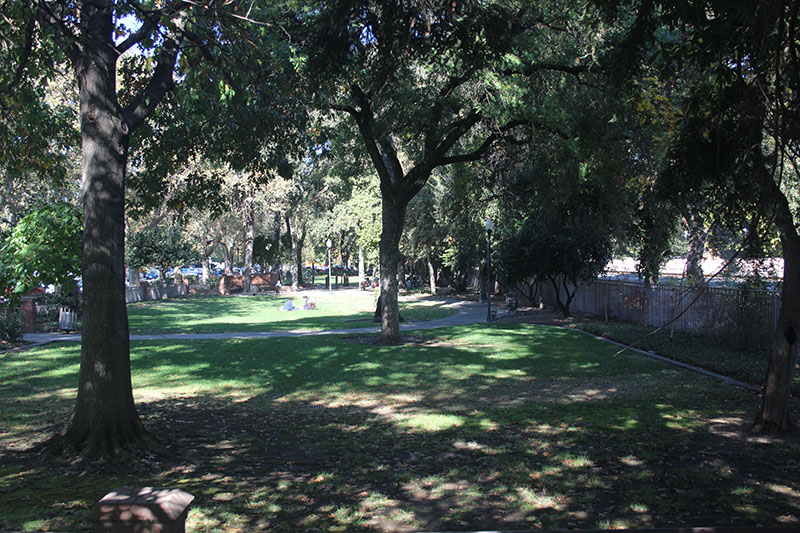
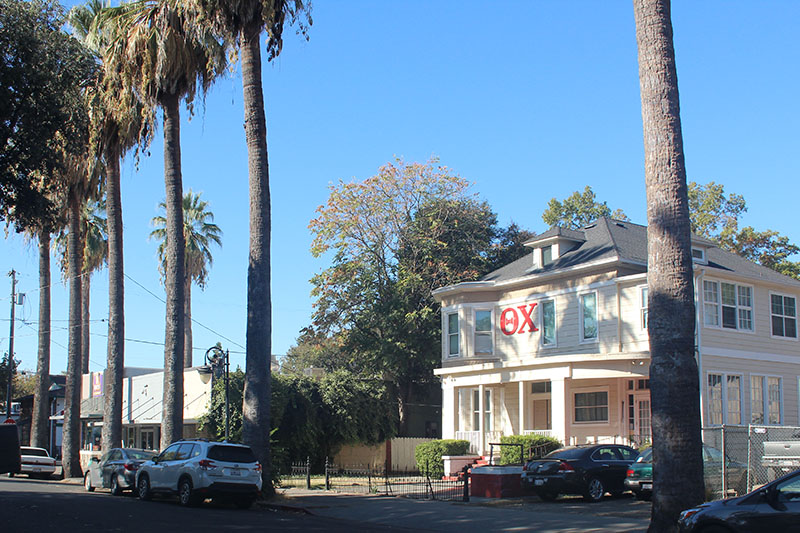
In a video from Gerson Lehrman Group, Turi McKinley explains how design research has both immersion and discovery stages (GLG, 2016). The immersion stage dives deep into the brand’s current equity and needs. The discovery stage explores possible solutions by getting hand-on interaction with people, places, and objects. For the U-Town branding project, the immersion phase was online secondary research into the history and current brand equity of the neighborhood. The information gathered in this phase led to connections made in the discovery stage. Several misconceptions were dispelled by exploring and photographing U-Town. A 2016 article in the Chico News and Review described the neighborhood’s history of raucous house parties and drunken riots, but also noted measures being taken by the city and Chico State to make the area safer for students and residents (Hardee, 2016). A visit to the area on a Saturday afternoon to gather primary research confirmed that those measures were largely successful. Students still drink and party, but those parties no longer spill into the streets and the neighborhood has a very laid-back peaceful vibe.
Depot ParkFraternity house
Problem Solving
The ultimate purpose of design research is solving a design
problem. The first step is defining the problem statement. Branding a district
is not a design problem. Instead, you must ask a specific question, such as “How
do I change the perception of this place for the target audience?” The primary design
problem for branding the U-Town neighborhood is “How do I change the
neighborhood’s party reputation?”
In the LinkedIn Learning video course “Learning Design Research,” Andy Schwanbeck suggests using KWHL tables to directly inform how to solve a problem (Schwanbeck, 2015). For the place branding assignments, the table below categorized the goals for the research process.
K: What do you already know?
W: What do you need to find out?
H: How will you learn it?
L: What do
you hope to learn?
U-Town has largely outgrown its party past, but that reputation remains.
The majority of residents are college students under 30.
A variety of small businesses and restaurants are focused on student needs.
Top reasons why students want to live in the area. Entertainment options besides alcohol.
How is U-Town different from other campus-adjacent neighborhoods?
Brand Equity study utilizing qualitative data from Niche.com neighborhood reviews and studies by the City of Chico Public Works Department.
Comparative Analysis of U-Town, Barber, and Downtown Chico.
What is the current brand equity of U-Town and what is its primary point of differentiation?
The Brand Equity study for U-Town discovered that the most liked aspects of the neighborhood are the beautiful trees and walkability. Both of these aspects provided a path to changing U-Town’s party reputation. The Comparative Analysis study found that the mature urban forest and walkable proximity to the college are two distinctive assets that appeal to nature-minded students. This emphasis on the local, environmentally friendly aspect of the neighborhood can help change its reputation as a raucous party area to a place that is nourishing to personal growth.
Innovative Thinking
A primary take-away from the Design Research course is that innovation
is about differentiation. The place branding research required us to find
the qualities that make a location stand out. Miguel Rivas notes that “distinctiveness
emerges from the singular combination of different city assets and approaching
the city narrative as an honest introspection, projected with healthy optimism
into the future” (Rivas, 2015). Researching a location’s assets and narrative
provides unique insights and understanding of how the brand connects with the
target audience. By synthesizing innovative designs based on differentiation,
we are building skills that can be used on future brand development projects.
The design research skills learned in the course are basic to the profession, but how they are used is a demonstration of innovative thinking. Finding U-Town’s “Zag” required a deep immersion in its current brand equity plus discovery of its differentiation. Comparisons were made to Downtown Chico, which also suffered from a negative “party town” reputation before being transformed into a family-friendly destination. With effective branding as an environmentally friendly neighborhood, U-Town can make a similar transformation.
Acquiring Competencies
The following are concepts or skills learned in the Design
Research course. They are categorized as Academic (pertaining to school
work) or Occupational (pertaining to work in the Media Design field),
and Technical (pertaining to software or other design skills) or Conceptual
(new terminology, procedures, or ideas).
Week 1
Mastery Goals and Active Learning. Academic, Conceptual.
The difference between art and design. Occupational, Conceptual.
Principles of Place Branding. Occupational, Conceptual.
Week 2
What is Design Research? Academic, Conceptual.
Pure Research vs Applied Research. Academic, Conceptual.
In the final week of Design Research, we are updating our Mastery Journals to describe our progress and reflect on the course. The overview will include documentation of what we’ve learned and how we’ve met the learning objectives. To demonstrate Innovative Thinking, we must compare our work to others in the industry. Professor Argo noted that innovative thinking can be applied even if the product isn’t 100% innovative. For example, our place branding research uncovered unique qualities to neighborhoods that are unremarkable at first glance. The comparative analysis was an important tool for discovering differentiation and “finding the zag” as recommended by Marty Neumeier (2006). This innovative thinking helps us understand the choices we must make to create more effective designs.
Differentiation in Place Branding
Innovative thinking is necessary for strong Differentiation.
It requires looking at the status quo, then doing something different. However,
there should be reasoning and purpose behind the differentiation. We compare our
work to others to know WHY they did what they did, not to imitate them. The
article “5 Place Branding Principles for Successful Brand Development and
Management” states that “Place branding is above all about the distinctiveness
of a place” (Editorial Team, 2019). This month’s research was about discovering
the unique qualities of our chosen place that make it stand out in comparison
to its competitors. Professor Argo encouraged us to find an “Onliness”
statement about our place:
_____ is the ONLY neighborhood that _____.
This differentiation will help set the voice and tone for
the visuals we will create in the next class.
APA Formatting
Like all academic writing in the Media Design MFA program, this
month’s Mastery Journal and paper must be written in APA format. Professor Argo
recommended the
Purdue Online Writing Lab as a valuable reference for proper formatting. He
also noted that the APA paper templates included with Microsoft Word may not
necessarily use the correct font, so it is important to check the minor
details. Specifications are there for a reason. They demonstrate
attention to detail, a requirement for mastery and professional success. In the
book Mastery, Robert Greene suggests that artists’ works suffer when
they “think in large brush strokes” (Greene, 2013). Attention to detail
demonstrates a deeper understanding of the work, helping it connect with the
audience.
References:
Greene, R. (2013). Mastery [VitalSource Bookshelf version]. New
York: Penguin Books. Retrieved from vbk://9781101601020
This week was all about finding differentiation: one
thing about the brand that provides the best value and sets it apart from the
competition. In his book ZAG, Marty Neumeier explains that “radical
differentiation doesn’t test well in focus groups” (Neumeier, 2006). People
will claim to want more of the same, but better. Real innovation can be
uncomfortable to many because it’s new and often risky. This leads to a level
playing field of sameness. In the video “Why Isn’t Your Brand Differentiation
Working?”, David Brier says that “Finding and taking advantage of
differentiating factors in your brand communications serves to unlevel this
playing field” (Brier, 2018). This week’s research will help us find useful
differentiation for our place brand. Neumeier concluded that the keys to finding
your zag are “hitting ’em where they ain’t (differentiation) and getting in
front of a parade (finding a trend)” (Neumeier, 2006).
You can’t be all things to all people.
Research provides a wealth of information that must be funneled
down to find focus. That focus is your differentiation. It’s important to
find the unique qualities that are of worth to the target audience. In
the video “Why Isn’t Your Brand Differentiation Working?”, David Brier states “it’s
important to find aspects of your brand that are superior/unique and align with
the target audience’s wants and needs” (Brier, 2018). Professor Argo added that
we should come up with one or two words that define the theme of what we’re
finding and where we want to go. This umbrella concept will guide the
voice and tone of our designs.
Innovation in Media Design
Professor Argo reminds us that innovation is about differentiation. Our place branding research is all about finding the qualities that make a location stand out. Miguel Rivas notes that “distinctiveness emerges from the singular combination of different city assets and approaching the city narrative as an honest introspection, projected with healthy optimism into the future” (Rivas, 2015). Researching a location’s assets and narrative provides unique insights and understanding of how the brand connects with the target audience. By synthesizing innovative designs based on differentiation, we are building skills that can be used on future brand development projects.


 Joshua Siegel's Mastery Journal