Design Strategies and Motivation – Week 3 Live Session

This week Professor Argo shifted the focus of the Live Session review to identifying and presenting concepts more than reporting what happened in the meeting. This insight and synthesis is meant to show a logical, critical thinking process by connecting outside sources (including previous work).

Purpose of a Creative Brief

Just as every design agency or in-house design group has a different idea of what a mood board or style guide should contain, there are many different types of creative briefs depending on the project and persons creating the brief. However, all creative briefs serve a similar purpose: to define a singular message that sets the objective of the project. The creative brief is “a blueprint for your project that not only helps the creative team but also will help you as you shape the overall strategy and goals for the project” (Bruun, 2019). No matter how long or short the creative brief, Felton (2013) recommends that it answers the following three questions:

  1. What benefit are you promising?
  2. Who are you making it to?
  3. Why should they believe you?

Other areas can be addressed but answering those three questions should provide a strategy for solving the design problem at hand.

Brand Image

When developing a creative strategy, it’s important to keep in mind the brand image. Felton (2013) credits David Ogilvy with creating the idea of brand-image advertising. When products like shoes, cola, or sushi are very similar to their competitors, customers look to the brand image for differentiation. Brand image is more than a logo or package design, it is the recognizable personality of the brand. This includes not only visual elements and copy style but also the brand reputation built through customer interactions (Thimothy, 2016). To stand out from competitors, a brand image should be recognizable and relatable to the target audience, like an old friend they want to spend time with.

Unique Selling Proposition vs Emotional Selling Proposition

The idea of the Unique Selling Proposition (USP) was conceived in the 1950s by Rosser Reeves as a way to single out a product’s unique benefit to set it apart from competitors (Felton, 2013). This product-oriented strategy is one way of finding brand differentiation, but more recently the USP has given way to the Emotional Selling Proposition (ESP) conceived by John Hegarty. Instead of looking for the logical benefits of a product, the ESP finds the emotional selling points of the product. How does it make the use feel happier or more attractive? McPheat (2019) notes that negative emotions can drive a selling proposition as well by addressing consumer worries and fears. A creative strategy that combines the product-oriented USP and consumer-oriented ESP gives people more reasons to use the brand.


References:

Bruun, K. (2019, June 19). 10 Key Elements of a Successful Creative Brief. Retrieved from https://www.upwork.com/hiring/design/how-to-create-an-effective-creative-brief/

Felton, G. (2013). Advertising: Concept and Copy (Third). New York: W.W. Norton.

McPheat, S. (2019, April 23). What Is An Emotional Selling Proposition & Is It Better Than A Unique Selling Proposition? Retrieved from https://www.mtdsalestraining.com/mtdblog/emotional-selling-proposition-better-than-a-unique-selling-proposition.html

Thimothy, S. (2016, October 31). Why Brand Image Matters More Than You Think. Retrieved from https://www.forbes.com/sites/forbesagencycouncil/2016/10/31/why-brand-image-matters-more-than-you-think/

Strategic Development parts 3-4

Strategic Development part 3: Understanding Consumer Behavior

Maslow’s Hierarchy of Needs

Theodore Levitt said, “Products are problem-solving tools” (Felton, 2013). When somebody buys a new jacket, they are not just looking to stay warm. They are also buying a status symbol that raises their esteem. A good product can solve multiple problems if we understand the human needs that must be addressed. Psychologist Abraham Maslow described a “hierarchy of needs” in human beings that start with low level physiological needs like hunger that must be met first before ascending to higher-level psychological needs like love and esteem (Felton, 2013).

Here are a few ways that Boxpark Sushi can respond to these needs.

1. Physiological needs: hunger, thirst, warmth, pain avoidance, sexual release, and others.

  • Boxpark Sushi satisfies hunger and thirst with delicious food and beverages.

2. Safety needs: housing, clothing, financial and physical security.

  • Customers should be reassured about the safety of consuming raw seafood. Cooked and non-seafood options should be available, along with a “freshness guarantee”.
  • Boxpark’s container stores might be claustrophobic for some customers. An open layout with lots of daylight can make the restaurant more comfortable.

3. Love and belongingness needs: social acceptance and personal intimacy.

  • Customers are part of the sushi tribe, a select group according to a survey (Shelby, 2015) that found that 45% of people in the U.S. Midwest have never tried sushi.
  • Diners are treated like a friend by their sushi chef, a “sushi sensei” who can educate the diners while preparing their food.
  • Boxpark is a small, community-based shopping experience. Live entertainment and common dining areas improve public interactions.

4. Esteem needs: feelings of adequacy and achievement, approval, prestige, social status

  • Sushi eaters are considered more sophisticated and cultural than the average Joe.
  • Learning about and trying different kinds of sushi is an achievement.
  • Sushi is often eaten at celebratory occasions.

5. Self-actualization needs: the need to understand, cognitively and aesthetically; the ultimate integration of the self and realization of one’s highest inner potential.

  • For some people, eating sushi can be a spiritual experience. The artistry and culture of sushi makes it more than just a quick meal.
  • East Side Milwaukee is located near the University of Wisconsin Green Bay – Sheboygan Campus. Eating sushi while attending college lets students expand their culinary horizons while preparing for their future.

Settle and Alreck’s Shopping List of Needs

Robert Settle and Pamela Alreck expanded on Maslow’s hierarchy with their own shopping list of human needs (Felton, 2013). Unlike Maslow’s list, these needs are not presented in the order of which they should be addressed.

Achievement: the need to perform difficult tasks, exercise one’s skills.

  • According to a survey by Pei Wei (Shelby, 2015), 11 percent of sushi eaters consider themselves a “black belt” in sushi eating and 27 percent of sushi eaters consider themselves a “white belt” in sushi eating. This suggests that the more sushi the customer has tried, the greater sense of accomplishment.

Independence: the need to be autonomous, have options, be different.

  • Many people enjoy the freedom of options with the “build your own” meals from chain restaurants like Subway and Chipotle. The central Florida chain Sus Hi Eatstation does the same for casual Asian food with customizable sushi roll, bowls, and burritos. Letting diners craft their own meal helps them feel independent.

Exhibition: the need to gain public attention, show off, be noticed.

  • Successful brands have a lot of interaction with their customers, on social media and in real life. Promotions and in-store events let customers show off their love of the brand. For example, Sus Hi Eatstation offered free sushi to diners who dressed like a ninja on International Ninja Day (White, 2019).

Recognition: the need to be highly regarded by others, to be held up as a good example.

  • Boxpark Sushi menu items could be rated with a system based on karate’s colored belts. Accessible, American items like California rolls would be rated “white belt”, while sushi with more unusual ingredients like Natto (fermented soybeans) and Nama-shirasu (immature sardines) would earn eaters a coveted “black belt” (Joy, 2017).

Dominance: the need to exercise power over others, direct and supervise, have influence.

  • Sus Hi Eatstation tells customers to “master their meal” by customizing the ingredients. This choice of wording appeals to the need for dominance.

Affiliation: the need to be closely associated with others, the need for relationships.

  • Frequent sushi eaters are part of the sushi “tribe”, a select group of enthusiasts who can share their knowledge and love of sushi.
  • Group dining areas in the Boxpark mall encourage interaction with other diners.

Nurturance: the need to provide care for others, to have and protect.

  • Many restaurants give back to the community by supporting charities and local school fundraisers. Customer participation in these efforts fulfils the need for nurturance.

Succorance: the need to receive help from others, be comforted, be encouraged and supported.

  • According to a survey by Pei Wei (Shelby, 2015), 30 percent of first-time sushi eaters had someone help them order. Boxpark Sushi chefs can provide this kind of education and reassurance to help people feel more comfortable trying something new.

Sexuality: the need to establish and develop one’s sexual identity, be sexually attractive, give and receive sexual satisfaction.

  • Can sushi be sexy? The Japanese practice of nyotaimori, serving sushi on a nude model’s body, originated in the samurai period (Scalza, 2014). “Body sushi” is a controversial practice that some consider degrading to women, yet it is still practiced in Japan and by private catering companies in the West.

Stimulation: the need to stimulate the senses, pursue vigorous activity, engage the mind and body, stimulate the palate, be active.

  • Sushi stimulates the palate with interesting flavors and textures.
  • Boxpark Sushi chefs interact with customers, engaging their minds.

Diversion: the need to relax, have fun, escape from routines, be entertained.

  • For many, sushi is eaten at celebratory occasions like birthdays and anniversaries. The experience is entertaining and engaging, a chance to have fun with friends and family.
  • Boxpark malls are modern and hip, the perfect place for hanging out with friends and meeting new people.

Novelty: the need to alter routine, be surprised, acquire new skills, have new and different experiences.

  • There are many types of traditional sushi, and even more recent innovations in Western style sushi. Every visit to Boxpark Sushi provides an opportunity for diners try something new.

Understanding: the need to comprehend, teach and learn, discover patterns, make connections.

  • Sushi is more than a food. In its highest form, it is an art that is appreciated the more it is studied. Learning more about sushi with each visit to Boxpark Sushi appeals to the need for understanding.

Consistency: the need for order and cleanliness, to control uncertainty and avoid ambiguity, make accurate predictions.

  • Consistency is highly valued by many restaurant eaters, which is one of the reasons fast food chains like McDonalds are so popular with Americans. A Big Mac bought in Florida is identical to one bought in Nevada. Boxpark Sushi can also deliver consistent food but with a more personal, upscale experience.

Security: the need to be free from fear, feel safe and protected, avoid accidents, acquire assets.

  • Customers should be reassured about the safety of consuming raw seafood. Cooked and non-seafood options should be available, along with a “freshness guarantee”.
  • Boxpark’s container stores might be claustrophobic for some customers. An open layout with lots of daylight can make the restaurant more comfortable.
  • Upper East Side and Lower East Side Milwaukee have high crime statistics (Areavibes, 2018), so special efforts should be made to ensure the safety of Boxpark visitors.

References:

Areavibes. (2018). Milwaukee, WI Crime. Retrieved from https://www.areavibes.com/milwaukee-wi/crime/

Felton, G. (2013). Advertising: Concept and Copy (Third). New York: W.W. Norton.

Joy, A. (2017, October 29). 10 Unusual Sushi Toppings You’ll Learn to Love. Retrieved from https://theculturetrip.com/asia/japan/articles/10-unusual-sushi-toppings-youll-learn-to-love/

Scalza, R. (2014, September 6). Naked Sushi Makes Waves in Vancouver. Retrieved from https://www.insidevancouver.ca/2014/09/06/naked-sushi-makes-waves-in-vancouver/

Shelby Food Service. (2015, March 24). Pei Wei Releases Sushi Survey Results, Adds New Rolls. Retrieved from https://www.keltonglobal.com/recognition/pei-wei-releases-sushi-survey-results-adds-new-rolls/

White, B. (2019, December 2). Celebrate International Ninja Day With Us And Score Free Sushi!Retrieved from https://sushieatstation.com/celebrate-international-ninja-day-with-us-and-score-free-sushi/

Strategic Development part 4: Analyzing the Marketplace – Segmentation

Demographics

Gender: Sushi appeals to all genders, although a survey by Pei Wei (Shelby, 2015) suggests that American males are more likely than females to have tried sushi.

Age: 25-35. The survey by Pei Wei (Shelby, 2015) reports than 84 percent of 18-34-year-olds have tried sushi, while only 50 percent of seniors (age 65+) have tried it. The median age of East Side Milwaukee is 29.3 years (City-Data).

Location: East Side Milwaukee, Wisconsin.

Mobility: Car. Demographics of East Side Milwaukee gathered from the 2017 American Community Survey (Point2Homes) report that the vast majority of East Side residents use an automobile as their primary means of transport.

Income: $66,000 Median Household Income is reported for ages 25-44 in East Side Milwaukee (Point2Homes).

Expenditures: The U.S. Bureau of Labor Statistics (2019) reports that American consumers spent an average of $3,459 on food away from home in 2018, up 2.8 percent from 2017.

Occupation: White collar – technical, sales, and office occupations (City-Data).

Education: College graduate – over 50 percent of East Side Milwaukee residents have a Bachelor’s or Graduate Degree (Point2Homes).

Nationality: Primarily American. 89 percent of East Side Milwaukee residents are U.S. born citizens (Point2Homes).

Religion: 71 percent of East Side Milwaukee residents are Christian and 25 percent are non-religious (Pew Research Center).

Family Status: Single, no children. Over 55 percent of East Side Milwaukee residents have never married (Point2Homes) and parents are less likely bring their children to sushi restaurants that other types of food establishments with a kid’s menu.

Psychographics

The psychographic profile below is based on my personal experiences with friends, family, and associates who enjoy sushi on a regular basis.

Attitudes: Multicultural and open to new foods and experiences.

Opinions: Concerned about the environmental impacts of their food choices.

Habits: Exercises regularly and tries to maintain a healthy diet.

Personality: Friendly and outgoing. Interested in new experiences.

Lifestyle: Into physical fitness but not obsessed. Works hard during the week and cuts loose on the weekends.

Hobbies: Art, running, and yoga. Enjoys travelling to exotic destinations.

Buying Behavior

1. When:

  • Usage Rate: Sushi is primary eaten for lunch or dinner, and few sushi restaurants are open before 11AM. Some aficionados eat it weekly, but most diners it is eaten less often.
  • Readiness Stage: People are aware of sushi, but many who haven’t tried it are stuck on the “raw fish” aspect. Container malls are less familiar to Americans, but the concept has caught on in cities across the world.

2.  What:  Eating healthy food in a hip, urban setting. Boxpark is a place to hang out and shop, not just eat and go.

3. Why: 

  • Loyalty status: Low, even among sushi eaters. Good sushi is available from several restaurants in East Side Milwaukee, but the none in a mall-like setting where customers can do other shopping.
  • Attitude toward product: Positive among sushi eaters. Negative or cautious among consumers with “stuck points” like raw fish, eating with chopsticks, and unfamiliar words.

References:

City-Data. (n.d.) East Side neighborhood in Milwaukee, Wisconsin. Retrieved from: http://www.city-data.com/neighborhood/East-Side-Milwaukee-WI.html

Pew Research Center. (n.d.). Religious Landscape Study – Adults in Wisconsin. Retrieved from: https://www.pewforum.org/religious-landscape-study/state/wisconsin/

Point2Homes. (n.d.). East Side Milwaukee Demographics. Retrieved from: https://www.point2homes.com/US/Neighborhood/WI/Milwaukee/East-Side-Milwaukee-Demographics.html

U.S. Bureau of Labor Statistics. (2019, September 10). Consumer Expenditures 2018. Retrieved from https://www.bls.gov/news.release/cesan.nr0.htm

Design Strategies and Motivation – Week 2 Live Session

The second week of the Design Strategies and Motivation course delved deeper into understanding a brand’s users and marketplace. We read chapters three and four from George Felton’s Advertising: Concept and Copy and continued the Strategic Development project for the fictional Boxpark Sushi in East Side Milwaukee.

Sushi Barriers

The students participating in the Week 2 Live Session shared what we learned about sushi through personal observations and research in week one. We identified several potential barriers to people who haven’t tried sushi.

  1. The Japanese language and writing can be intimidating.
  2. Eating with chopsticks can be difficult.
  3. Ginger and wasabi can be too spicy to the unfamiliar.
  4. Ingredients like raw fish, octopus, sea urchin, and roe are unusual to many people.

Removing or mitigating these barriers could make people less hesitant to try sushi. Here are a few ways to make sushi more “comfortable” to Americans.

  1. English names and descriptions of each type of sushi and its ingredients.
  2. Let people know that it’s acceptable to eat sushi with a fork or your hands.
  3. Spiciness “levels” or ratings for sushi and sides.
  4. Western sushi innovations like the waffle breakfast sushi, bacon and egg sushi, and peanut butter and jelly sushi (Tom, n.d.) that appeal to American kids and adults who don’t like seafood.

The Sushi Sensei

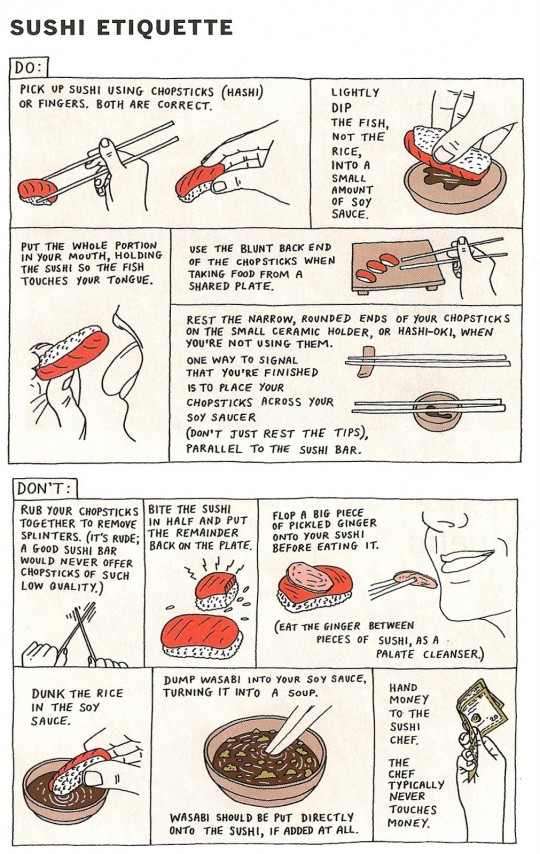
We also talked about how most people are introduced to sushi by a friend or family member who is already an aficionado. This kind of “sushi sensei” makes the first time less intimidating by explaining various processes and ingredients to the newcomer. Eating sushi can be a “rite of passage” that tests people’s taste buds. There is procedure and a lot to learn, as demonstrated by the infographic below from designer Peter Arkle that illustrates basic sushi etiquette for beginners.

Literal vs Abstract Thinking

Finally, Professor Argo reminded us how literal thinking and imagery lead to unoriginal, ineffective designs. Instead, we are encouraged to think in abstracts, to think of the basic needs that the product or brand is addressing or the problem it is solving. We should “try to find metaphors that capture the psychological essence of a problem more than simply its external reality” (Felton, 2013).

A sushi brand represented by a roll and chopsticks will not be distinctive. Therefore, our strategic development research is meant to funnel down the information we’ve gathered into a singular message that directly addresses the client’s needs. Finding that “zag” is essential before creating any brand visuals.


References:

Felton, G. (2013). Advertising: Concept and Copy (Third). New York: W.W. Norton.

Tom, H. (n.d.) 21 Unique Recipes for Sushi Without Raw Fish. Retrieved from: https://spoonuniversity.com/recipe/21-unique-recipes-for-sushi-without-raw-fish

Strategic Development part 2 – The Competition

The second step of the Strategic Development project is to research the brand’s competition. Burstein (2012) refers to three types of competitors in the business world:

  1. Direct competitors: brands with similar products that are likely to be used if your client’s product did not exist.
  2. Indirect competitors: brand with similar products but a strong differentiation from your client or in another market segment.
  3. Replacement competitors: brands with very different products that are competing for the same customer’s time and money.

For this project we are focusing on direct and indirect competitors while being aware of all aspects of the client’s marketplace.

A primary reason for researching a brand’s competition is to find ways to differentiate from competitors and better serve customers.

Comparison Criteria

Traditional Sushi: Sushi is freshly prepared by trained sushi chefs in an area where diners can order directly and interact with their chef. A variety of maki, sashimi, and other traditional sushi are made with locally sourced, sustainable ingredients.

Modern Sushi: Western sushi innovations, especially those without raw fish, can introduce new customers leery of traditional sushi as well as introducing new culinary trends. Tom (n.d.) describes many interesting rolled food options, including waffle breakfast sushi, bacon and egg sushi, and peanut butter and jelly sushi that appeal to American kids and adults who don’t like seafood.

Ordering Options: In addition to the dine-in sushi bar experience, diners should have the option to pick up premade to-go boxes, order take-out, and place orders by phone, text, online, or with an app.

Affordable Prices: Quality chefs and ingredients require more money, but these costs could be offset by the lower overhead of operating from a Boxpark container. Prices should reflect the quality of the sushi while remaining competitive with nearby restaurants.

Direct Competitors

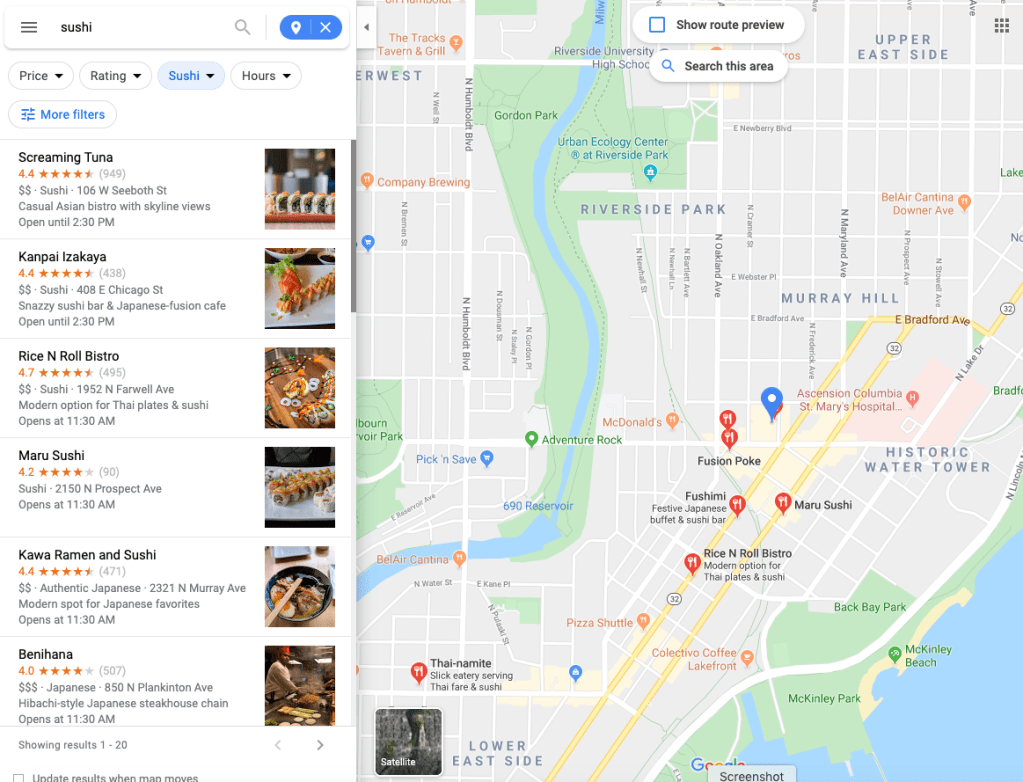
Three popular sushi restaurants were located in East Side Milwaukee using Google Maps.

Map of East Side Milwaukee

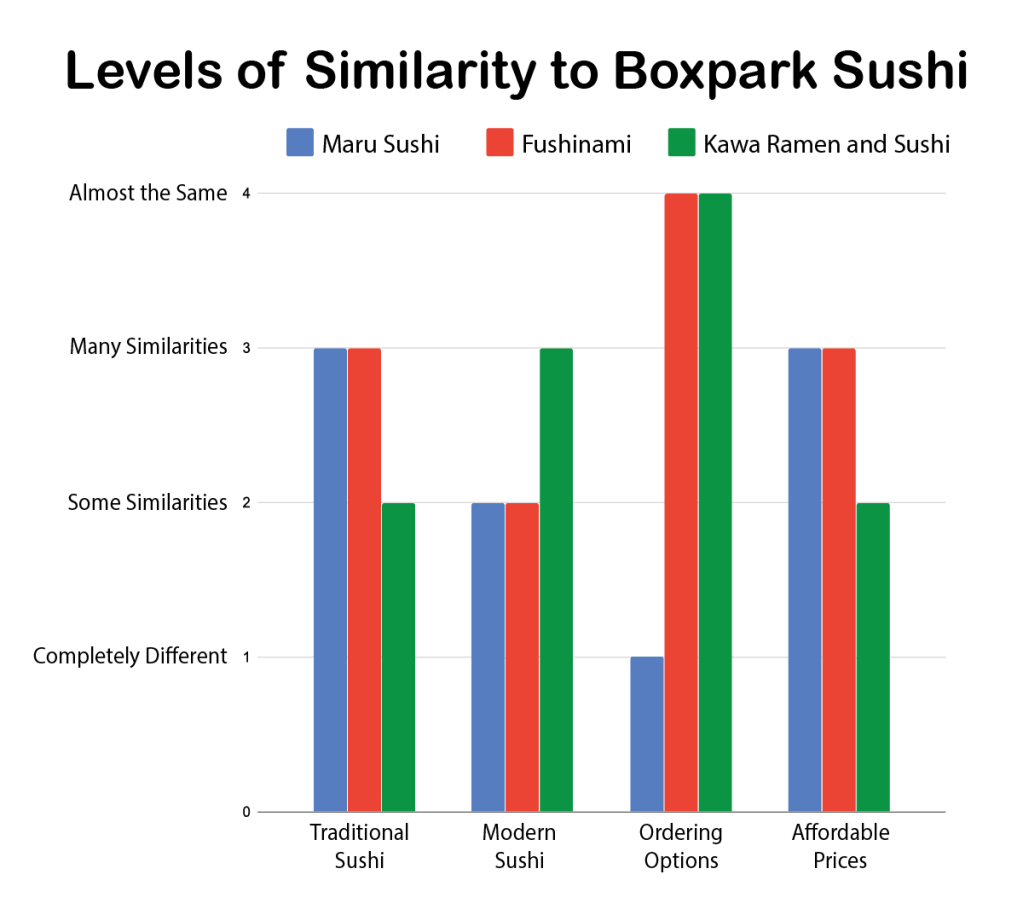
Maru Sushi: Located on North Prospect Avenue, Maru Sushi features an all-you-can eat lunch special and a simple menu with classic and signature maki rolls. Online reviews are mostly positive, but a few mention slow service and too much rice in the rolls.

Fushinami: A Japanese buffet and sushi bar on North Farwell Avenue, just around the corner from Maru Sushi. Many online reviewers enjoyed the all-you-can eat buffet, especially the seafood. Sushi is included with the buffet, and all sushi is made fresh to order by the sushi bar chefs. The restaurant also includes a full bar and “party tray” platters of sushi available for take-out.

Kawa Ramen and Sushi: A small and modern style restaurant that serves a variety of sushi, noodle dishes, and Japanese appetizers and beverages. Their sushi prices are higher than other nearby restaurants, and their website notes that they only serve 120 bowls of ramen each day. Online reviews range from average to “the best sushi and ramen I have ever had in my life,” (Dix, 2019).

Chart - Levels of Similarity to Boxpark Sushi
Chart – Levesl of Similarity to Boxpark Sushi

Indirect Competitors

Asian Fusion: A modern restaurant serving traditional and modern takes on Chinese dishes from a variety of provinces. Known as a home-away-from-home for Chinese-born college students (OnMilwaukee, 2019).

FreshFin Poké: A bright, modern counter-serve restaurant featuring signature and build-your-own poké bowl. Poké is a Hawaiin dish of raw, marinated fish tossed with rice and vegetables that has been described as “the next generation of sushi” (Pfeffer, 2017).

Huan Xi Chinese Restaurant: A small restaurant with a bar and Hot Pot stations at each table, so diners can prepare their own hot pot dishes. Online reviews suggest that many local students order take-out here, but the service is slow.

Features used as criteria to determine that the business is a competitor:

  • Asian Cuisine
  • Location in East Side Milwaukee
  • Popular with College Students
  • Dine-in and Take-out options

References:

Burstein, D. (September 28, 2012). Market Competition 101: The 3 Types Of Competitors To Keep An Eye On. Retrieved from: https://rpablog.marketingsherpa.com

Dix, Z. (2019). Review of Kawa Ramen and Sushi. Retrieved from: https://goo.gl/maps/3S4zL8hsNvgTrPeU6

OnMilwaukee. (October 25, 2019). East Side dining guide. Retrieved from: https://onmilwaukee.com/dining/articles/east-side-dining-guide.html

Pfeffer, S. E. (June 5, 2017). What Is a Poke Bowl, Anyway? A Chef Breaks Down the Food Trend. Retrieved from: https://people.com/food/poke-bowl-food-trend-recipe/

Tom, H. (n.d.) 21 Unique Recipes for Sushi Without Raw Fish. Retrieved from: https://spoonuniversity.com/recipe/21-unique-recipes-for-sushi-without-raw-fish

Strategic Development Part 1 – The Clients Product

The first assignment for the Design Strategies and Motivation course is a Strategic Development project for a fictional client: a Boxpark sushi shop in East Side Milwaukee. To understand a brand, we must first learn everything about the product, its competitors, and its users.

Step 1. Firsthand Use

I’ve enjoyed sushi since my late teens, but it was an acquired taste. I first tried it out of curiosity and my love for Japanese culture. Like many people, I was dubious of eating raw fish but found the combinations of flavors to be irresistible. In college and beyond, sushi was a rare treat only enjoyed once every two or three years with select friends. More recently, I’ve tried pre-prepared “supermarket sushi” but found it far lacking in flavor compared to freshly prepared sushi from a Japanese restaurant.

Restaurant Sushi

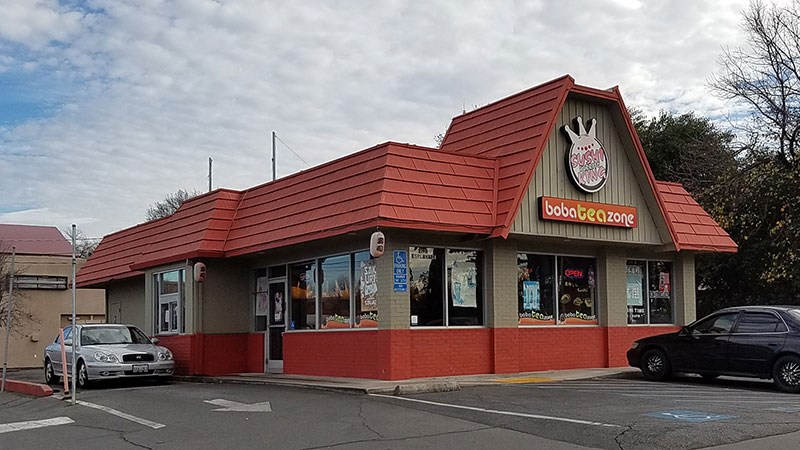
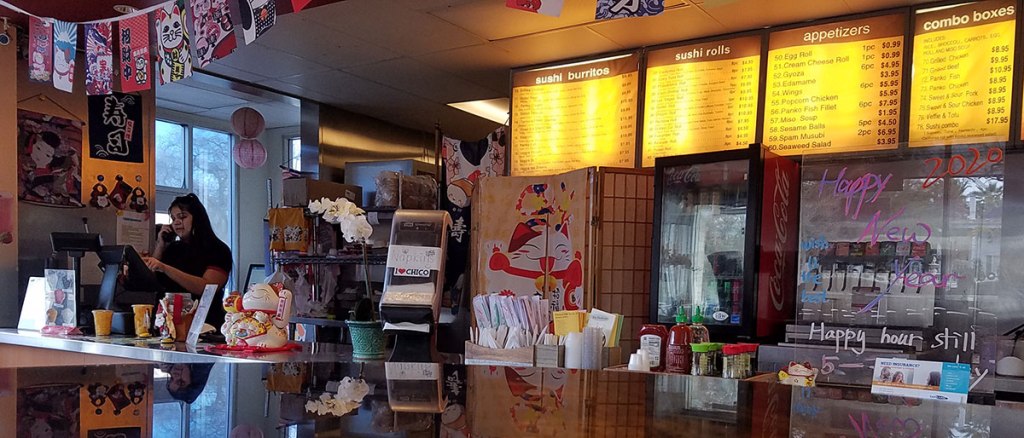
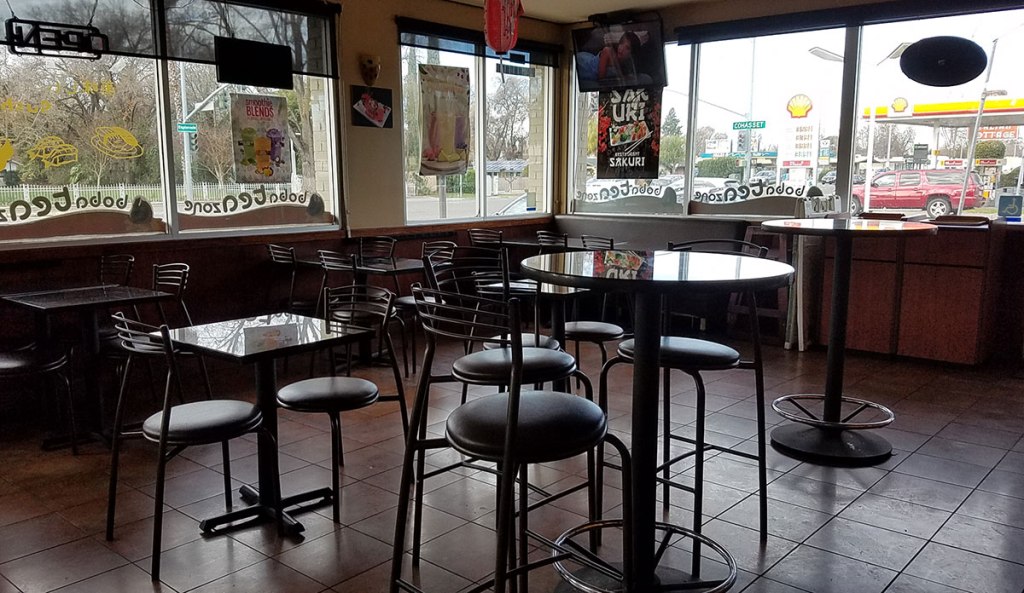
Chico, California has ten restaurants that serve sushi. They range from the award-winning Japanese Blossoms to fast food Sushi Burrito King. On a recent visit to Sushi Burrito King, I observed no customers eating inside the restaurant. Instead, most customers opted to use the drive-through or take-out their order, suggesting that it was popular for people looking for a quick meal on the go.

Sushi Burrito King exterior
Sushi Burrito King interior
Sushi Burrito King empty dining area

In contrast, sit-down restaurants like Japanese Blossoms encourage the dine-in experience with high end décor and a wider variety of menu items. These kinds of establishments make eating sushi feel like a more authentic experience compared to just grabbing a fast meal.

Supermarket Sushi

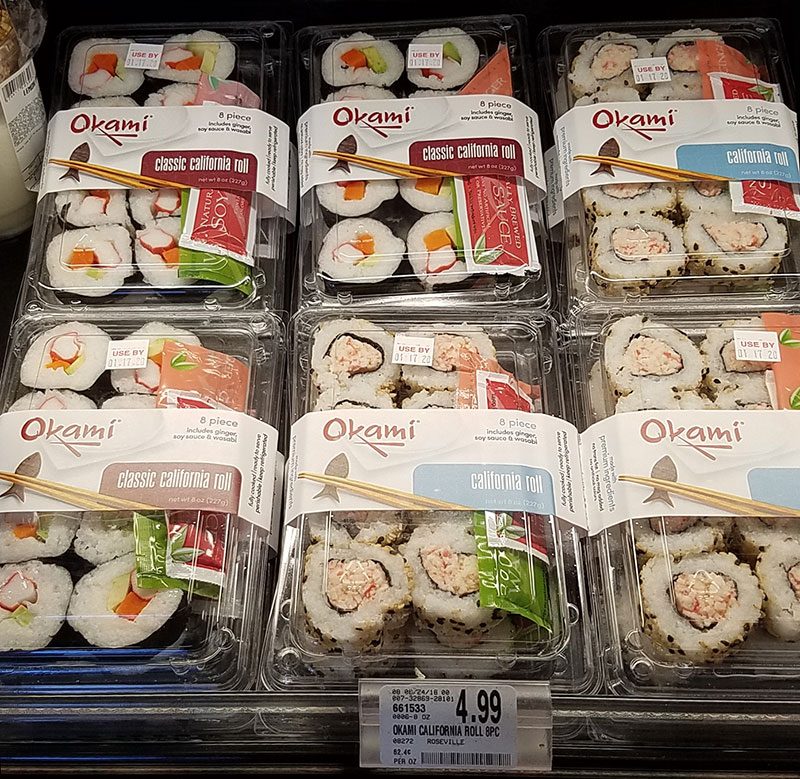
As sushi gains acceptance in the U.S. and other Western nations, it has become available in many supermarkets and even gas station convenience marts. The quality varies greatly depending on who produced the product, as well as the ingredients. Save Mart, a local bargain supermarket, carries Okami brand prepackaged sushi. I have tried this brand twice in the past and was disappointed by the flavor and texture.

Okami prepackaged sushi at Save Mart grocery.

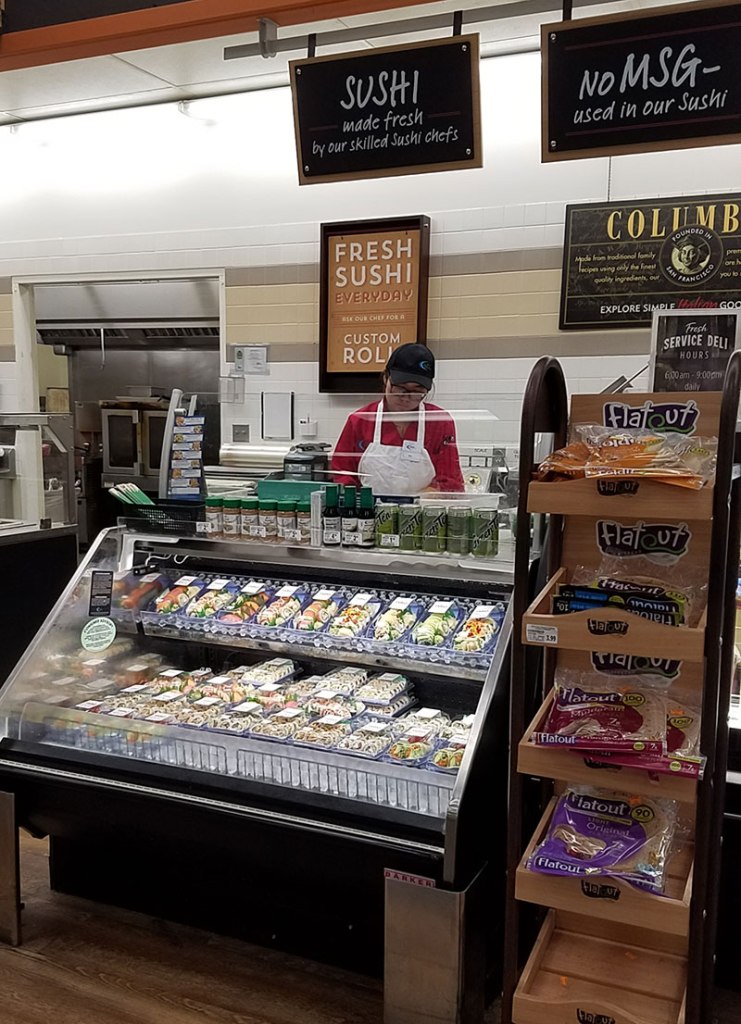
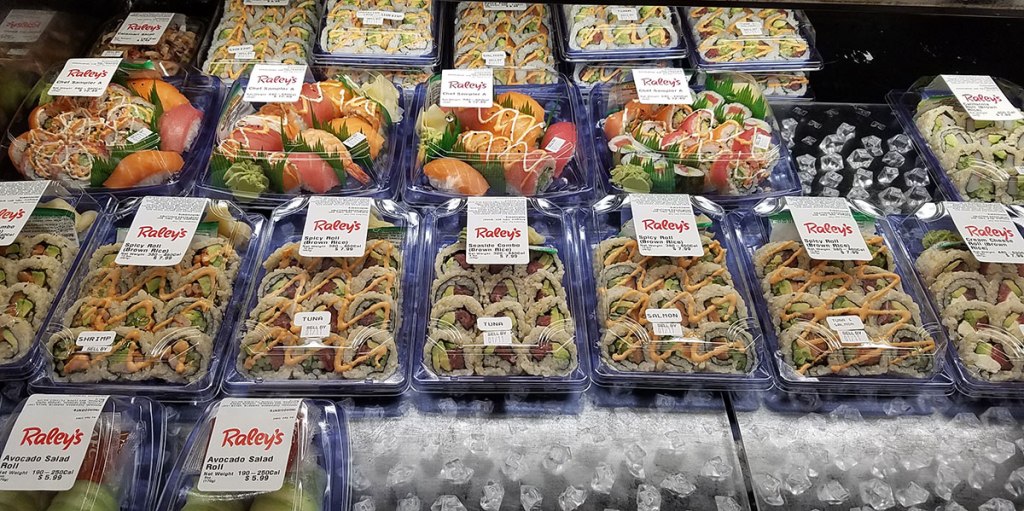
Across the street, the high-end Raley’s supermarket carries a wider selection of sushi freshly made by the in-store sushi chef. I watched as she prepared the day’s product, and she even offered to make anything that wasn’t already available. I didn’t buy anything that day, but I’ve tried Raley’s sushi before and can attest that it looks and tastes the same as sushi I’ve eaten at Japanese restaurants. The prices are about the same as restaurant sushi as well.

Preparing sushi at Raley’s supermarket.
Freshly prepared sushi at Raley’s supermarket.

Boxpark Sushi

Boxpark was inspired by the street-food scene, combining the diversity of Asian street markets with Western mall culture. Although I haven’t personally visited any of the three Boxpark locations, I spent many months in Thailand and other parts of Southeast Asia. The markets and food carts there always had amazing food at great prices, often cooked right in front of you. Combined with live entertainment, eating at the street markets was always a sensory experience. I believe that Boxpark Sushi can be a similar experience. Freshly prepared sushi at a good price, better than most supermarket sushi but a different experience than a sit-down restaurant.

Step 2. Secondary Research

Misconceptions About Sushi

One of the biggest misconceptions that Americans have about sushi is that it’s just “raw fish”. Many confuse sashimi, slices of raw fish, for sushi which is actually vinegared rice topped with other ingredients which may or may not include fish. The use of raw fish in sushi only became possible after the invention of refrigeration. Before then, the fish was preserved by salt and fermentation (Lee, 2019). Many Americans are only familiar with sushi “rolls”, or Maki sushi which is rolled tightly and sliced to form short cylinders. However, there are other types of sushi including Nigiri, shaped rice topped by raw fish, and Uramaki, which is a western style “inside out” Maki roll.

Sushi in America

House (2018) notes that in the 1950s, sushi made the transition from being served at “indigenous” Japanese restaurants serving primarily an intra-ethnic clientele to an “ethnic” cuisine being marketed to non-Japanese. Sushi bars became a staple of Japanese restaurants and played a significant role in increasing the accessibility and popularity of sushi in America throughout the 1960s and beyond.

Sushi Innovations

New creations like the California roll helped sushi gain acceptance, as ingredients like crab and avocado were considered more palatable to white Americans than raw fish (Bhabha, 2013). Other regional innovations include the Philadelphia roll with smoked salmon, cucumber, and cream cheese. More recently, the sushi burrito has gained popularity at fast-casual restaurants. Creator Peter Chen asked, “What would happen if you made a really large sushi roll, operationalized it for speed, and also modernized it by infusing Latin flavors?” (Gabriele, 2019). The resulting hybrid dish combined the flavors and textures of sushi with the convenience and portability of a burrito.

East Side Milwaukee Demographics

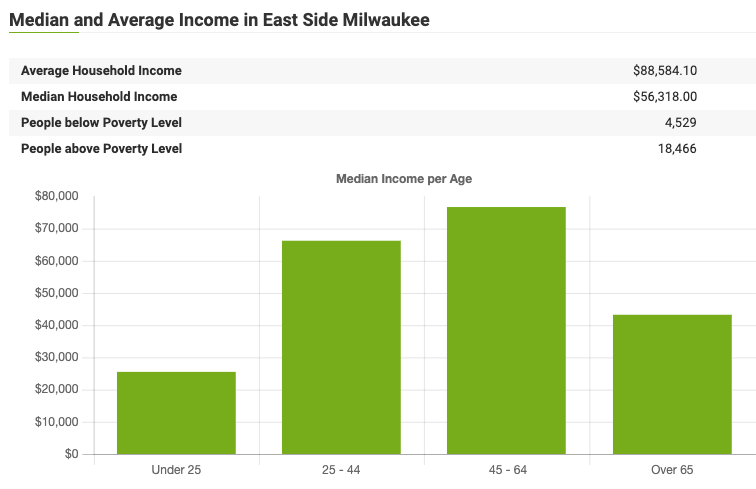
Demographic data gathered from the 2017 American Community Survey revealed interesting information about consumers in East Side Milwaukee. Employment statistics show that there are 92.27% white collar employees compared to 7.73% blue collar employees. Education numbers show that 67% are college educated. Despite the Median Household Income being lower than the Wisconsin state average, East Side Milwaukee consumers between the ages of 25-64 have a higher than average income as illustrated in the chart below.

Median and Average Income in East Side Milwaukee graph

These statistics and other numbers from East Side Milwaukee Demographics (n.d.) suggest that residents of East Side Milwaukee may be more upscale and educated that other urban neighborhoods and therefore more open to cuisine from non-American cultures.

Step 3. Consumer Thoughts

I conducted primary research by interviewing personal acquaintances and by collecting social media responses to the question “Do you like sushi? Why or why not?”

The responses varied greatly, from people who eat sushi often to those who have never tried it and probably never will. Those who enjoy sushi appreciate the “freshness” and “combination of different flavors and textures.” Others eat sushi occasionally because it is “something different” or “reminds me of the ocean.” One person also expressed their love of wasabi, commenting that sushi is one of the few things that goes well with the spicy sauce. Maki rolls, especially Americanized ones like California rolls, are more recognized and popular than other types of sushi. Most of the people I spoke with did not have a favorite sushi, preferring to try something new every time or looking at the menu and trying “whatever looks good.”

People who did not like sushi had either tried it and did not like the taste or had never tried it mostly due to an aversion to raw fish. Negative comments describe the taste as “nasty” and texture as “slimy”. One person said, “seaweed should stay in the ocean” and described sushi rice as “sour”. However, most people who didn’t like sushi focused on uncooked seafood ingredients, confirming my findings on American misconceptions about sushi. Several people expressed concern over contracting “parasites” or “worms” from raw fish and assumed it was part of all of sushi cuisine.

These findings suggest that education about sushi’s various ingredients and food safety could help overcome the common misconceptions that make many Americans hesitant to try sushi. A few people also said that sushi is “too expensive for not enough food,” or “it doesn’t fill you up.” This “filling” aspect of food is something to consider when catering to students and other young Americans.

Step 4. Category

Shipping Container Parks

Boxpark is a food, retail, and entertainment park made of repurposed shipping containers. Roger Wade conceived Boxpark as a “pop up mall,” launching the first park in Shoreditch, England in 2011 (Fry, 2017).  The video below provides a first-person tour of the Shoreditch Boxpark.

Similar container parks have since appeared across the world. Many of these parks feature live entertainment and group dining. Boxpark now has three malls in the U.K., which are distinctive with their black and white branding. Other “cargotecture” shopping centers continue to flourish in urban centers as adaptable public markets (Miller, 2019). Because container parks are largely made of repurposed materials, they are models of sustainability and innovation.

Sushi Bars

Sushi bars let customers order directly from the chef rather than wait staff. The sushi is prepared in front of customers, providing a personalized interactive experience (Grabianowski, 2005). This is very similar to the way street food is enjoyed across the world. The sushi bar model also fits in well with other small and personable eateries in Boxpark shopping centers.

Boxpark Asian Food

The following is a current list of Boxpark eateries that serve Asian food, gathered from the Boxpark website.

Wembley

  • Bun House: authentic Chinese steamed buns, bao and traditional dishes from Hong Kong.
  • Koolcha: stuffed naans, cocktails, biryanis, small plates and Indian beer.
  • Mitsuryu: traditional Japanese cuisine from sushi to curries.
  • Thai Express UK: freshly prepared Thai cuisine with gluten free, vegetarian and halal options.
  • Yamagoya: Japanese ramen and rice dishes.

Croydon

  • Bao Bao Taiwanese Street Food: authentic Taiwanese street food serving traditional bao buns and noodle soups.
  • Camile Thai: healthy Asian and locally sourced Thai food with sustainability in mind.
  • Kubo: authentic mouthwatering recipes all the way from the Philippine islands.
  • The Noodle Bar: authentic noodles with sizzling fresh vegetables, prawns and meats.
  • Thai Express UK: freshly prepared Thai cuisine with gluten free, vegetarian and halal options.
  • Tashi Sushi: Croydon’s finest sushi.

Step 5. Important Takeaways

  1. Sushi quality depends largely on the chef and ingredients, not where it was made.
  2. East Side Milwaukee has a young, educated population that may be more accepting of sushi than the average American.
  3. Boxpark and other container markets combine modern brands and traditional street food.
  4. Negative perceptions of sushi are mainly focused on the raw fish aspect due to health concerns and personal taste.
  5. Maki rolls are more popular with Americans than other types of sushi.
  6. Sushi bars provide a personal, interactive experience for diners.
  7. Many Boxpark restaurants are inspired by regional street food.

References:

Bhabha, L. (2013). The History of Sushi in the U.S. Retrieved from https://food52.com/blog/9183-the-history-of-sushi-in-the-u-s

Burstein, D. (September 28, 2012). Market Competition 101: The 3 Types Of Competitors To Keep An Eye On. Retrieved from: https://rpablog.marketingsherpa.com

East Side Milwaukee Demographics. (n.d.) Retrieved from https://www.point2homes.com/US/Neighborhood/WI/Milwaukee/East-Side-Milwaukee-Demographics.html

Fry, S. (2017). Boxing clever: The firms based in shipping containers. Retrieved from https://www.bbc.com/news/business-38742250

Gabriele, A. (2019). The Origins of the Sushi Burrito: Q&A with the Inventor. Retrieved from https://www.themanual.com/food-and-drink/sushi-burrito-sushiritto/

Grabianowski, E. (2005). At the Sushi Bar. How Sushi Works. Retrieved from https://science.howstuffworks.com/innovation/edible-innovations/sushi2.htm

House, J. (2018). Sushi in the United States, 1945–1970. Food & Foodways: History & Culture of Human Nourishment, 26(1), 40–62. https://doi.org/10.1080/07409710.2017.1420353

Lee, A. (2019). SUSHI. History Today, 69(3), 84–88. Retrieved from http://search.ebscohost.com.oclc.fullsail.edu:81/login.aspx?direct=true&db=a9h&AN=134556318&site=eds-live

Miller, P. (2019). Is cargotecture the future of construction? What you need to know for your next project. Retrieved from https://inhabitat.com/is-cargotecture-the-future-of-construction-what-you-need-to-know-for-your-next-project/

Sushi. (2018). Funk & Wagnalls New World Encyclopedia, 1; Retrieved from http://search.ebscohost.com.oclc.fullsail.edu:81/login.aspx?direct=true&db=funk&AN=su217350&site=eds-live

Design Strategies and Motivation – Week 1 Live Session

The new year and second half of the Media Design MFA program begins with the Design Strategies and Motivation course. In the first week, we read several articles about Design Strategy and two chapters from George Felton’s Advertising: Concept and Copy. We also began a Strategic Development project for a fictional client: a Boxpark sushi shop in East Side Milwaukee.

The Value of Strategic Design

In the week 1 live session, Professor Bartley Argo encouraged us to dive deep into our research of sushi, East Side Milwaukee, and container park malls in order to create the brand. We need to understand what consumers want and why they want it. Argo noted that many companies will already have the business established before they come to a designer, but the design skills and strategies we are learning help build our value. Rosebrook (2017) reaffirms this, saying “A designer who spends time giving insights on how you can solve a business problem with a creative solution will ultimately help you position yourself as more than a pixel pusher.” These problem-solving skills are what separates designers from production artists.

Researching the Client’s Product

The first step of the Strategic Development project is to research the client’s product, in this case sushi. Argo recommended following four prompts from Advertising: Concept and Copy (Felton, 2013).

  1. If possible, use it: wear it, eat it, drive it, drink it, bathe with it, etc. Learn everything about the product firsthand by conducting primary research on YOURSELF as a consumer.
  2. Become its student, learn what’s in it, how it’s made, who makes it, how it works, what its history is, all those things. Learn about the different types of sushi and the history of its use in the USA.
  3. Find out what consumers think about the product. Talk to people like sushi chefs, food critics, and the average person who likes (or dislikes) sushi.
  4. Don’t just focus on your client’s product, learn about the category too. There are many different kinds of sushi prepared in different ways and served by different types of establishments. A wide knowledge of the category helps you find ways to differentiate the product.

Types of Competition

The second step of the Strategic Development project is to research the brand’s competition. Burstein (2012) refers to three types of competitors in the business world:

  1. Direct competitors: brands with similar products that are likely to be used if your client’s product did not exist.
  2. Indirect competitors: brand with similar products but a strong differentiation from your client or in another market segment.
  3. Replacement competitors: brands with very different products that are competing for the same customer’s time and money.

For this project we are focusing mainly on direct and indirect competitors, but it’s good to be aware of all aspects of your client’s marketplace.

References:

Burstein, D. (2012). Market Competition 101: The 3 types of competitors to keep an eye on. Retrieved from https://sherpablog.marketingsherpa.com/marketing/competition-types-to-watch/

Felton, G. (2013). Advertising: Concept and Copy (Third). New York: W.W. Norton.

Rosebrook, D. (2017) What is Design Strategy? Retrieved from https://read.compassofdesign.com/what-is-design-strategy-497453c9d83a

Organizational Structures Mastery Journal

Reflection

The Organizational Structures course provided deep knowledge about the structures of motion, storytelling, and design employment. New skills were developed for both academic and occupational applications. This paper examines each assignment and the resources used to complete the assignment.

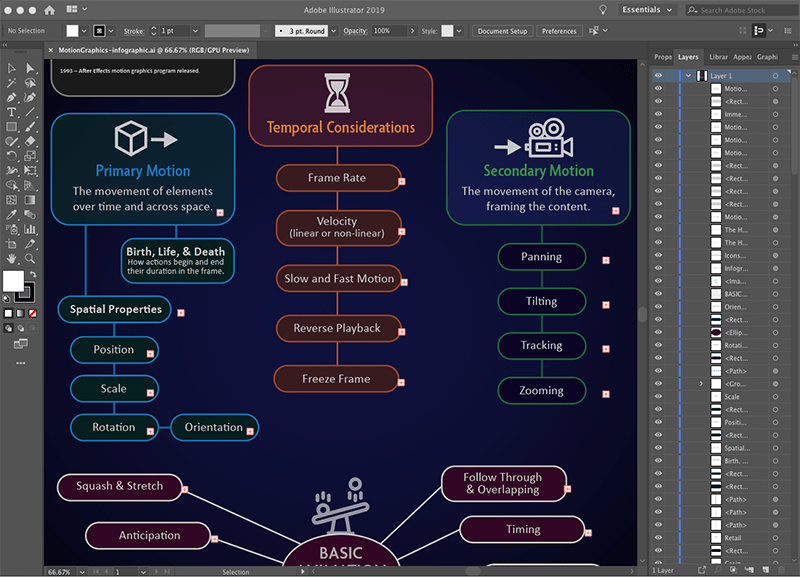
Week one began with research into the structure of motion. Krasner (2013) provided a brief history of motion graphics, examples of motion graphics in public spaces, and the basic concepts of motion literacy including the principles of animation. The first assignment for the week’s mastery journal was to create an infographic based on what we learned from the readings. Tutorial videos by Harmer (2019) demonstrated how to create vector infographics with Adobe Illustrator.

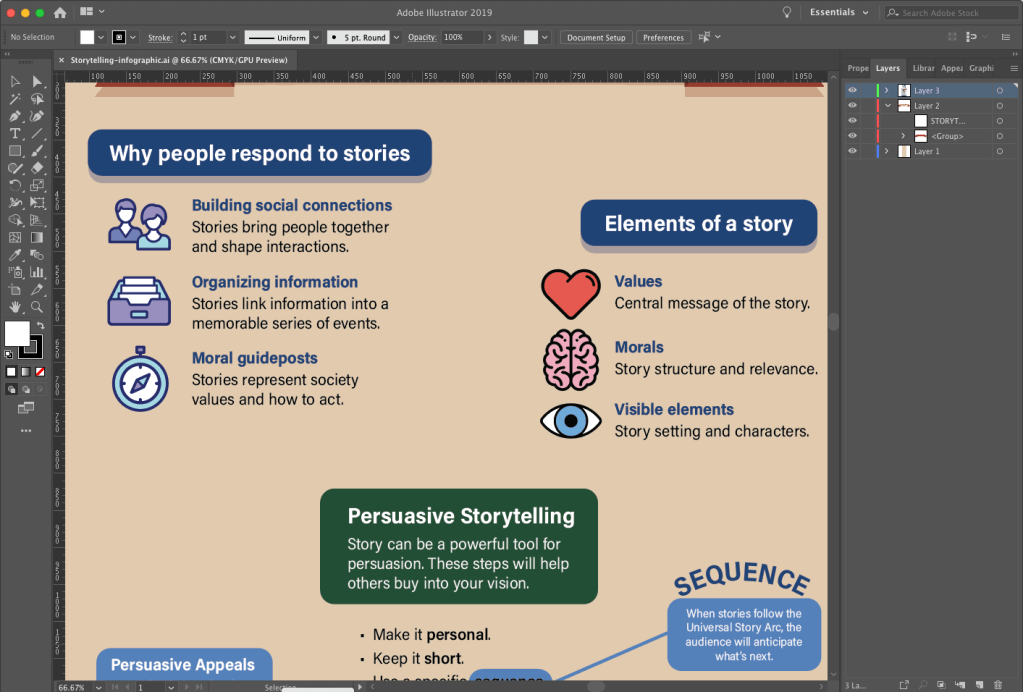
Screenshot of creating an infographic in Adobe Illustrator.

Also in week one, we were assigned groups for a video discussion. Although this discussion would not take place until later in the month, our group connected by email to discuss availability for an online meeting. The purpose of this meeting was to meet our peers and share what we learned in the class.

In week two we researched the structure of storytelling in design. Krasner (2013) described conceptualization in motion design. Huber (2017) supported Krasner’s ideas for creative inspiration and using previsualization techniques like concept sketches and storyboards to develop story ideas. She also provided insight on storytelling with video, from preproduction to post-production. The assignment for this week’s mastery journal was to create another infographic based on what we learned from the readings.

Screenshot of creating an infographic in Adobe Illustrator.

Week two also contained an After Effects Design Challenge to demonstrate our motion graphics skills. Video tutorials from Robinson (2019) imparted new knowledge and skills within Adobe After Effects like using the Graph Editor to make keyframed movements smoother and more natural.

Screenshot of creating a motion design in Adobe After Effects

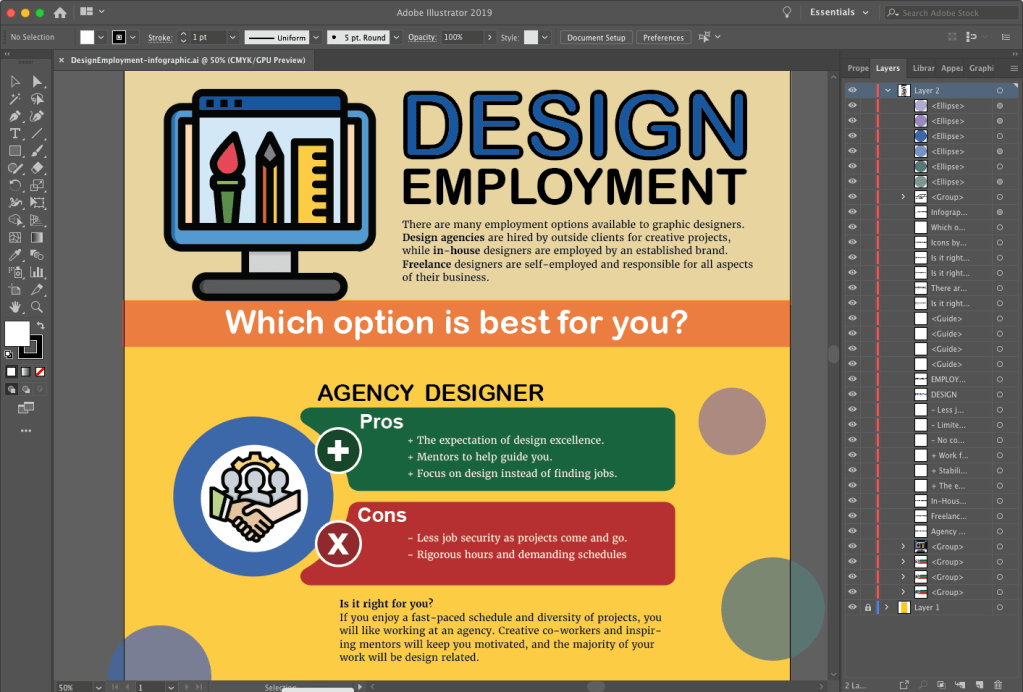
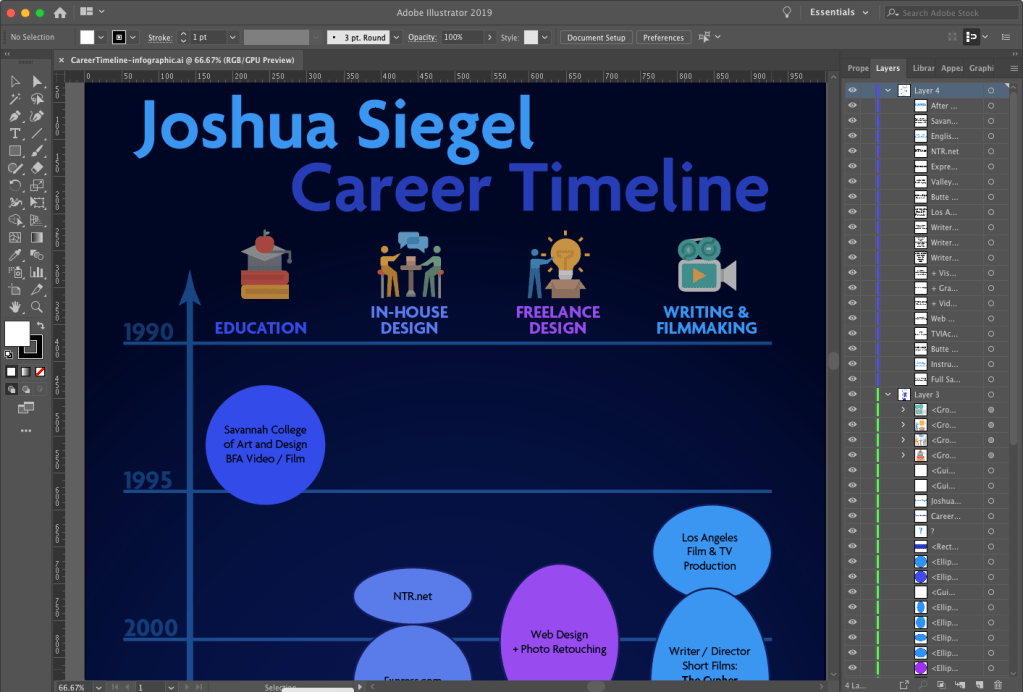
In week three we researched the structure of design employment. Articles by Flavin (2017), Castillo (n.d.), and others described the pros and cons of working in-house, with a design agency, and freelance. This information was used to create another infographic for the mastery journal. In addition to this infographic outlining what we learned about design employment, we created a visual timeline of our employment in the different employment sectors.

Screenshot of creating an infographic in Adobe Illustrator.
Screenshot of creating a timeline infographic in Adobe Illustrator.

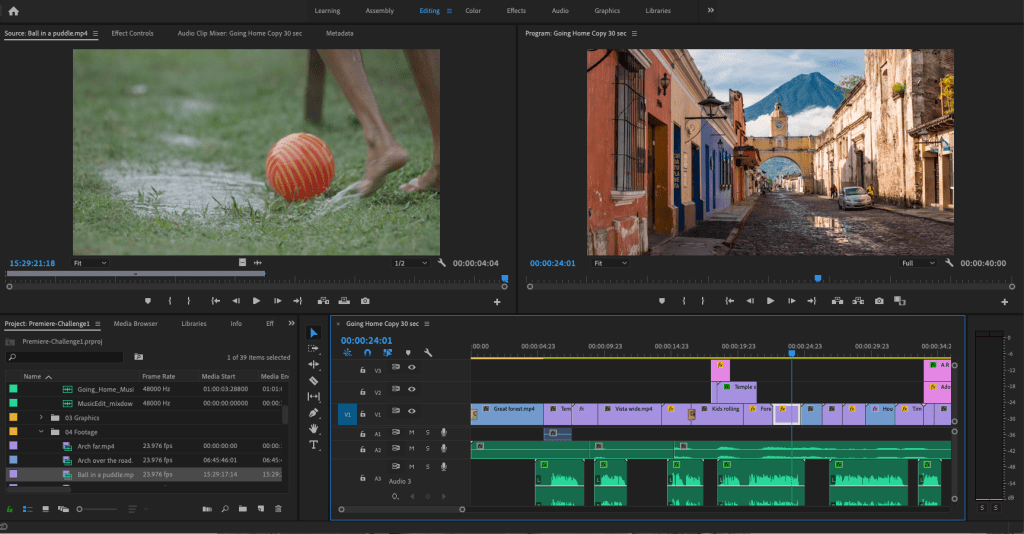
Also in week three, we completed a Premiere Pro design challenge. The “Going Home” video used by Jago (2017) as an example in the Adobe tutorials was a good demonstration of Premiere’s tools. I edited a forty second video using the music, voiceover, and footage provided in the tutorial sample files.

Screenshot of editing video in Adobe Premiere Pro.

For week four’s design challenge, students were given the choice of creating a Kinetic Typography animation, three Cinemagraphs, moving Parallax Images, or a Motion Poster. I created the cinemagraphs in Photoshop, following tutorials from Duggan (2016).

Screenshot of creating a cinemagraph in Adobe Photoshop.

Week four imparted the academic knowledge and practice of creating an annotated bibliography. We learned that the annotated bibliography is not a summary. Instead, it is an analysis of the central theme and scope of the article or book. The six sources of motion and storyboarding information researched for this assignment are useful resources for future courses.

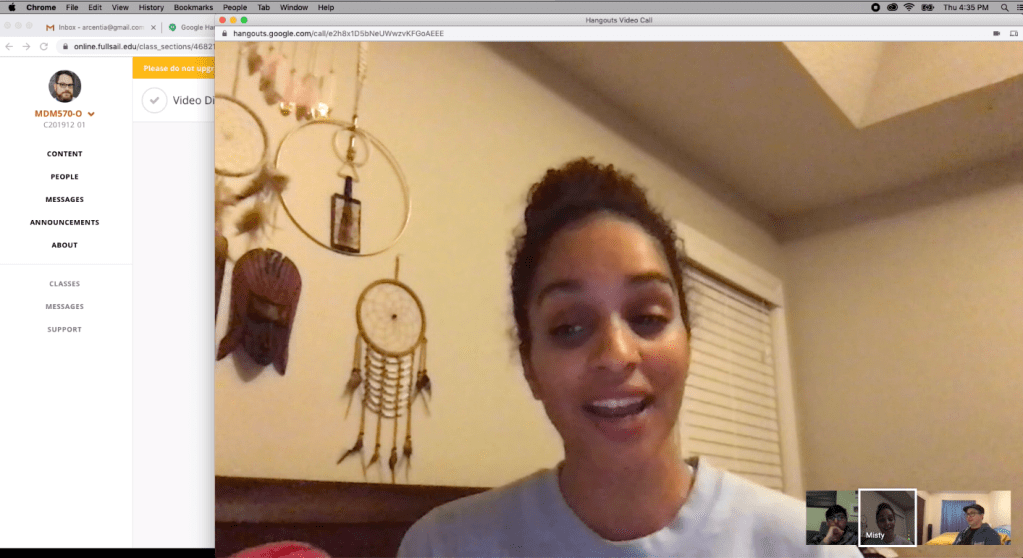
The video discussion arranged in the first week took place on Thursday, December 19. Our group discussed the assignments and learning materials, as well as sharing examples of motion design storytelling in real-world applications like motion posters for films. The meeting effectively wrapped up our experience in Organizational Structures by sharing with our peers.

Video discussion screenshot.

Connecting/Synthesizing/Transforming

This month’s research and assignments imparted a great deal of information, both conceptual and technical. Krasner (2013) provided a wide perspective on the history, concept, and techniques of motion design. He emphasized that storyboards are a valuable tool for conceptualization and ideation, in addition to outlining a story in the preproduction stage. Huber (2017) supported the importance of developing stories with previsualization tools like concept sketches and storyboards.

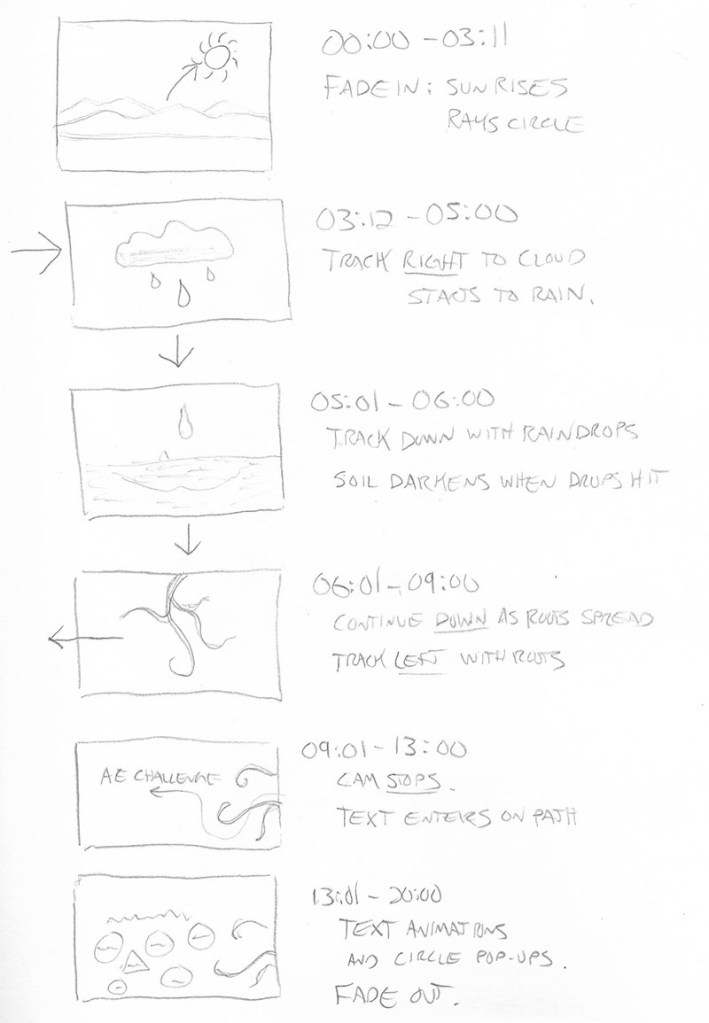
For the After Effects design challenge, I used storyboards to plan, plot, and time my motion graphic.

I transformed this knowledge into a 20-second animation that follows the movements of nature (a rising sun, falling rain, and growing roots) to illustrate the Principles of Animation created by Disney animators and explained by Krasner (2013). While creating the motion graphic, I consulted LinkedIn Learning tutorials by Robinson (2019) for technical ways to make animations follow the principles more closely. This research revealed how to use easy ease key-framing and the graph editor to make movements smoother and more organic.

Problem Solving

One design problem I resolved this month was the pacing of the Premiere Pro design challenge video. The “Going Home” promo video edited by Jago (2017) as an example in the Adobe tutorials was a good demonstration of Premiere’s tools, but the pace of the 60-second edit felt very slow and plodding compared to the upbeat music and imagery. I first created a 30-second edit that was too fast-paced, so I tried another 40-second cut. This edit contained all the information of the example video, but with a pace and run-time more appropriate for the short attention spans of social media.

Innovative Thinking

This month I created my first infographics and cinemagraphs. Although I am proud of my first efforts, they do not yet compare to the work of professional designers. Much more practice and experimentation are needed to get to that level. My video editing and motion design skills are more developed, but still need much improvement.

Creating my first cinemagraphs required going outside my comfort zone to work with video in Photoshop. The first two were relatively straight forward, but the Hawaii postcard cinemagraph was more challenging because there was no easy way to make the video loop. Instead, I used time remapping to make the video bounce back and forth in time. While not very realistic, this “ping-pong” type motion is used in many animated GIFs that are shared on social media.

Acquired Competencies

The following are concepts, skills, or new resources learned in the Organizational Structures course. They are categorized as Academic (pertaining to school work) or Occupational (pertaining to work in the Media Design field), and Technical (pertaining to software or other design skills) or Conceptual (new terminology, procedures, or ideas).

Academic

TechnicalConceptual
A story’s theme is its underlying message.

A story’s tone should align with its audience, its values, and its message.

Story Elements: Values: central message of the story. Morals: story structure and relevance. Visible elements: story setting and characters.

Logline: a one sentence summary that conveys the central message of the story.

A creative portfolio is not about showing 20 decent pieces, it’s about showing 5 great pieces.

Motion Graphics in Public Spaces: LED technology makes large public displays more interactive and purpose driven.

Motion Graphics in Film, Television, and Interactive Media: Animation can entertain, inform, and drive audience participation by combining traditional graphic design with the visual language of film.

BENSOUND is an excellent resource to find royalty-free music for motion graphics and video presentations.

AIGA: the professional association for design offers resources for students and professional designers.
Precursors of Animation: Multiple optical devices used the persistence of vision phenomenon to achieve early forms of animation.

Early Cinematic Inventions: Animation evolved with motion pictures in many forms including stop-motion and cell animation.

Experimental Animation and Innovators: Animators create new techniques for motion design and pure artistic expression.

Aristotle’s Three Persuasive Appeals: Ethos – The credibility of the speaker or story. Logos – The logic of a story’s message. Pathos – The emotional engagement of the audience.

Synaesthesia: a merging of senses (ie: hearing colors).

Causal Reasoning: the process of identifying relationships between a cause and a corresponding event.

Designs can be “hacked” by repurposing existing images and ideas.

Communication skills and availability are essential for freelancers.

Mentors can often be found at design agencies.

Occupational

TechnicalConceptual
Principles of Animation: The basic language of how objects move was established by Disney animators and described in the book The Illusion of Life by Frank Thomas and Ollie Johnston (1995).

Materials: real-world textures, materials, and found objects can provide inspiration and add authenticity to design.

Audience Segmentation:  analyzes audience characteristics including demographics, psychographics (i.e., personality), and firmographics (or business setting).

Affective Primer: the process of manipulating the emotions of an audience before the message is delivered. 

Creating Adobe Illustrator Infographics: Adobe Illustrator, Microsoft Excel, and other programs provide many tools for creating data-driven illustrations.

Adobe After Effects Graph Editor adjusts motion keyframes for more realistic, organic animations.

Lumetri Color panel allows for easy color grading within Adobe Premiere.

Essential Sound panel lets you improve sound quality within Adobe Premiere.

Cinemagraphs are still photographs that contains a small moving element.
Universal Sequence or story arc:
Set up – Establishes time, place, and characters.
Tension point – A problem or challenge is presented.
Turning point – A possible solution or twist is introduced.
Resolution – The conclusion reinforces the core message.

Pictorial Continuity: cohesion in content and style of visuals.

Sequential Continuity: logical flow of events between frames.

Primary (Object) Motion: Animation of an element’s spatial properties and how it moves over time and across space.

Secondary (Camera) Motion: Movement of the camera and how it frames the content.

Temporal Considerations: Linear movements mimic mechanical devices, while non-linear movements are more natural. Techniques such as slow motion and reverse playback can alter the sense of time.

In-house designers must be proactive, otherwise they are just following orders.

The primary role of in-house designers is explaining the brand to consumers.

Freelance designers can often pick up jobs from overloaded design agencies.

It’s important to be aware of current design trends and knowledgeable of graphic design from the past.  

References:

Castillo, R. (n.d.). In-house, agency, or freelance—what’s right for me? Retrieved from https://www.aiga.org/aiga/content/inspiration/in-house-agency-or-freelancewhats-right-for-me/

Duggan, S. (2016, April 6). Creating a Cinemagraph in Photoshop. LinkedIn Learning. Retrieved from https://www.lynda.com/Photoshop-tutorials/Create-Cinemagraph-Photoshop/471669-2.html?org=fullsail.edu

Flavin, B. (2017, July 24). Where Do Graphic Designers Work? In-House vs. Agency vs. Freelance. Retrieved from https://www.rasmussen.edu/degrees/design/blog/where-do-graphic-designers-work/

Harmer, T. (2019, July 19). Illustrator Infographics. LinkedIn Learning. Retrieved from https://www.linkedin.com/learning/creating-illustrator-infographics/illustrator-infographics?u=50813145

Huber, A. (2017). Telling the Design Story. Focal Press. Retrieved from https://learning.oreilly.com/library/view/telling-the-design/9781351849210/

Jago, M. (2017, September 20). Create a project and import a clip. Retrieved from https://helpx.adobe.com/premiere-pro/how-to/create-project-import-media.html

Krasner, J. (2013). Motion graphic design. Applied history and aesthetics. 3rd, rev. ed. Oxford: Focal Press. Retrieved from https://learning.oreilly.com/library/view/motion-graphic-design/9780240821139/

Robinson, I. (2019). After Effects: Principles of Motion Graphics. LinkedIn Learning. Retrieved from https://www.linkedin.com/learning/after-effects-principles-of-motion-graphics-2/custom-speed-changes?u=50813145

Thomas, F., & Johnston, O. (1995). The illusion of life: Disney animation. New York: Hyperion.

Organizational Structures – Week 4 Live Session Response

Augmented Reality

Meron Gribetz’s demonstration of the Meta 2 headset show some of the possible applications for augmented reality (AR). AR puts a layer of information on the real world, allowing users to interact with virtual objects and data. Designers should “imagine how we can create this new reality in a way that extends the human experience, instead of gamifying our reality or cluttering it with digital information” (Gribetz, 2016).

Gribetz introduces three key concepts for making AR a tool that extends our bodies:

  1. Neural Path of Least Resistance: You are the operating system, using spatial memory instead of traditional file systems.
  2. Touch to See: Proprioception, the sense of our body parts in space, lets us understand our work more directly by touching it.
  3. The Holographic Campfire: You can interact socially if people can see and work on the same virtual objects.

Composing Movement

Akira Kurosawa was a master filmmaker whose work has inspired many directors and cinematographers. The Youtube video from Every Frame a Painting demonstrates how Kurosawa captured movement on-screen to tell stories that are visually stimulating.

  1. The movement of Nature: Often in the background, the movements of water and other natural elements add emotion to a scene.
  2. The movement of Crowds: Reaction shots of numerous people sharing an emotion amplifies that emotion.
  3. The movement of Individuals: Every character has a distinct way of moving.
  4. The movement of Camera: Every move has a beginning, middle, and end that moves the audience through the scene.
  5. The movement of the Cut: Editing can give a rhythm of movement to a scene.

Knowing When to Cut

Film and video editing is largely instinctual, but the Youtube video from Every Frame a Painting provides advice on how to judge a shot and knowing when to cut to the next shot. Actors’ eyes tell you the emotion of the scene. Good actors can do this nonverbally. Think about how much time do I give this emotion? The audience needs time to feel and share the emotion. There is a rhythm to traditional Hollywood editing. It should happen so naturally that you don’t even notice it. Cutting against a rhythm can be disturbing, which can help add drama or emotion.

References:

Every Frame a Painting. (2015, March 19). Akira Kurosawa – Composing Movement [Video file]. Retrieved from https://www.youtube.com/watch?v=doaQC-S8de8

Every Frame a Painting. (2016, May 12). How Does an Editor Think and Feel? [Video file]. Retrieved from https://www.youtube.com/watch?v=3Q3eITC01Fg

Gribetz, M. (2016). A glimpse of the future through an augmented reality headset. TED2016. Retrieved from https://www.ted.com/talks/meron_gribetz_a_glimpse_of_the_future_through_an_augmented_reality_headset

Cinemagraph Design Challenge

For this week’s design challenge, we were given the choice of creating a Kinetic Typography animation, three Cinemagraphs, moving Parallax Images, or a Motion Poster. I chose to create the Cinemagraphs because I had never created this type of design before.

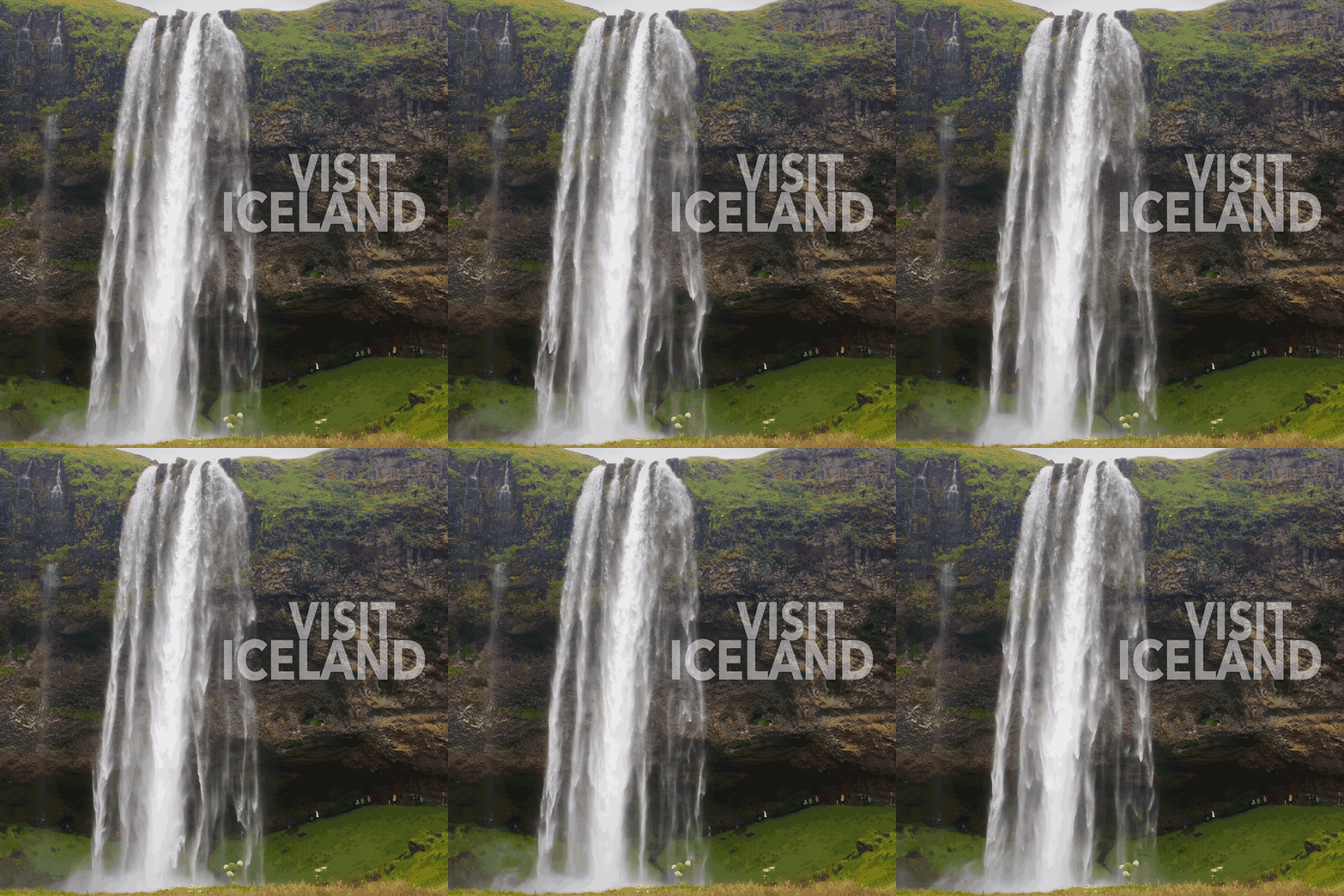
Iceland cinemagraph

Connecting, Synthesizing, Transforming

First created in 2011 by digital artist Kevin Burg and photographer Jamie Beck, cinemagraphs are still photographs that contains a small moving element. Animated GIFs have become a popular image format on social media, and cinemagraphs are considered “animated GIF for adults” (Mevorah, 2017).

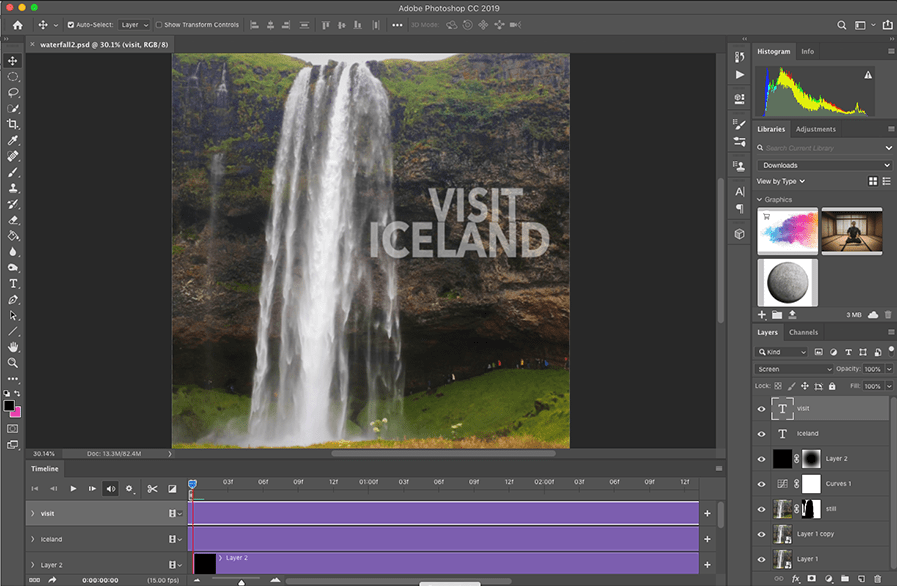
Normally, I do the majority of motion designs in Adobe After Effects, but I wanted to try using Photoshop’s video tools for this project. Duggan (2016) describes how to create a cinemagraph in Photoshop using layer masks and looping videos. His tutorials on LinkedIn Learning helped me create three cinemagraphs and export the animated GIFs. Popa (2018) provided additional information on how to optimize the file size of animated GIFs to reduce the load time.

Night Life cinemagraph

Solving Problems

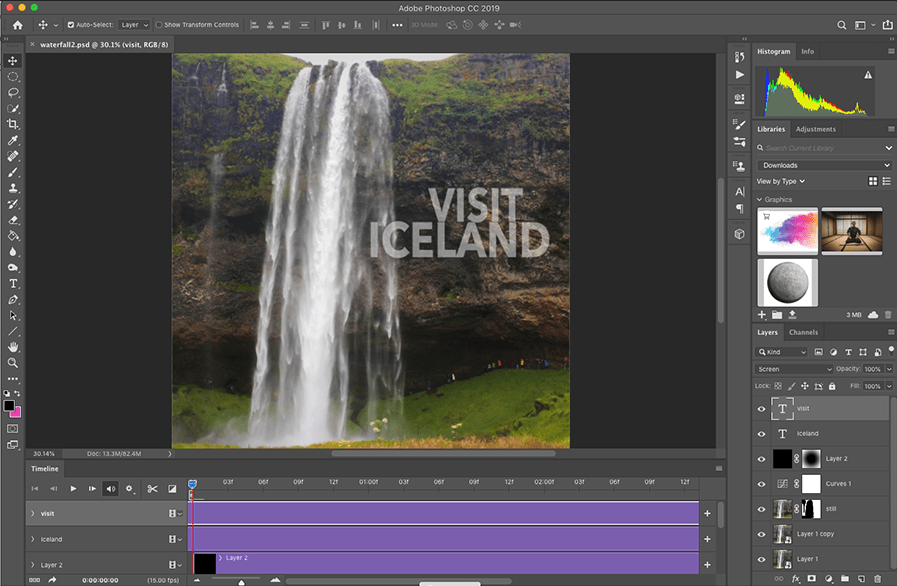
I started by downloading royalty free stock videos from Videezy. For each cinemagraph, I imported the video file into Photoshop and changed the aspect ratio (frame size) to a square. Next, I looped the video by splitting it and adding a cross dissolve to hide the edit. I chose the best still frame and freeze framed it on a layer above the video. After selecting the part of the image that would show motion, I created a mask on the still layer to reveal the video below it.

To make each cinemagraph feel like a piece of content marketing, I added text with the opacity set to screen mode so it was semi-transparent. The final step was exporting full-sized MP4 videos and web-optimized animated GIFs. I was able to do all of this within Photoshop, making the workflow more efficient than using multiple applications.

Hawaii cinemagraph

Innovative Thinking

The Hawaii cinemagraph was the most challenging because there was no place to smoothly loop the video. Instead, I used time remapping to make the video bounce back and forth in time. While not very realistic, this “ping-pong” type motion is used in many animated GIFs that are shared on social media.

Acquiring Competencies

Although I was somewhat aware of Photoshop’s video features, I was more accustomed to working in After Effects. This design challenge taught me the benefits of working with video in Photoshop, especially for content marketing projects. I had seen many cinemagraphs online, but I did not know that the medium had a name, who had created it, or how it could be used in both advertising and fine art.

Photoshop screenshot

Reflection

I’m glad I decided to create the cinemagraphs, because it was a very new experience. I will definitely create more in the future, as content marketing for clients and as personal creative exercises. I would like to try animating elements of classical paintings that are in the public domain. Many of the same techniques can be used for creating motion posters. Although I didn’t create a poster for this challenge, I plan to do so for any future film projects.


References:

Duggan, S. (2016, April 6). Creating a Cinemagraph in Photoshop. Retrieved from https://www.lynda.com/Photoshop-tutorials/Create-Cinemagraph-Photoshop/471669-2.html?org=fullsail.edu

Mevorah, V. (2017, May 21). What is a Cinemagraph? Retrieved from https://www.widewalls.ch/cinemagraph/

Popa, G. (2018, July 19). 6 Incredibly Simple Tricks to Reduce the Size of your Animated GIFs. Retrieved from https://blog.bannersnack.com/reduce-the-size-animated-gifs/

Organizational Structures – Week 3 Live Session Response

Human Centered Design.

IDEO’s David Kelley talks about including behaviors and personalities in taking a more human-centered approach to design. Kelly notes that the hardware has become less important than the user experience when designing products. As a result, “Designers are more trusted and more integrated into the business strategy of companies” (Kelly, 2002). Master Designers should have a broad knowledge of many fields, including psychology. By including human behavior and target audience personalities in our design process, we create more effective solutions.

The Long Goal of Design

Too often, designers are focused on the short goals of a project: establishing a style, creating graphic elements, etc. Michael Bierut’s talk at TEDNYC reminded me of the importance of the long goal. How will this design change someone’s life?

“I was just focused on a foot ahead of me, as far as I could reach with my own hands. Instead, way off in the distance was a librarian who was going to find… a source of inspiration so that she in this case could do her work really well…” (Bierut, 2017).

The long goal may be a mystery at the start of the process, but Bierut’s story of how the murals of children inspired the librarian is a good reminder of why design is all about building human connections.

Week 4 Assignments

The Mastery Reflection assignment opened early to help us get started. Dr. Baldowski recommends that we focus on academic writing and answering all the questions in detail. The reflection demonstrates our understanding of material and concepts presented this month. Categorizing the overview helps us organize the information and reflect on what we learned.

The Annotated Bibliography helps us find new sources of information and evaluate those sources. The 150-word analysis of each source is not a summary. Instead, it is a description of the central theme and scope of the article or book. The Cornell University Library (n.d.) recommends that authors “Include one or more sentences that:

  1. evaluate the authority or background of the author
  2. comment on the intended audience
  3. compare or contrast this work with another you have cited, or
  4. explain how this work illuminates your bibliography topic.”

We will refer to the annotated bibliography in future classes, so I look forward to taking on this project.

References:

Bierut, M. (2017). TEDNYC How to design a library that makes kids want to read. Retrieved from https://www.ted.com/talks/michael_bierut_how_to_design_a_library_that_makes_kids_want_to_read

How to Prepare an Annotated Bibliography: The Annotated Bibliography. (n.d.) Cornell University Library. Retrieved from https://guides.library.cornell.edu/annotatedbibliography

Kelley, D. (2002) TED2002 Human-centered design. Retrieved from https://www.ted.com/talks/david_kelley_human_centered_design