Strategic Development parts 3-4

Strategic Development part 3: Understanding Consumer Behavior

Maslow’s Hierarchy of Needs

Theodore Levitt said, “Products are problem-solving tools” (Felton, 2013). When somebody buys a new jacket, they are not just looking to stay warm. They are also buying a status symbol that raises their esteem. A good product can solve multiple problems if we understand the human needs that must be addressed. Psychologist Abraham Maslow described a “hierarchy of needs” in human beings that start with low level physiological needs like hunger that must be met first before ascending to higher-level psychological needs like love and esteem (Felton, 2013).

Here are a few ways that Boxpark Sushi can respond to these needs.

1. Physiological needs: hunger, thirst, warmth, pain avoidance, sexual release, and others.

  • Boxpark Sushi satisfies hunger and thirst with delicious food and beverages.

2. Safety needs: housing, clothing, financial and physical security.

  • Customers should be reassured about the safety of consuming raw seafood. Cooked and non-seafood options should be available, along with a “freshness guarantee”.
  • Boxpark’s container stores might be claustrophobic for some customers. An open layout with lots of daylight can make the restaurant more comfortable.

3. Love and belongingness needs: social acceptance and personal intimacy.

  • Customers are part of the sushi tribe, a select group according to a survey (Shelby, 2015) that found that 45% of people in the U.S. Midwest have never tried sushi.
  • Diners are treated like a friend by their sushi chef, a “sushi sensei” who can educate the diners while preparing their food.
  • Boxpark is a small, community-based shopping experience. Live entertainment and common dining areas improve public interactions.

4. Esteem needs: feelings of adequacy and achievement, approval, prestige, social status

  • Sushi eaters are considered more sophisticated and cultural than the average Joe.
  • Learning about and trying different kinds of sushi is an achievement.
  • Sushi is often eaten at celebratory occasions.

5. Self-actualization needs: the need to understand, cognitively and aesthetically; the ultimate integration of the self and realization of one’s highest inner potential.

  • For some people, eating sushi can be a spiritual experience. The artistry and culture of sushi makes it more than just a quick meal.
  • East Side Milwaukee is located near the University of Wisconsin Green Bay – Sheboygan Campus. Eating sushi while attending college lets students expand their culinary horizons while preparing for their future.

Settle and Alreck’s Shopping List of Needs

Robert Settle and Pamela Alreck expanded on Maslow’s hierarchy with their own shopping list of human needs (Felton, 2013). Unlike Maslow’s list, these needs are not presented in the order of which they should be addressed.

Achievement: the need to perform difficult tasks, exercise one’s skills.

  • According to a survey by Pei Wei (Shelby, 2015), 11 percent of sushi eaters consider themselves a “black belt” in sushi eating and 27 percent of sushi eaters consider themselves a “white belt” in sushi eating. This suggests that the more sushi the customer has tried, the greater sense of accomplishment.

Independence: the need to be autonomous, have options, be different.

  • Many people enjoy the freedom of options with the “build your own” meals from chain restaurants like Subway and Chipotle. The central Florida chain Sus Hi Eatstation does the same for casual Asian food with customizable sushi roll, bowls, and burritos. Letting diners craft their own meal helps them feel independent.

Exhibition: the need to gain public attention, show off, be noticed.

  • Successful brands have a lot of interaction with their customers, on social media and in real life. Promotions and in-store events let customers show off their love of the brand. For example, Sus Hi Eatstation offered free sushi to diners who dressed like a ninja on International Ninja Day (White, 2019).

Recognition: the need to be highly regarded by others, to be held up as a good example.

  • Boxpark Sushi menu items could be rated with a system based on karate’s colored belts. Accessible, American items like California rolls would be rated “white belt”, while sushi with more unusual ingredients like Natto (fermented soybeans) and Nama-shirasu (immature sardines) would earn eaters a coveted “black belt” (Joy, 2017).

Dominance: the need to exercise power over others, direct and supervise, have influence.

  • Sus Hi Eatstation tells customers to “master their meal” by customizing the ingredients. This choice of wording appeals to the need for dominance.

Affiliation: the need to be closely associated with others, the need for relationships.

  • Frequent sushi eaters are part of the sushi “tribe”, a select group of enthusiasts who can share their knowledge and love of sushi.
  • Group dining areas in the Boxpark mall encourage interaction with other diners.

Nurturance: the need to provide care for others, to have and protect.

  • Many restaurants give back to the community by supporting charities and local school fundraisers. Customer participation in these efforts fulfils the need for nurturance.

Succorance: the need to receive help from others, be comforted, be encouraged and supported.

  • According to a survey by Pei Wei (Shelby, 2015), 30 percent of first-time sushi eaters had someone help them order. Boxpark Sushi chefs can provide this kind of education and reassurance to help people feel more comfortable trying something new.

Sexuality: the need to establish and develop one’s sexual identity, be sexually attractive, give and receive sexual satisfaction.

  • Can sushi be sexy? The Japanese practice of nyotaimori, serving sushi on a nude model’s body, originated in the samurai period (Scalza, 2014). “Body sushi” is a controversial practice that some consider degrading to women, yet it is still practiced in Japan and by private catering companies in the West.

Stimulation: the need to stimulate the senses, pursue vigorous activity, engage the mind and body, stimulate the palate, be active.

  • Sushi stimulates the palate with interesting flavors and textures.
  • Boxpark Sushi chefs interact with customers, engaging their minds.

Diversion: the need to relax, have fun, escape from routines, be entertained.

  • For many, sushi is eaten at celebratory occasions like birthdays and anniversaries. The experience is entertaining and engaging, a chance to have fun with friends and family.
  • Boxpark malls are modern and hip, the perfect place for hanging out with friends and meeting new people.

Novelty: the need to alter routine, be surprised, acquire new skills, have new and different experiences.

  • There are many types of traditional sushi, and even more recent innovations in Western style sushi. Every visit to Boxpark Sushi provides an opportunity for diners try something new.

Understanding: the need to comprehend, teach and learn, discover patterns, make connections.

  • Sushi is more than a food. In its highest form, it is an art that is appreciated the more it is studied. Learning more about sushi with each visit to Boxpark Sushi appeals to the need for understanding.

Consistency: the need for order and cleanliness, to control uncertainty and avoid ambiguity, make accurate predictions.

  • Consistency is highly valued by many restaurant eaters, which is one of the reasons fast food chains like McDonalds are so popular with Americans. A Big Mac bought in Florida is identical to one bought in Nevada. Boxpark Sushi can also deliver consistent food but with a more personal, upscale experience.

Security: the need to be free from fear, feel safe and protected, avoid accidents, acquire assets.

  • Customers should be reassured about the safety of consuming raw seafood. Cooked and non-seafood options should be available, along with a “freshness guarantee”.
  • Boxpark’s container stores might be claustrophobic for some customers. An open layout with lots of daylight can make the restaurant more comfortable.
  • Upper East Side and Lower East Side Milwaukee have high crime statistics (Areavibes, 2018), so special efforts should be made to ensure the safety of Boxpark visitors.

References:

Areavibes. (2018). Milwaukee, WI Crime. Retrieved from https://www.areavibes.com/milwaukee-wi/crime/

Felton, G. (2013). Advertising: Concept and Copy (Third). New York: W.W. Norton.

Joy, A. (2017, October 29). 10 Unusual Sushi Toppings You’ll Learn to Love. Retrieved from https://theculturetrip.com/asia/japan/articles/10-unusual-sushi-toppings-youll-learn-to-love/

Scalza, R. (2014, September 6). Naked Sushi Makes Waves in Vancouver. Retrieved from https://www.insidevancouver.ca/2014/09/06/naked-sushi-makes-waves-in-vancouver/

Shelby Food Service. (2015, March 24). Pei Wei Releases Sushi Survey Results, Adds New Rolls. Retrieved from https://www.keltonglobal.com/recognition/pei-wei-releases-sushi-survey-results-adds-new-rolls/

White, B. (2019, December 2). Celebrate International Ninja Day With Us And Score Free Sushi!Retrieved from https://sushieatstation.com/celebrate-international-ninja-day-with-us-and-score-free-sushi/

Strategic Development part 4: Analyzing the Marketplace – Segmentation

Demographics

Gender: Sushi appeals to all genders, although a survey by Pei Wei (Shelby, 2015) suggests that American males are more likely than females to have tried sushi.

Age: 25-35. The survey by Pei Wei (Shelby, 2015) reports than 84 percent of 18-34-year-olds have tried sushi, while only 50 percent of seniors (age 65+) have tried it. The median age of East Side Milwaukee is 29.3 years (City-Data).

Location: East Side Milwaukee, Wisconsin.

Mobility: Car. Demographics of East Side Milwaukee gathered from the 2017 American Community Survey (Point2Homes) report that the vast majority of East Side residents use an automobile as their primary means of transport.

Income: $66,000 Median Household Income is reported for ages 25-44 in East Side Milwaukee (Point2Homes).

Expenditures: The U.S. Bureau of Labor Statistics (2019) reports that American consumers spent an average of $3,459 on food away from home in 2018, up 2.8 percent from 2017.

Occupation: White collar – technical, sales, and office occupations (City-Data).

Education: College graduate – over 50 percent of East Side Milwaukee residents have a Bachelor’s or Graduate Degree (Point2Homes).

Nationality: Primarily American. 89 percent of East Side Milwaukee residents are U.S. born citizens (Point2Homes).

Religion: 71 percent of East Side Milwaukee residents are Christian and 25 percent are non-religious (Pew Research Center).

Family Status: Single, no children. Over 55 percent of East Side Milwaukee residents have never married (Point2Homes) and parents are less likely bring their children to sushi restaurants that other types of food establishments with a kid’s menu.

Psychographics

The psychographic profile below is based on my personal experiences with friends, family, and associates who enjoy sushi on a regular basis.

Attitudes: Multicultural and open to new foods and experiences.

Opinions: Concerned about the environmental impacts of their food choices.

Habits: Exercises regularly and tries to maintain a healthy diet.

Personality: Friendly and outgoing. Interested in new experiences.

Lifestyle: Into physical fitness but not obsessed. Works hard during the week and cuts loose on the weekends.

Hobbies: Art, running, and yoga. Enjoys travelling to exotic destinations.

Buying Behavior

1. When:

  • Usage Rate: Sushi is primary eaten for lunch or dinner, and few sushi restaurants are open before 11AM. Some aficionados eat it weekly, but most diners it is eaten less often.
  • Readiness Stage: People are aware of sushi, but many who haven’t tried it are stuck on the “raw fish” aspect. Container malls are less familiar to Americans, but the concept has caught on in cities across the world.

2.  What:  Eating healthy food in a hip, urban setting. Boxpark is a place to hang out and shop, not just eat and go.

3. Why: 

  • Loyalty status: Low, even among sushi eaters. Good sushi is available from several restaurants in East Side Milwaukee, but the none in a mall-like setting where customers can do other shopping.
  • Attitude toward product: Positive among sushi eaters. Negative or cautious among consumers with “stuck points” like raw fish, eating with chopsticks, and unfamiliar words.

References:

City-Data. (n.d.) East Side neighborhood in Milwaukee, Wisconsin. Retrieved from: http://www.city-data.com/neighborhood/East-Side-Milwaukee-WI.html

Pew Research Center. (n.d.). Religious Landscape Study – Adults in Wisconsin. Retrieved from: https://www.pewforum.org/religious-landscape-study/state/wisconsin/

Point2Homes. (n.d.). East Side Milwaukee Demographics. Retrieved from: https://www.point2homes.com/US/Neighborhood/WI/Milwaukee/East-Side-Milwaukee-Demographics.html

U.S. Bureau of Labor Statistics. (2019, September 10). Consumer Expenditures 2018. Retrieved from https://www.bls.gov/news.release/cesan.nr0.htm

Design Research – Mastery Journal

The fifth month of Full Sail University’s Media Design MFA program was focused on Design Research. Design research is different than the pure research or applied research conducted in other professional fields. Rather, it is a research-driven design process that explores how a problem is solved, then communicates the value of the solution. This goes beyond learning about design elements like typography or color theory. Design research requires looking at a design problem from multiple angles to uncover new ideas and solutions.

We learned the concepts and methodologies of design research through place branding assignments. The readings and videos established a strong basic knowledge, and the assignments put this newly acquired knowledge into practice.  Over a three week period, students were tasked with choosing a local neighborhood, then conducting a brand analysis and comparative analysis. We conducted primary research by exploring and photographing the chosen neighborhoods, then used secondary research to discover the current brand equity and find ways to differentiate it from similar neighborhoods.

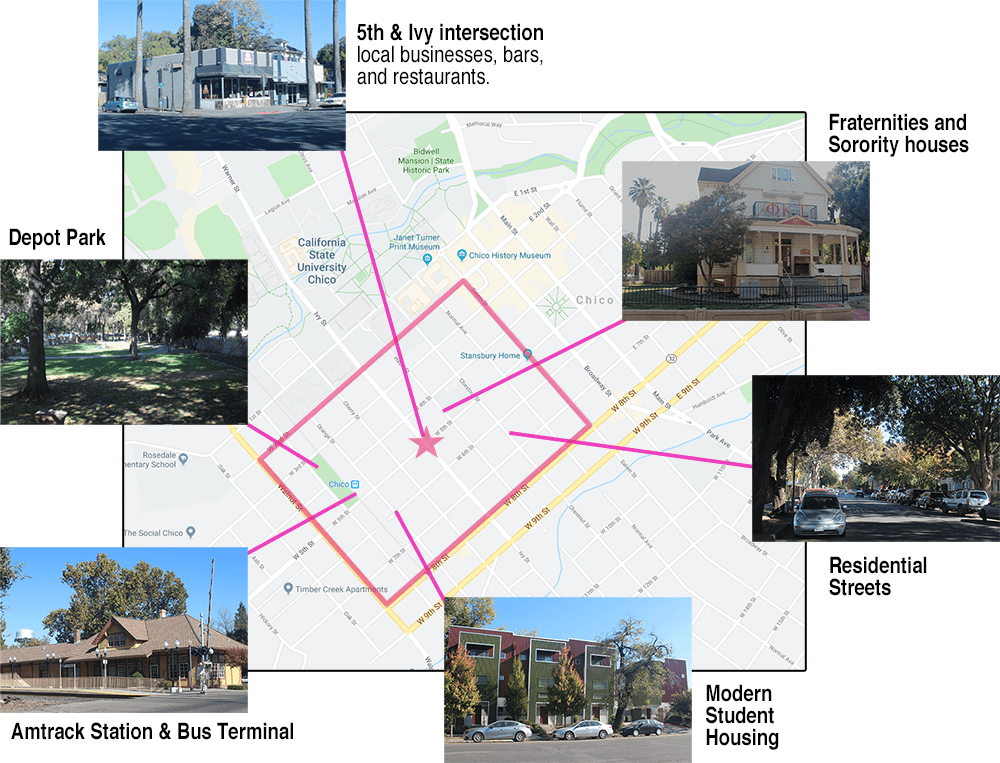
I chose the “U-Town” area in Chico, California. As the oldest residential neighborhood in the city, it has many positive qualities that have often been overshadowed by a reputation for college house parties. For an overview of how each assignment contributed to the learning process, read “Learning Design Research Through Place Branding”.

Connecting / Synthesizing / Transforming

Prior to each assignment, Professor Argo provided links to multiple online articles and videos related to the assignment. These instructional materials established strong knowledge of Place Branding, Brand Equity, Design Research, and Differentiation. Each week built on previous lessons in a logical progression. For example, the article “5 Place Branding Principles for Successful Brand Development and Management” detailed the principles inherent to effective place branding: distinctiveness, authenticity, memorability, co-creation, and a sense of the place that drives emotional connections (Editorial Team, 2019). These principles were reinforced by research into the current brand equity of the U-Town neighborhood (its authenticity, memorability, and sense of the place) and a comparative analysis to find its differentiation (or distinctiveness).

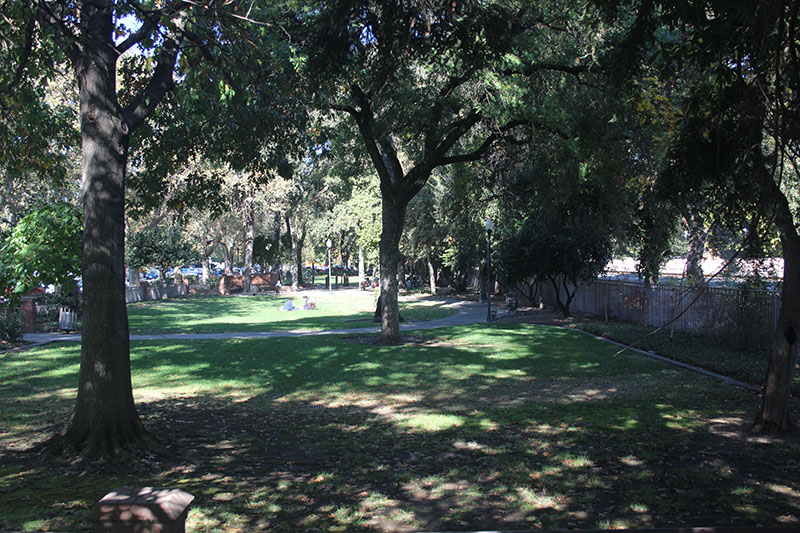
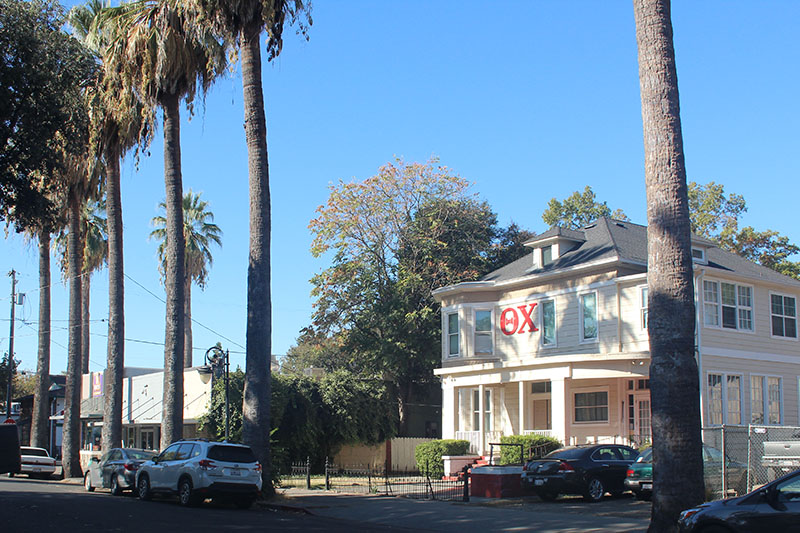
In a video from Gerson Lehrman Group, Turi McKinley explains how design research has both immersion and discovery stages (GLG, 2016). The immersion stage dives deep into the brand’s current equity and needs. The discovery stage explores possible solutions by getting hand-on interaction with people, places, and objects. For the U-Town branding project, the immersion phase was online secondary research into the history and current brand equity of the neighborhood. The information gathered in this phase led to connections made in the discovery stage. Several misconceptions were dispelled by exploring and photographing U-Town. A 2016 article in the Chico News and Review described the neighborhood’s history of raucous house parties and drunken riots, but also noted measures being taken by the city and Chico State to make the area safer for students and residents (Hardee, 2016). A visit to the area on a Saturday afternoon to gather primary research confirmed that those measures were largely successful. Students still drink and party, but those parties no longer spill into the streets and the neighborhood has a very laid-back peaceful vibe.

Depot Park
Fraternity house

Problem Solving

The ultimate purpose of design research is solving a design problem. The first step is defining the problem statement. Branding a district is not a design problem. Instead, you must ask a specific question, such as “How do I change the perception of this place for the target audience?” The primary design problem for branding the U-Town neighborhood is “How do I change the neighborhood’s party reputation?”

In the LinkedIn Learning video course “Learning Design Research,” Andy Schwanbeck suggests using KWHL tables to directly inform how to solve a problem (Schwanbeck, 2015). For the place branding assignments, the table below categorized the goals for the research process.

K: What do you already know? W: What do you need to find out? H: How will you learn it? L:  What do you hope to learn?
U-Town has largely outgrown its party past, but that reputation remains.

The majority of residents are college students under 30.

A variety of small businesses and restaurants are focused on student needs.  
Top reasons why students want to live in the area.
  Entertainment options besides alcohol.  

How is U-Town different from other campus-adjacent neighborhoods?
Brand Equity study utilizing qualitative data from Niche.com neighborhood reviews and studies by the City of Chico Public Works Department.

Comparative Analysis of U-Town, Barber, and Downtown Chico.
What is the current brand equity of U-Town and what is its primary point of differentiation?

The Brand Equity study for U-Town discovered that the most liked aspects of the neighborhood are the beautiful trees and walkability. Both of these aspects provided a path to changing U-Town’s party reputation. The Comparative Analysis study found that the mature urban forest and walkable proximity to the college are two distinctive assets that appeal to nature-minded students. This emphasis on the local, environmentally friendly aspect of the neighborhood can help change its reputation as a raucous party area to a place that is nourishing to personal growth.

Innovative Thinking

A primary take-away from the Design Research course is that innovation is about differentiation. The place branding research required us to find the qualities that make a location stand out. Miguel Rivas notes that “distinctiveness emerges from the singular combination of different city assets and approaching the city narrative as an honest introspection, projected with healthy optimism into the future” (Rivas, 2015). Researching a location’s assets and narrative provides unique insights and understanding of how the brand connects with the target audience. By synthesizing innovative designs based on differentiation, we are building skills that can be used on future brand development projects.

The design research skills learned in the course are basic to the profession, but how they are used is a demonstration of innovative thinking. Finding U-Town’s “Zag” required a deep immersion in its current brand equity plus discovery of its differentiation. Comparisons were made to Downtown Chico, which also suffered from a negative “party town” reputation before being transformed into a family-friendly destination. With effective branding as an environmentally friendly neighborhood, U-Town can make a similar transformation.

Acquiring Competencies

The following are concepts or skills learned in the Design Research course. They are categorized as Academic (pertaining to school work) or Occupational (pertaining to work in the Media Design field), and Technical (pertaining to software or other design skills) or Conceptual (new terminology, procedures, or ideas).

Week 1

Mastery Goals and Active Learning. Academic, Conceptual.

The difference between art and design. Occupational, Conceptual.

Principles of Place Branding. Occupational, Conceptual.

Week 2

What is Design Research? Academic, Conceptual.

Pure Research vs Applied Research. Academic, Conceptual.

Developing Brand Equity. Occupational, Conceptual.

Defining a design problem. Occupational, Conceptual.

Week 3

What is Differentiation? Academic, Conceptual.

When the competition zigs, you zag. Occupational, Conceptual.

You can’t be all things to all people. Occupational, Conceptual.

Week 4

Innovative Thinking in Media Design. Occupational, Conceptual.

Differentiation in Place Branding. Academic, Conceptual.

APA Formatting. Academic, Technical.

Creating Illustrator Infographics (LinkedIn Learning). Occupational, Technical.


References:

GLG. (2016, May 4). Frog Design’s Turi McKinley on Problem Solving and Design Research: GLG Leading Learners. Retrieved from https://www.youtube.com/watch?v=h2jBP3oOJZM

Hardee, H. (2016, April 14). Losing our buzz: Does Chico (State) still deserve its hard-partying reputation? Chico News and Review. Retrieved from https://www.newsreview.com/chico/losing-our-buzz/content?oid=20614263

Rivas, M. (2015) Innovative Place Brand Management: Relearning City Branding. Retrieved from https://urbact.eu/sites/default/files/final_report_urbact_citylogo_2012-2015_miguel_rivas.pdf

Schwanbeck, A. (2015, February 24). Learning Design Research. Retrieved from https://www.lynda.com/Design-Foundations-tutorials/Foundations-Design-Research/182890-2.html?org=fullsail.edu

Team, E. (2019, June 1). 5 Place Branding Principles for Successful Brand Development and Management. Retrieved from https://placebrandobserver.com/5-place-branding-principles-to-guide-brand-development-management/

Design Research – Week 4 Reflection

Innovative Thinking

In the final week of Design Research, we are updating our Mastery Journals to describe our progress and reflect on the course. The overview will include documentation of what we’ve learned and how we’ve met the learning objectives. To demonstrate Innovative Thinking, we must compare our work to others in the industry. Professor Argo noted that innovative thinking can be applied even if the product isn’t 100% innovative. For example, our place branding research uncovered unique qualities to neighborhoods that are unremarkable at first glance. The comparative analysis was an important tool for discovering differentiation and “finding the zag” as recommended by Marty Neumeier (2006). This innovative thinking helps us understand the choices we must make to create more effective designs.

Differentiation in Place Branding

Innovative thinking is necessary for strong Differentiation. It requires looking at the status quo, then doing something different. However, there should be reasoning and purpose behind the differentiation. We compare our work to others to know WHY they did what they did, not to imitate them. The article “5 Place Branding Principles for Successful Brand Development and Management” states that “Place branding is above all about the distinctiveness of a place” (Editorial Team, 2019). This month’s research was about discovering the unique qualities of our chosen place that make it stand out in comparison to its competitors. Professor Argo encouraged us to find an “Onliness” statement about our place:

_____ is the ONLY neighborhood that _____.

This differentiation will help set the voice and tone for the visuals we will create in the next class.

APA Formatting

Like all academic writing in the Media Design MFA program, this month’s Mastery Journal and paper must be written in APA format. Professor Argo recommended the Purdue Online Writing Lab as a valuable reference for proper formatting. He also noted that the APA paper templates included with Microsoft Word may not necessarily use the correct font, so it is important to check the minor details. Specifications are there for a reason. They demonstrate attention to detail, a requirement for mastery and professional success. In the book Mastery, Robert Greene suggests that artists’ works suffer when they “think in large brush strokes” (Greene, 2013). Attention to detail demonstrates a deeper understanding of the work, helping it connect with the audience.

References:

Greene, R. (2013). Mastery [VitalSource Bookshelf version]. New York: Penguin Books. Retrieved from vbk://9781101601020

Neumeier, M. (2006) ZAG: The Number-One Strategy of High-Performance Brands. Retrieved from https://learning.oreilly.com/library/view/zag-the-number-one/0321426770/

Team, E. (2019, June 1). 5 Place Branding Principles for Successful Brand Development and Management. Retrieved from https://placebrandobserver.com/5-place-branding-principles-to-guide-brand-development-management/

Design Research – Week 3 Reflection

When the competition zigs, you zag.

This week was all about finding differentiation: one thing about the brand that provides the best value and sets it apart from the competition. In his book ZAG, Marty Neumeier explains that “radical differentiation doesn’t test well in focus groups” (Neumeier, 2006). People will claim to want more of the same, but better. Real innovation can be uncomfortable to many because it’s new and often risky. This leads to a level playing field of sameness. In the video “Why Isn’t Your Brand Differentiation Working?”, David Brier says that “Finding and taking advantage of differentiating factors in your brand communications serves to unlevel this playing field” (Brier, 2018). This week’s research will help us find useful differentiation for our place brand. Neumeier concluded that the keys to finding your zag are “hitting ’em where they ain’t (differentiation) and getting in front of a parade (finding a trend)” (Neumeier, 2006).

You can’t be all things to all people.

Research provides a wealth of information that must be funneled down to find focus. That focus is your differentiation. It’s important to find the unique qualities that are of worth to the target audience. In the video “Why Isn’t Your Brand Differentiation Working?”, David Brier states “it’s important to find aspects of your brand that are superior/unique and align with the target audience’s wants and needs” (Brier, 2018). Professor Argo added that we should come up with one or two words that define the theme of what we’re finding and where we want to go. This umbrella concept will guide the voice and tone of our designs.

Innovation in Media Design

Professor Argo reminds us that innovation is about differentiation. Our place branding research is all about finding the qualities that make a location stand out. Miguel Rivas notes that “distinctiveness emerges from the singular combination of different city assets and approaching the city narrative as an honest introspection, projected with healthy optimism into the future” (Rivas, 2015). Researching a location’s assets and narrative provides unique insights and understanding of how the brand connects with the target audience. By synthesizing innovative designs based on differentiation, we are building skills that can be used on future brand development projects.


References:

Brier, D. (2018) Why Isn’t Your Brand Differentiation Working? Retrieved from https://www.youtube.com/watch?v=FKrVCxSwbyQ

Neumeier, M. (2006) ZAG: The Number-One Strategy of High-Performance Brands. Retrieved from https://learning.oreilly.com/library/view/zag-the-number-one/0321426770/

Rivas, M. (2015) Innovative Place Brand Management: Relearning City Branding. Retrieved from https://urbact.eu/sites/default/files/final_report_urbact_citylogo_2012-2015_miguel_rivas.pdf

Design Research – Week 2 Reflection

Pure Research vs Applied Research

Pure (or Basic) Research looks for understanding of the theoretical aspects of a subject, relying on quantitative data for answers. Applied Research looks for knowledge to solve a specific problem. Design Research is a form of applied research that involves looking at a problem from different perspectives, often using qualitative data to understand the “why’s” of user behavior. Jon Freach notes that design research is not hard science. Instead, it “gives designers and clients a much more nuanced understanding of the people for whom they design while providing knowledge that addresses some of the most fundamental questions we face throughout the process” (Freach, 2011). In other words, design research provides insight of what users need and the best ways to address those needs.

Developing Brand Equity

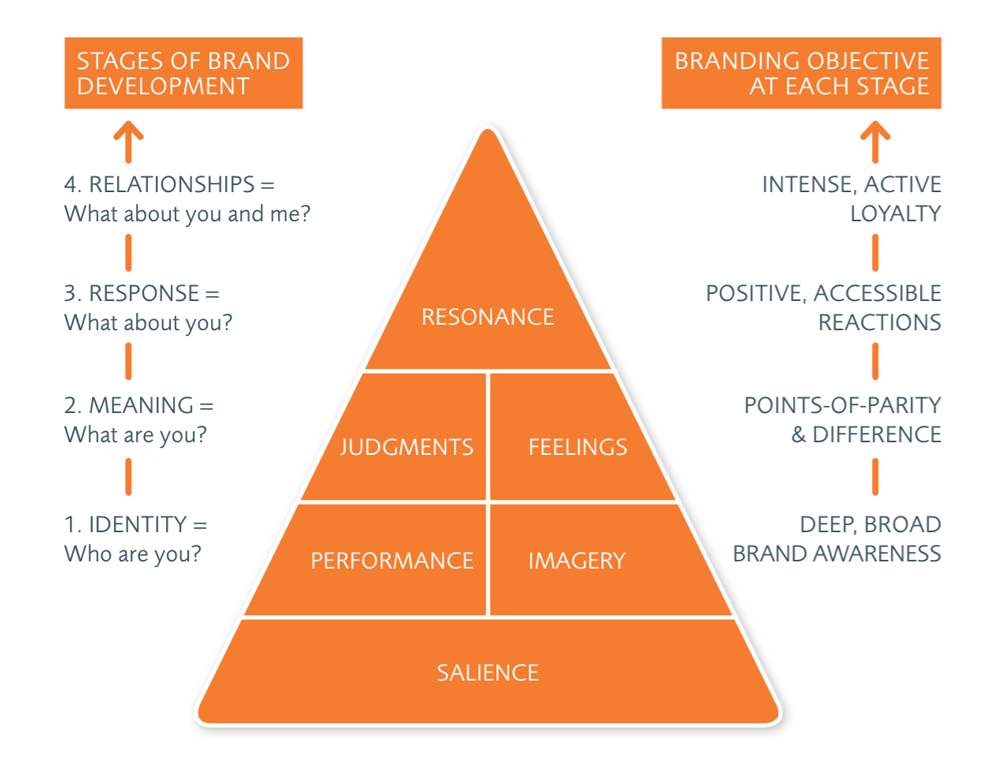
Design strategy can change with understanding of brand equity: how users perceive a brand. What makes it unique? What works and what doesn’t? Articles from Inkbot Design (2017) and Modicom (2017) both refer to the Brand Equity Pyramid described by Kevin Lane Keller in his book, Strategic Brand Management (Keller, 2013). Keller’s model, pictured below, visualizes the stages of brand development used to shape the audience perception of the brand.

Graphic from medium.com and Inkbot Design 

At the base of this pyramid is Salience, or brand identity. Who is the brand and how do people recognize it? The next level, Meaning, relates to “how you communicate what your brand means and stands for” (Modicom, 2017). This includes the performance of the brand and how imagery meets psychological needs. The third level is the Response to the brand, based on both judgments and feelings of the user. The top of the pyramid is Resonance, or “how much of a connection your customers have with your brand” (Design, 2017). This highest level of brand equity promotes customer loyalty and encourages them to share the brand with others.

Defining a Design Problem

In design research, knowing the problem is the first step. Solving it comes later. Branding a district is not a design problem. Instead, you must ask a specific question. How do I change the perception of this place for the target audience? How do I communicate the affordability of housing while still speaking to an affluent audience? Answering questions like these requires knowing the four dimensions of brand equity: brand loyalty, brand awareness, brand associations, and perceived quality (Design, 2017). If there are negatives, focus on the positives. By asking the right questions, you can find effective ways to build brand equity.

References:

Design, I. (2017, December 3). What Is Brand Equity and Why Is It Valuable In Business? Retrieved from https://medium.com/@inkbotdesign/what-is-brand-equity-and-why-is-it-valuable-in-business-a2f875b5e13.

Freach, J. (2011, November 22). The Art of Design Research (and Why It Matters). Retrieved from https://www.theatlantic.com/entertainment/archive/2011/05/the-art-of-design-research-and-why-it-matters/239561/.

Keller, K. L. (2013). Strategic brand management: building, measuring, and managing brand equity. Boston: Pearson.

Modicom. (2017, July 24). Building Brand Equity. Forbes. Retrieved from https://www.forbes.com/sites/propointgraphics/2017/07/08/building-brand-equity/#1b0f2cc76e8f.

Design Research – Week 1 Reflection

Mastery Goals

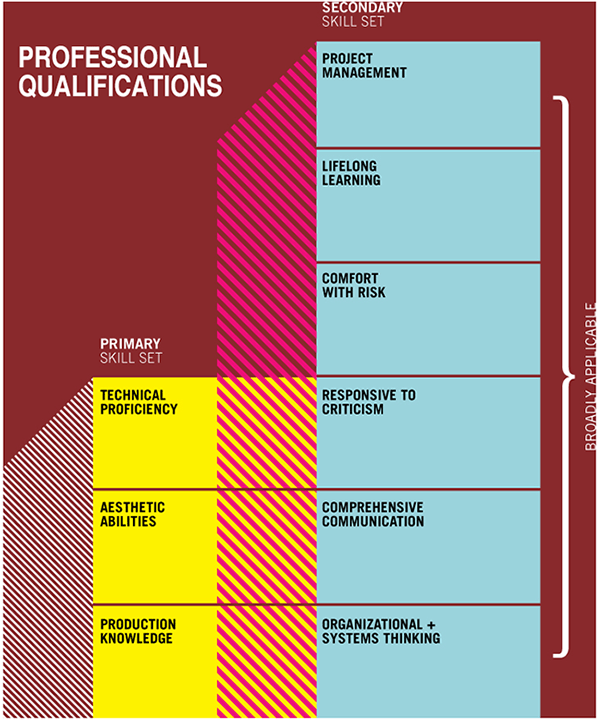
The first live session of Design Research reviewed the month’s projects and how to apply learning from previous courses. Professor Argo’s comments helped me realize the importance of revisiting personal / career goals to determine an education strategy. After losing everything in the Camp Fire last November, I decided to pursue a Master’s degree to help me get more work as a teacher. Now five months into the Media Design MFA program, I understand that I can also redirect my career as a freelance designer / writer / storyteller. The knowledge gained from these courses adds to my professional qualifications in both the primary and secondary skill sets charted in the graph below from Design Currency (O’Grady & O’Grady, 2013).

professional qualifications graph

Active Learning

Professor Argo also encouraged the class to engage in active learning. The Safari Books and Lynda.com subscriptions that are included in the program have helped advance my technical proficiencies and production knowledge, but having so much available information can sometimes feel overwhelming. I need to take a closer look at the job market then focus my time and energy on the specific skills needed to advance my career. Each class in the Media Design MFA program has built on the last, developing my research and strategy skills while I independently develop my technical expertise in vector graphics and design with online courses like Logo Design: Illustrating Logo Marks (Glitschka, 2016). These secondary courses reinforce many of the lessons from the program classes, such as the importance of distinction from competitors and brand continuity.

The difference between art and design.

Art is a personal expression of its creator. It can be interpreted in different ways depending on the viewer and context. Design, however, has a purpose that is unrelated to its creator. Media Design communicates a very specific message, a problem to be solved or a need to be met. The key to effective design is to know what you’re communicating and who you’re communicating to. Designs can be made more powerful by following certain guidelines like David Airey’s “elements of iconic design” described in Logo Design Love (Airey, 2014). Although Airey’s advice pertains to logos, other design ingredients like headlines and colors should be also distinctive and relevant to the message being communicated.

References:

Airey, D. (2014, August 20). Logo Design Love, Annotated and Expanded Edition, Second Edition. Retrieved from https://ce.safaribooksonline.com/book/branding/9780133812589

Glitschka, V. (2016, August 10) Logo Design: Illustrating Logo Marks. Retrieved from https://www.lynda.com/Illustrator-tutorials/Foundations-Logo-Design-Illustrating-Logo-Marks/475455-2.html

OGrady, J. V., & OGrady, K. V. (2013, June 21). Design Currency: Understand, define and promote the value of your design work. San Francisco, CA: New Riders. Retrieved from https://ce.safaribooksonline.com/book/design/9780133052862

Learning Journal – Branding, part 2

This week I completed the Branding course from Adobe Education Exchange.

Our next assignment was to create a 3D visualization for the brand using Adobe Dimension.

This was my first time using Dimension. My previous 3D experience was in Photoshop and After Effects, mostly with the Element 3D plugin from Video Copilot.

Adobe Dimension is an easy way to create product mockups and other brand visualizations. The interface is a bit different from the Adobe apps I’m used to, but with help from the intro tutorial I created my first mockup in minutes.

Level Seven merchandise mockup

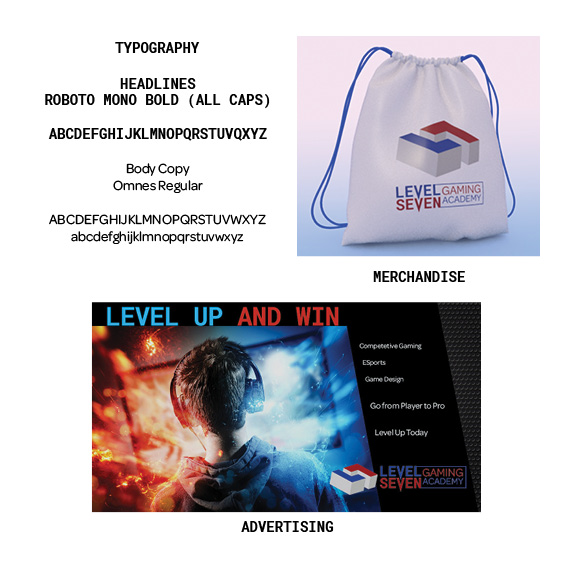
The next assignment in the Branding course is to create a print ad in Adobe InDesign. I started with the headline “Level Up and Win” and licensed an image from Adobe Stock. I adjusted the colors and curves of the image and placed it over a metal grill background that I downloaded free from Pixabay.com.

Level Seven print ad

I’ve used InDesign since 2013, so this exercise was pretty basic. However, it was fun writing headlines and body copy for an ad. It as good practice for the Copywriting class I’m taking this month as part of the Media Design MFA program at Full Sail University.

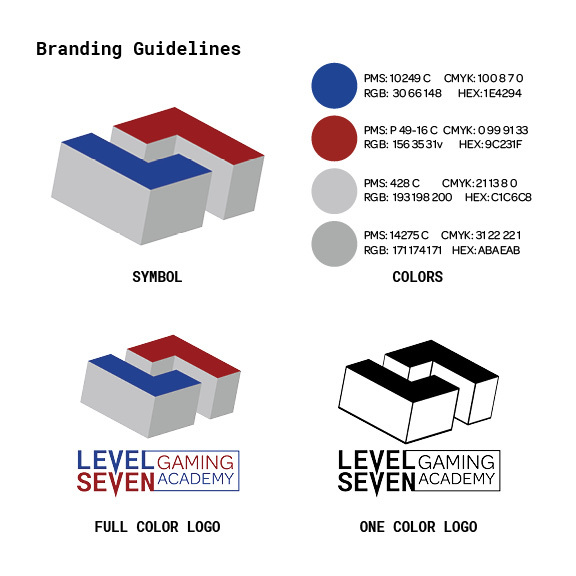
The final exercise for the Branding course is to create a basic Style Guide for our brand identity. I followed the example in Ali Blackwell’s video tutorial but added a Typography category.

Level Seven brand guide front cover
Level Seven brand guide page 1
Level Seven brand guide page 2
Level Seven brand guide back cover

Overall, this course provided a good introduction to creating a brand identity, visual assets, and a style guide to keep things consistent. I learned how to use Adobe Dimension for product visualizations and got good practice using Illustrator, Photoshop, and InDesign.

Learning Journal – Branding, part 1

The following assignments were created for the Branding course from Adobe Education Exchange.

Workshop 1 – Creating a Logomark

Our first assignment is to create a graphic logomark for a real or fictional school, so I invented Level Seven Gaming Academy as a place where students can learn and train to be professional electronic gamers.

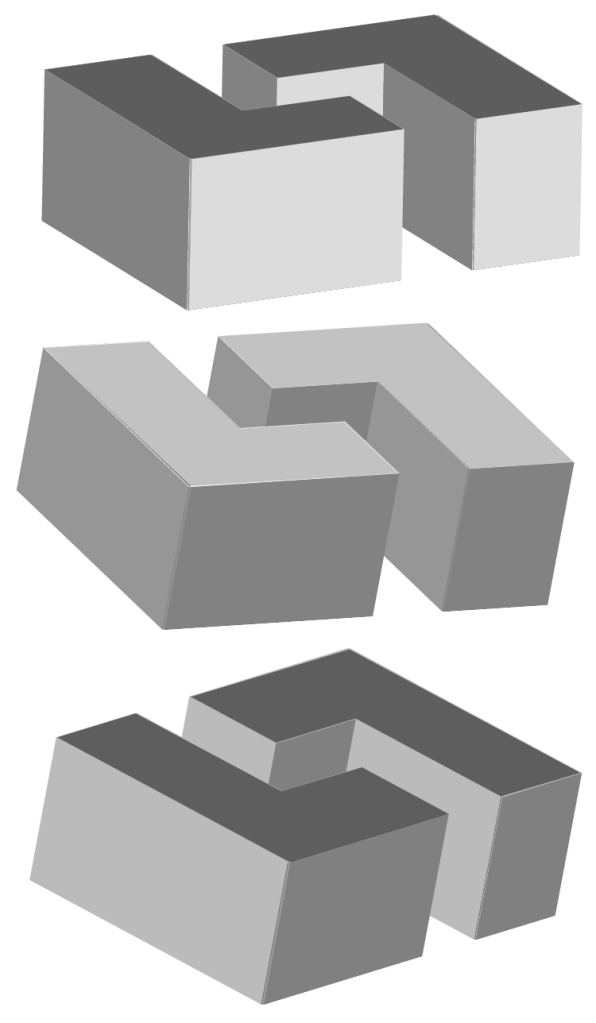
I quickly sketched a few rough concepts using mirrored L and 7 characters, settling on a rectangular design. In Adobe Illustrator, I created the L shape with the rectangle tool then rotated a copy 180 degrees to make the 7.

I always strive for simplicity in logo design, but this one needed more depth and energy. So I grouped the L7 layers and applied the 3D Extrude and Bevel effect on three copies with different settings.

This last iteration is the most successful because it is simple yet dynamic. I haven’t picked the logo colors at this stage because I am still defining the brand and fine-tuning the logo.

Workshop 2 – Creating a Logotype

For the next step, I experimented with typography to pair with the Level Seven logo. The fonts Roboto Mono Bold and Omnes Regular were the most successful pairing. I modified the V letters by adding a bottom point and enclosed “gaming academy” in a box to unify the design.

I’m happy with the design but not the colors. The L7 logomark doesn’t have enough contrast to be effective at small sizes. I’ll have to experiment further to find red and blue shades that more closely match the grayscale prototype, which had better contrast.

Logo Color Revision and Brand Pattern

After more experimentation, I found shades of red and blue that worked well in conjunction with grayscale solid shapes.

Level Seven Gaming Academy logo stacked
Level Seven Gaming Academy logo side by side

The simple shapes are evocative of puzzle games like Tetris, while the colors represent the “red vs blue” competition of shooter games. This new version of the logo also works well in one color and in small sizes.

Level Seven Gaming Academy logo black

Finally, I created a brand pattern using the 2-dimensional L7 design.

Level Seven Gaming Academy brand pattern

In the next Branding workshops, we will apply the logo to a product in Adobe Dimension and create a style guide of the brand.

Brand Vision Boards – part 3

The second half of this week was spent revising my Kyoto brand vision boards and updating my SWOT Analysis based on peer feedback.

GEOGRAPHY

History – Nature – Adventure

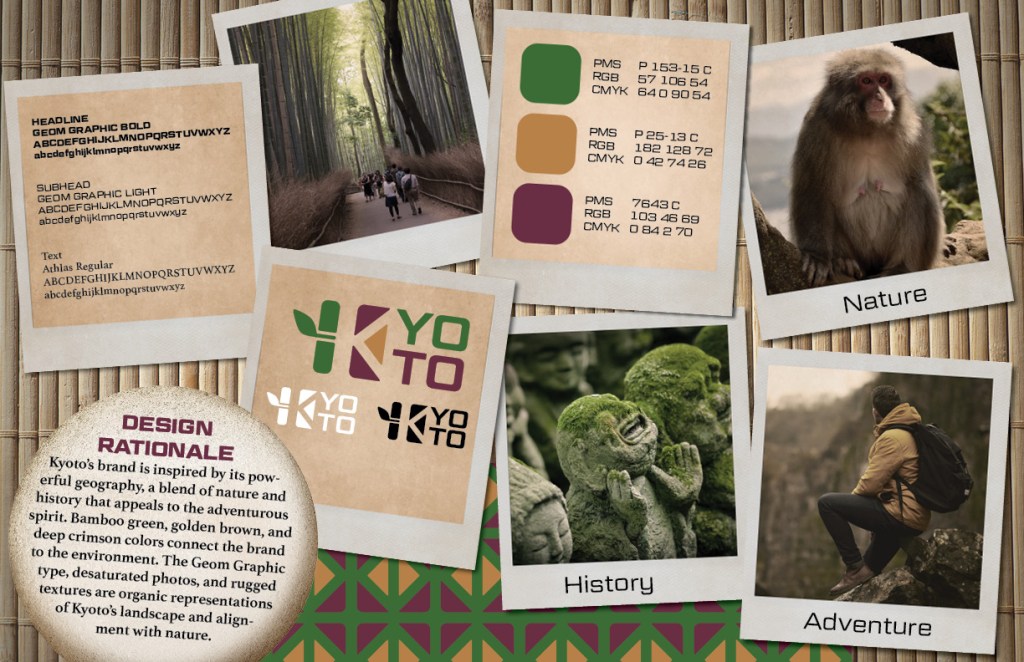
Kyoto geography brand vision board

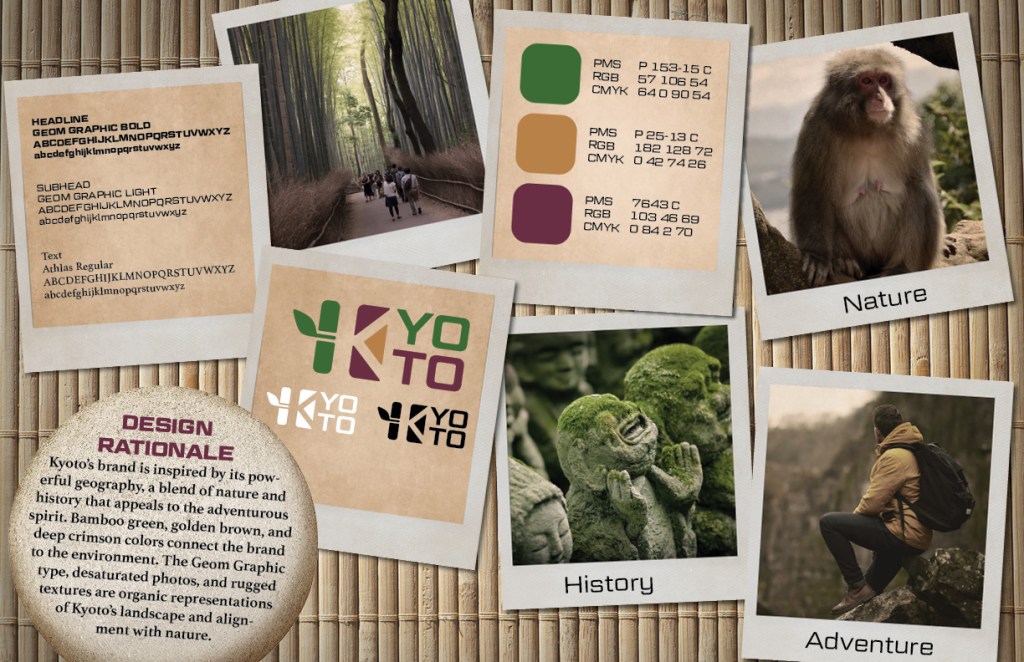
Design Rationale

Kyoto’s brand is inspired by its powerful geography, a blend of nature and history that appeals to the adventurous spirit. Bamboo green, golden brown, and deep crimson colors connect the brand to the environment. The Geom Graphic type, desaturated photos, and rugged textures are organic representations of Kyoto’s landscape and alignment with nature.

The first change was to lighten and smooth the rock texture behind the design rationale to help it stand out more. I also adjusted the adventure photo placement and added a brand pattern based on elements of the logo.


MODERN CULTURE

Creative – Friendship – Modern – Energy

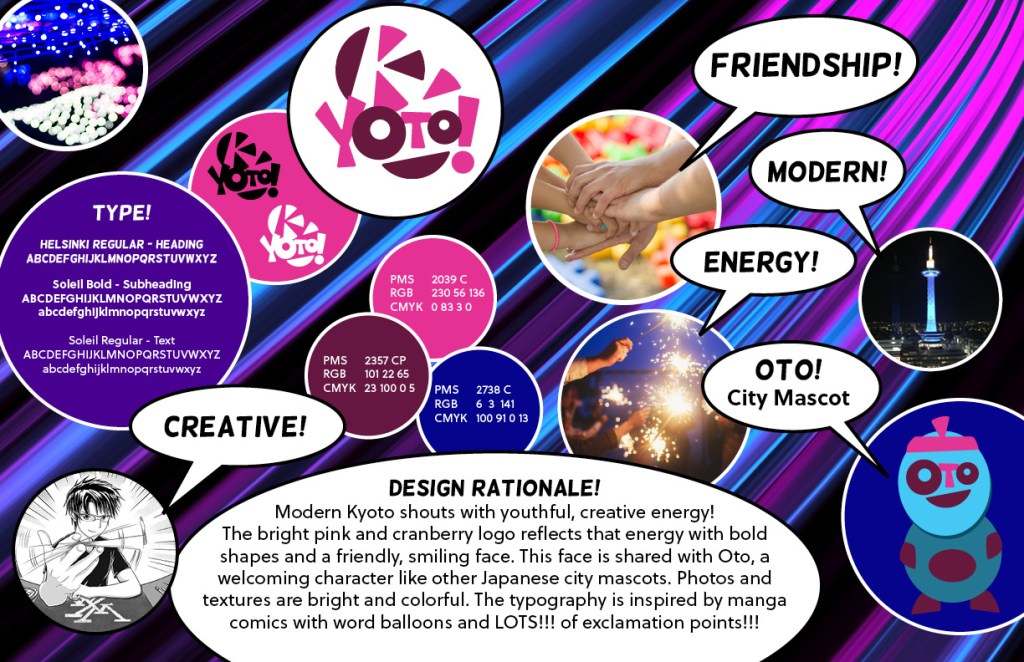
Kyoto modern culture brand vision board

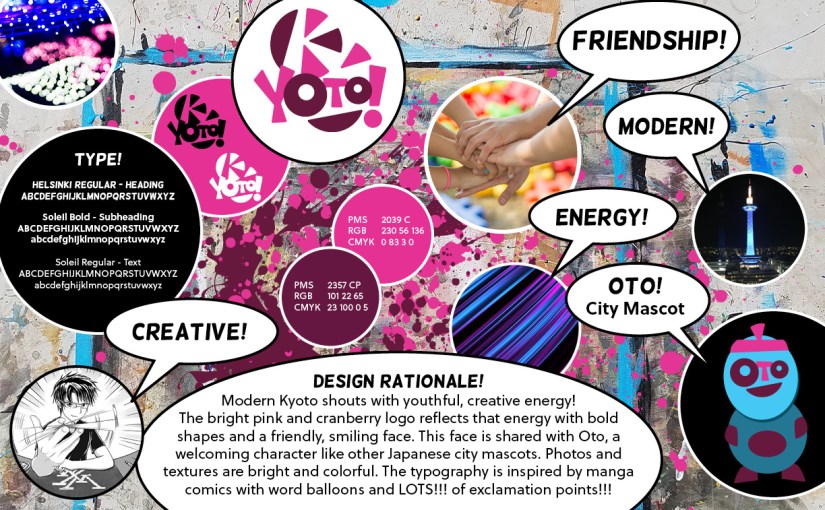
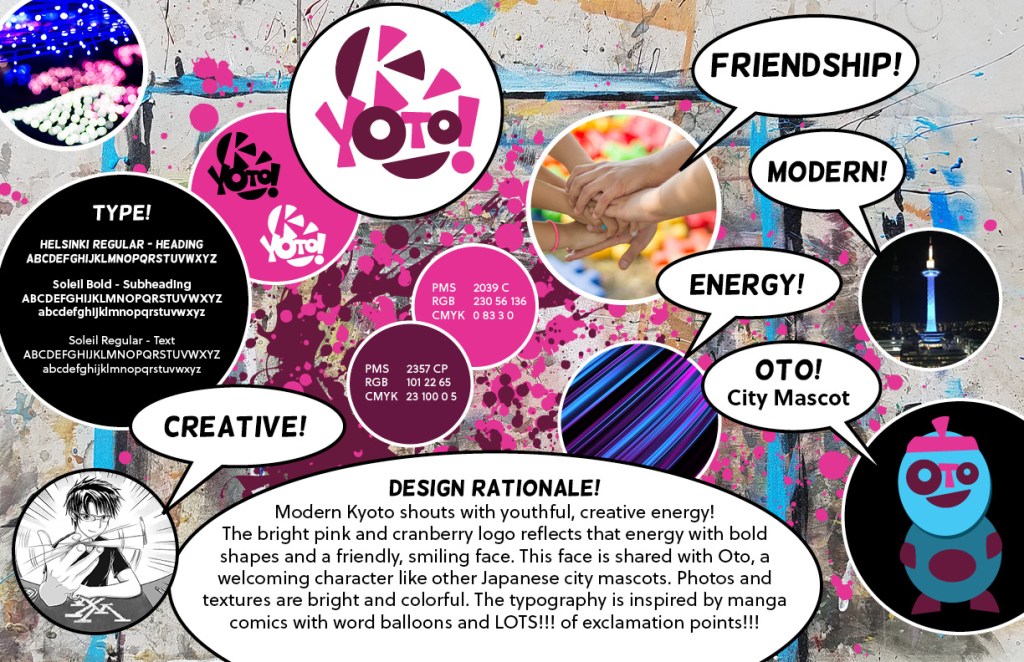
Design Rationale

Modern Kyoto shouts with youthful, creative energy! The bright pink and cranberry logo reflects that energy with bold shapes and a friendly, smiling face. This face is shared with Oto, a welcoming character like other Japanese city mascots. Photos and textures are bright and colorful. The typography is inspired by manga comics with word balloons and LOTS!!! of exclamation points!!!

I updated the background of this board based on peer critique, even though the feedback was based on personal tastes and not cited knowledge of the brand. The new background should have a broader appeal to older individuals and those who aren’t in tune with modern art. While not as distinctive as the first solution, it retains the energy of the brand.

A secondary color that doesn’t appear in the logo was also added to the palette. It’s currently only used as the background for the city mascot, but it can be part of brand patterns and other visual assets.


TRADITIONS

Elegance – Harmony – Spiritual

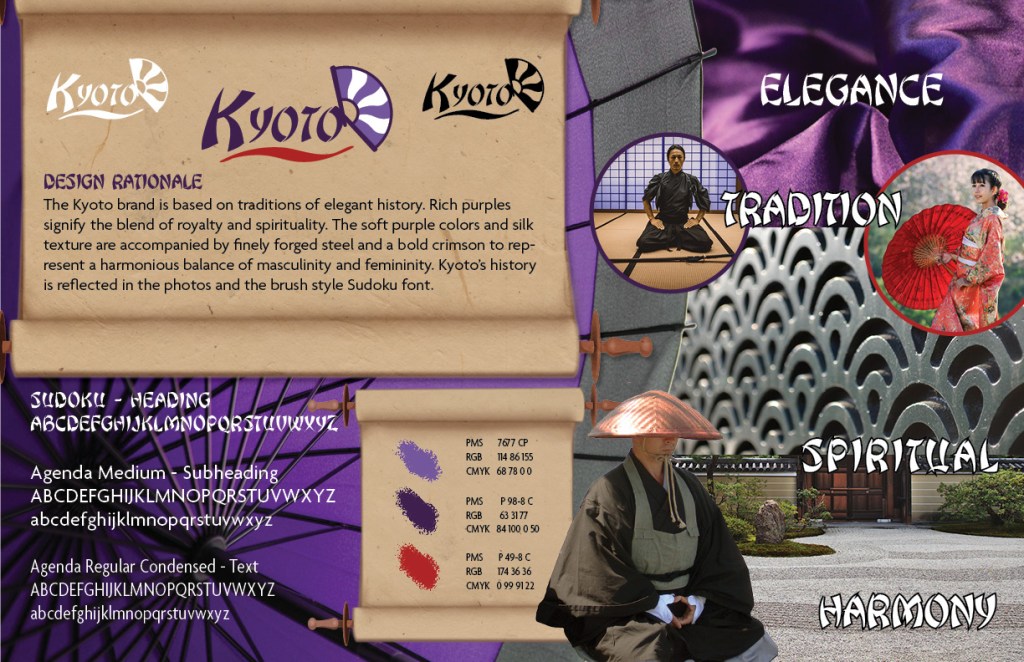
Kyoto traditions brand vision board

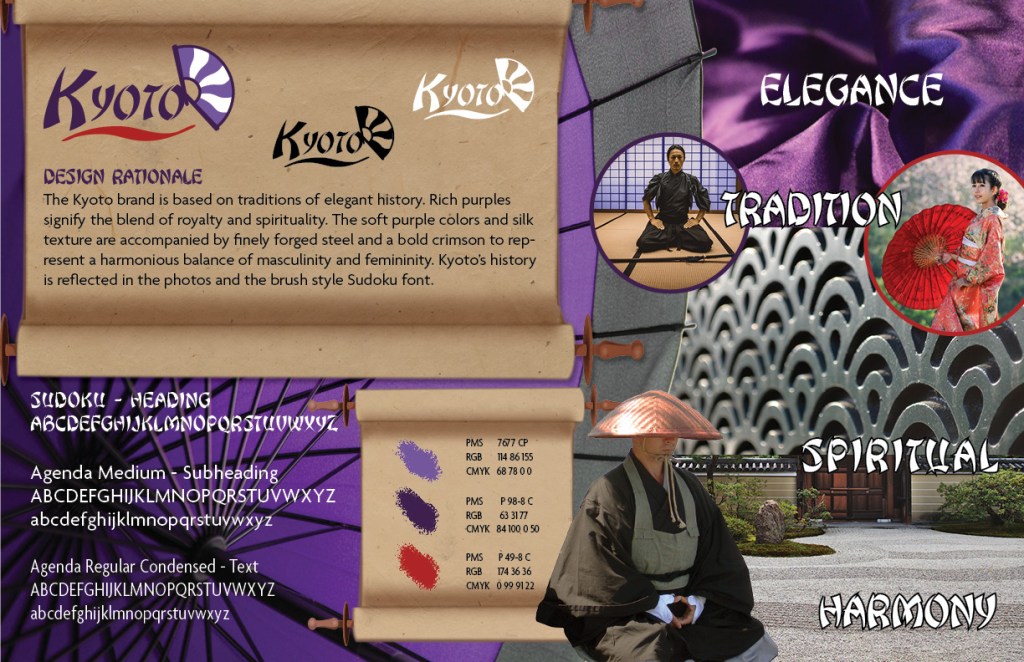
Design Rationale

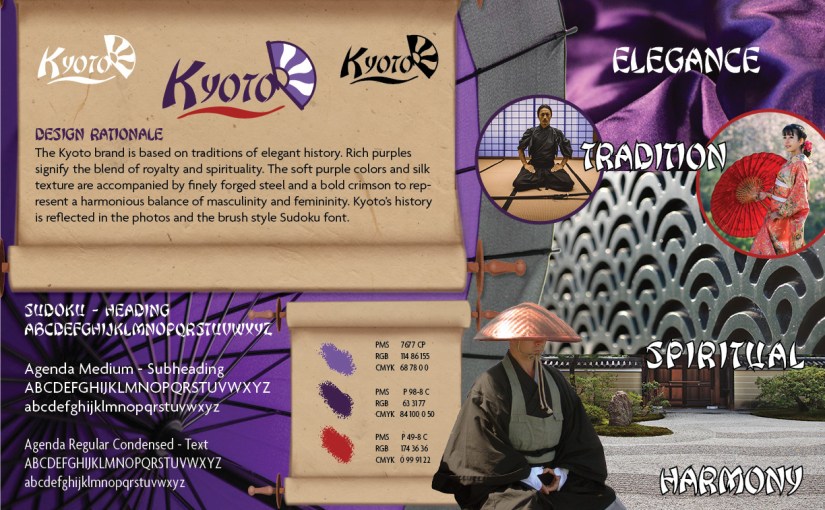
The Kyoto brand is based on traditions of elegant history. Rich purples signify the blend of royalty and spirituality. The soft purples and silk texture are accompanied by finely forged steel and a bold crimson to represent a harmonious balance of masculinity and femininity. Kyoto’s history is reflected in the photos and the brush style Sudoku font.

The Kyoto traditions vision board needed only minor modifications. I lightened the scroll backgrounds and changed the shadows to better match the rest of the design.

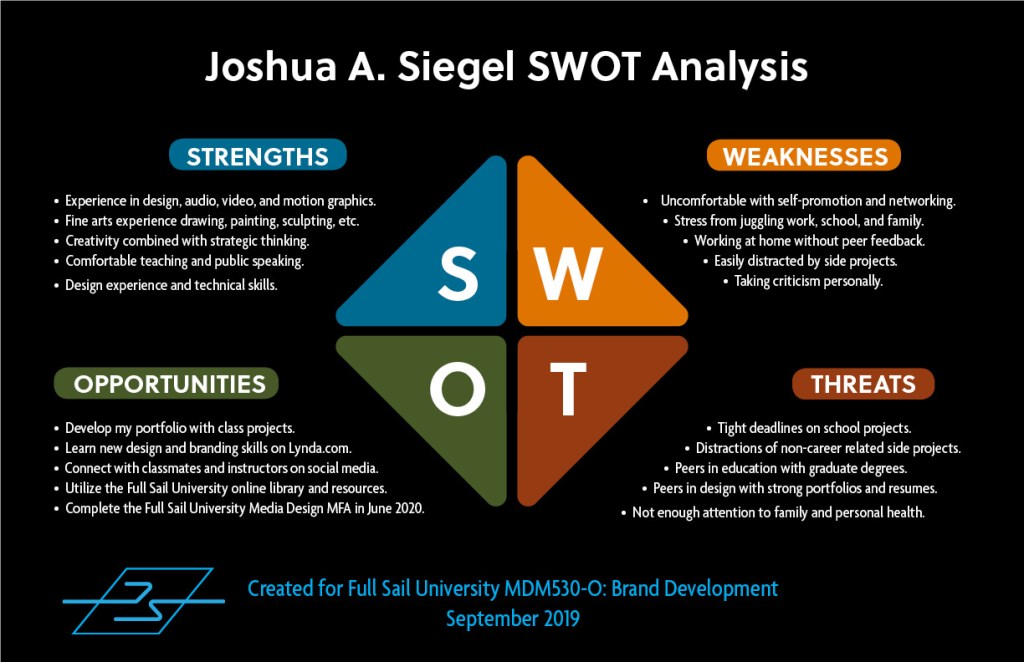
Personal SWOT Analysis Update

A classmate recommended incorporating experiences related to the Brand Development class. I found additional threats and weaknesses that I experienced this month, as well as new strengths and opportunities discovered along the way.

I also simplified the SWOT to concise bullet lists to keep the graphic simple. When writing my analysis, I think of it as TOWS, because I start by looking at external threats and opportunities to overcome those threats. Then I examine my internal weaknesses and find strengths to compensate. This is similar to the way Lisa Quast suggests conducting a personal SWOT analysis (Quast, 2013).

THREATS

  • Tight deadlines on school projects.
  • Distractions of non-career related side projects.
  • Peers in education with graduate degrees.
  • Peers in design with strong portfolios and resumes.
  • Not enough attention to family and personal health.

OPPORTUNITIES

  • Develop my portfolio with class projects.
  • Learn new design and branding skills on Lynda.com.
  • Connect with classmates and instructors on social media.
  • Utilize the Full Sail University online library and resources.
  • Complete the Full Sail University Media Design MFA in June 2020.

WEAKNESSES

  • Uncomfortable with self-promotion and networking.
  • Stress from juggling work, school, and family.
  • Working at home without peer feedback.
  • Easily distracted by side projects.
  • Taking criticism personally.

STRENGTHS

  • Experience in design, audio, video, and motion graphics.
  • Fine arts experience drawing, painting, sculpting, etc.
  • Creativity combined with strategic thinking.
  • Comfortable teaching and public speaking.
  • Design experience and technical skills.

References:

Quast, L. (2013, April 15). How To Conduct A Personal SWOT Analysis. Retrieved from https://www.forbes.com/sites/lisaquast/2013/04/15/how-to-conduct-a-personal-s-w-o-t-analysis/#3c896cb28d8b

Brand Vision Boards – part 2

Board Revisions

This week Jose Caceres and professor Andrea Kratz offered valuable feedback to help improve my Kyoto brand vision boards. Only minor adjustments were needed for each board, but the changes strengthened the brand connections.

Geography

Kyoto geography brand vision board

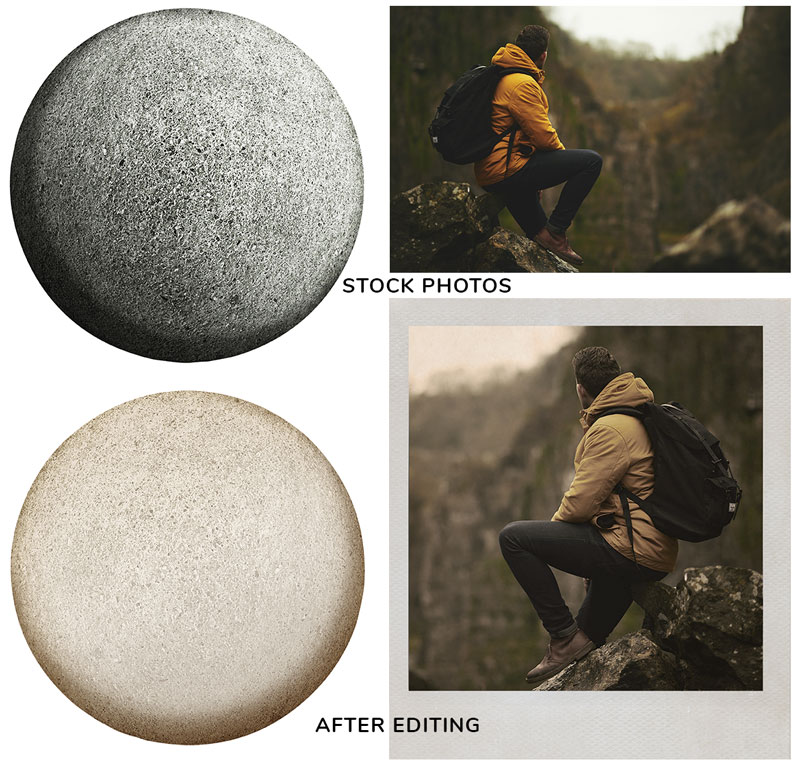
Caceres suggested adding a photo more suggestive of “adventure”, so I found a stock photo that fit the keyword then cropped it, flipped it, and adjusted the colors to more closely match the brand style. I also replaced the “history” temple photo with the moss-covered statues photo that blends both history and nature. Kratz suggested tying the Design Rationale more closely to the design, so I found a round stone image on Adobe Stock and used it as a background with minor hue and brightness adjustments.

On the Freepik.com blog, Orana Velarde offers fifteen ways to customize stock photos to better fit your brand (Velarde, 2017). The image below shows two of the stock images I used, before and after customization.

stock photo customizations

Modern Culture

Kyoto modern culture brand vision board

The modern Kyoto brand vision board needed the fewest changes. In the Week 4 Live Session video professor Andrea Kratz suggested changing the background color of some of the bubbles (Kratz, 2019), so I gave Oto and the typography bubble colorful but dark backgrounds with a white stroke. This minor change gave the design more contrast and balance.

Traditions

Before updating the traditions brand vision board, I revised the fan logo. The wavy lines on the fan are now more harmonious with the curviness of the wordmark.

Kyoto traditions brand logo
Kyoto traditions brand vision board

Following Kratz’s advice to de-blockify the Design Rationale, I created a scroll background in Photoshop using elements of clip art and textured paper. This background worked well for the logos and rationale, tying more closely to tradition than the previous color backgrounds. Because it was so effective, I made a second scroll background for the color palette. This texture can be part of the brand style guide if further developed.

Caceres suggested adding a photo more closely connected to “spirituality”. The design was already crowded, so I swapped out the dragons print for a photo of a Zen garden. I also replaced ambiguous Torii gate photo with a photo of a samurai. I added the purple background and adjusted the floor color to match the parchment. The design now feels more cohesive and connected to Kyoto’s history and traditions. My scroll backgrounds can be adjusted so the shadows are more consistent with the rest of the design, but that’s a minor change.

References:

Kratz, A. (2019, September 24). MDM530 Live Session Archives – Week 4. Retrieved from https://online.fullsail.edu/class_sections/46757/modules/180381/activities/1127121

Velarde, O. (2017). 15 Creative Ways to Customize Stock Photography to fit your brand. Retrieved from https://www.freepik.com/blog/15-creative-ways-customize-stock-photography-fit-your-brand/