
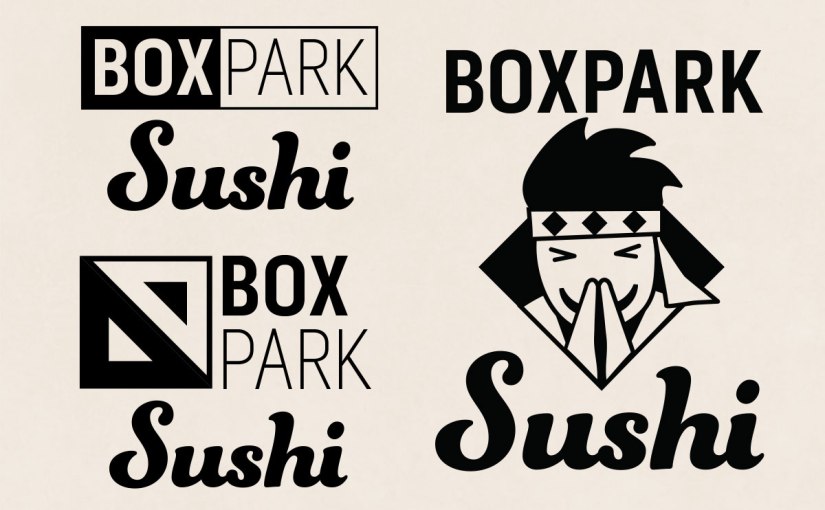
The top three concept sketches for the fictional Boxpark Sushi brand were developed into vector graphics in Adobe Illustrator.
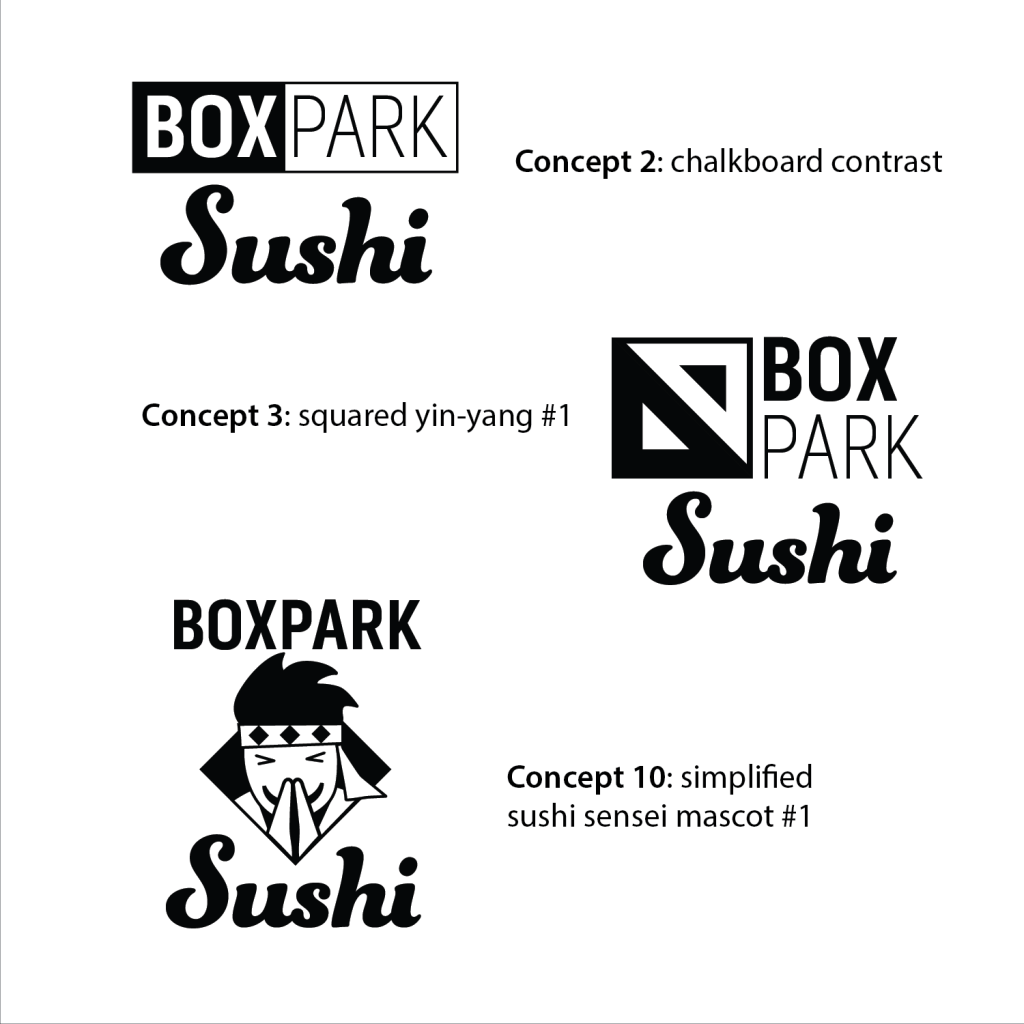
Concept 2: Chalkboard Contrast
The Boxpark Sushi brand is educational but fun, with the personality of a wise and friendly Sushi Sensei. Logo concept sketch 2 is based on a logotype developed previously for the Boxpark Sushi static vision board. The Pill Gothic 300mg typeface was chosen for the “Boxpark” type because it is both strong and condensed. According to Kolenda (2016), condensed fonts convey tightness and precision, traits that are valued in sushi preparation. The combination of the font’s bold and thin weights implies a balance of power and sophistication.
The idea of balance in continued by using the script typeface Funkydori for the word “Sushi”. The gentle curves of this font reflect the organic nature of the product and provide a feminine balance to the straight lines and hard angles of Pill Gothic 300mg. This logo concept uses the idea of an old-fashioned school blackboard to frame the Boxpark type, representing the brand’s wise characteristic as well as recalling the rectangular shapes of Boxpark shipping containers and providing visual contrast to the logo.
This solution is the simplest of the three presented logos. As noted by Airey (2014), the simplest solution is often the most effective because it helps meet other requirements of iconic design like “think small” and “focus on one thing”. However, this logo is also the least distinctive of the three solutions.
Concept 3: Squared Yin-Yang
Research of other sushi brand logos confirmed that the most overused logo elements are chopsticks, sushi rolls, and Asian script fonts. Therefore, none of my concept sketches contains those elements. Instead, I focused on imagery inspired by Karate, a Japanese martial art whose teachers are called “sensei”. Several of the concept sketches were in inspired by the yin-yang symbol, which represents the balance of light and dark or feminine and masculine.
This solution is the simplest of yin-yang inspired concepts. The squared yin-yang logo is a fun, modern take on the traditionally round symbol. It visually represents the box aspect of Boxpark as well as the wisdom and balance associated with the symbol. The squared yin-yang can also be utilized for brand patterns used in marketing, merchandise, and in-store decoration.
The squared yin-yang solution incorporates tradition in a simple yet distinctive logomark that is easy to commit to memory and works even at small sizes. For these reasons, the logo meets many of the elements for iconic design (Airey, 2014). This solution is also more innovative and distinctive than the simple logotype of Concept 2. A Google image search for “square yin yang symbol” revealed nothing too similar, which means other brands are probably not using the same design.
Concept 10: Simplified Sushi Sensei Mascot
The Boxpark Sushi brand is built around the concept of a friendly Sushi Sensei who helps customers become a “sushi black belt”. This persona helped shape the fun and wise characteristics of the brand and was the inspiration for many Mascot style logo concepts.
Mascots are a strong way to transfer and support a brand’s voice and tone (Yalanska, 2019). Custom characters like the Sushi Sensei reflect the brand qualities while adding emotional appeal and more personalized interaction with customers. Mascots can be simple like the Twitter blue bird or more complex cartoon characters like Tony the Tiger, a mascot designed for Kellog’s Frosted Flakes in 1952.
Many variations of the Sushi Sensei mascot were sketched, including sensei-inspired emoji and more detailed renderings. Several simplified sensei were sketched, but the first stood out because it best captured the fun aspect of the brand. The character is smiling, and the visual balance of light and dark in the logo is reminiscent of the yin and yang symbolism.
Curves in the mascot’s hair mimic the sushi type, while the black diamond framing and headband elements represent the box part of Boxpark. Although this logo is the least simple of the three solutions, it still works at small sizes and is very distinctive.
References:
Airey, D. (2014, August 20). Logo Design Love, Annotated and Expanded Edition, Second Edition. Peachpit Press.
Kolenda, N. (2016). The Psychology of Fonts. https://www.nickkolenda.com/font-psychology/
Yalanska, M. (2019, March 13). Design Me Live: The Power of Mascots in UI and Branding. https://blog.tubikstudio.com/design-me-live-the-power-of-mascots-in-ui-and-branding/
 Joshua Siegel's Mastery Journal