

Overview
Design Integration, the eighth course in the Media Design MFA program from Full Sail University, continued the development of a brand identity for a fictional client: Boxpark Sushi, located in East Side Milwaukee.
My classmates and I learned how to express the brand’s personality and voice through static vision boards, then added motion and sound to create dynamic vision boards. We also developed a media delivery plan to strategize the best media outlets and assets to reach the brand’s target audience. Finally, we integrated all the previous research and strategies into a design brief for the brand identity.
Connecting / Synthesizing / Transforming
The Voice and Tone assignment established the Boxpark Sushi voice as fun but wise, like an old friend who happens to know everything about sushi. Before work could begin on the brand’s static vision board, research was conducted to find an appropriate color palette. One of the resources recommended by Professor Argo was a Design Shack article by Carrie Cousins. Many positive color associations were listed in the article, including the association of “energy, ambition, and enthusiasm” with the color orange (Cousins, n.d.).
Further research uncovered the work of psychologist Nick Kolenda, who compiled information from numerous academic studies into easy to read marketing guides about the psychology of colors. Discussing color meanings and associations, Kolenda (2016) lists “fun, happiness, and abundance” as a few words associated with the color orange. However, it is also noted that these associations emphasize hue, but neglect the color’s value (brightness) and chroma (saturation).
Cousins (n.d.) addressed the associates of color value, noting that a darker shade of any color gives it a more negative association, while brighter tints create a more positive feel. On the Color Psychology website, Przybyla (n.d.) also notes that warm reds and oranges can increase one’s appetite. This is an important physiological response for food brands like Boxpark Sushi.
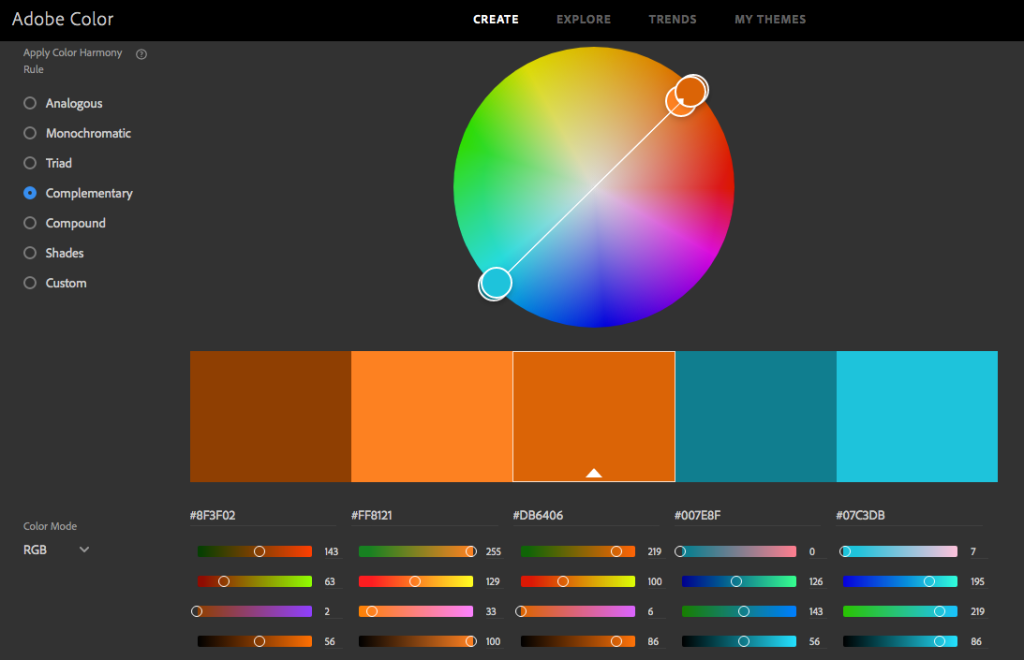
For these reasons a light orange was selected as the starting point for Boxpark Sushi’s primary color. The Adobe Color website was utilized to find an appropriate tint of the color orange. A complementary color harmony rule was used to find a secondary color. The teal blue color denotes intelligence and competence (Kolenda, 2016) as well as being visually complementary to the primary orange.
Problem Solving
Boxpark Sushi is a service-based brand, not product-based. The dynamic vision board needed to feel like a demonstration of the brand’s personality, not a commercial promoting the brand’s product. For that reason, the video included no clips of sushi being prepared or eaten. While sushi illustrations do pop up in the video, they are decorative and secondary to the imagery denoting the brand’s fun but wise personality.
Searches for royalty-free and attribution-free video clips were conducted on Pixababy and Pexels using search terms like “fun” and “laughter” to find inspiring images with orange and blue colors similar to the brand color palette established in the static vision board. Color adjustments were made in Adobe After Effects to closer match the brand colors.
Innovative Thinking
A Media Matrix is a graphical media planner that explains the pros and cons of advertising in four categories of delivery media: print, environmental, on-air, and online (Stone, 2010). Stone listed many of these advantages and disadvantages in the media matrix below.
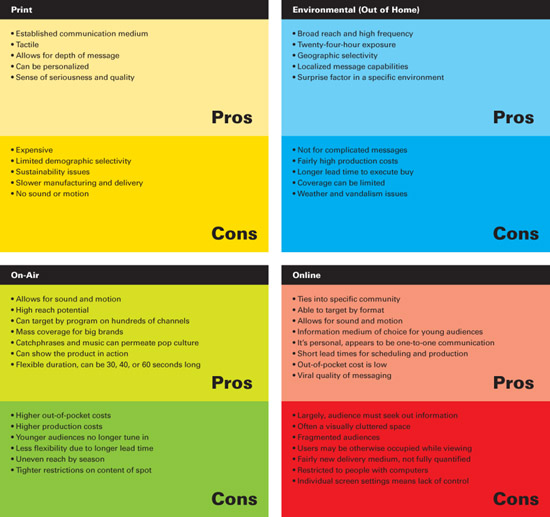
This matrix was used as a starting point while customizing a plan appropriate for Boxpark Sushi. The updated plan (below) was included in the final design brief and used to define which media assets would best serve the brand.
Media Matrix
| Environmental | ||
| PROS | • Tactile • Allows for depth of message • Sense of quality Distinctive take-out boxes turn customers into walking advertisements. | • Broad reach and high frequency • Twenty-four-hour exposure • Geographic selectivity Signage and ad banners near the Boxpark mall target a hungry local audience. |
| CONS | • Expensive • Sustainability issues • No sound or motion Eco-friendly printed packaging costs more but is beneficial to the brand and the planet. | • Not for complicated messages • Fairly high production costs • Weather and vandalism issues Signage and banners must be visually simple and resistant to Milwaukee weather. |
| On-Air | Online | |
| PROS | • Allows for sound and motion • High reach potential • Catchphrases can permeate pop culture • Can show the product in action Local tv and radio spots could connect with older consumers in Milwaukee. | • Allows for sound and motion • Information medium of choice for young audiences • It’s personal, appears to be one-to-one communication The brand’s young target audience uses the internet more than other media. |
| CONS | • Higher out-of-pocket costs • Higher production costs • Younger audiences no longer tune in • Less flexibility due to longer lead time High costs and a diminishing audience make tv advertising not ideal for this brand. | • Largely, audience must seek out information • Often a visually cluttered space • Fragmented audiences To stand out online, the brand must offer something useful to the consumer. |
Future media delivery strategies will look back at Stone’s original matrix for inspiration but seek further supporting details for each category’s pros and cons.
Acquiring Competencies
The following are concepts, skills, or new resources learned in the Design Integration course. They are categorized as Academic (pertaining to schoolwork) or Occupational (pertaining to work in the Media Design field), and Technical (pertaining to software or other design skills) or Conceptual (new terminology, procedures, or ideas).
Advertising is “the paid, non-personal distribution of a persuasive message with the purpose of promoting products or services to current or potential customers “(Gordon, 2017). Advertising is just one piece of a marketing campaign. [Occupational, Conceptual]
A Design Brief includes the objective and strategies defined in the creative brief but also adds additional information (Frenson, 2015). This can include color palette and typographical considerations, voice and tone samples, and media strategies. [Occupational, Conceptual]
A Media Matrix is a graphical media planner that explains the pros and cons of advertising in four categories of media: print, environmental, on-air, and online. [Occupational, Conceptual]
Looming motion occurs when visual stimuli get larger or closer, capturing more attention than receding motion because “…looming objects are more likely than receding objects to require an immediate reaction…” (Franconeri & Simons, 2005). [Academic, Conceptual]
Vision boards, also called mood boards or inspiration boards, help communicate ideas when words aren’t enough. WDD Staff (2008) notes that vision boards demonstrate the thinking behind your design ideas and help clients feel involved with the process. [Occupational, Conceptual]
A Mission Statement is a brief description of a brand’s fundamental purpose (Ward, 2019). It explains who the brand is to people in the organization and the public. [Occupational, Technical]
Brand Voice is determined by a distinctive personality, vocabulary, and rhythm and pace (Kenny, 2017). Brand voice is consistent, but the brand tone changes with the message. [Academic, Conceptual]
Brand Tone is determined by a number of factors including who you are addressing, the situation (or emotional state) the viewer is in, and the topic of your content (Stukent, 2018). [Academic, Conceptual]
Scaffolding is the process of showing and collaborating on the design strategy with the client so there are no surprises or uncertainty (The Futur, 2014). Vision boards are useful for scaffolding design projects. [Occupational, Conceptual]
Words and pictures should be used together achieve synergy, not redundancy (Felton, 2013, p. 81). Try to create some tension between word and image so that their combination achieves an effect greater than their individual sums. [Academic, Conceptual]
Visual Hierarchy is the ordering of content in a composition so that you effectively communicate information and create meaning by directing the viewers’ eyes to the most important information first (Lundgren, n.d.). [Occupational, Conceptual]
References:
Franconeri, S., & Simons, D. (2005). The dynamic events that capture visual attention: A reply to Abrams and Christ (2005). Perception & Psychophysics, 67(6), 962.
Frenson, M. (2016, July 5). How to write effective design briefs: a quick guide. https://unmatchedstyle.com/news/how-to-write-effective-design-briefs-a-quick-guide.php
Gordon, E. (2017). Marketing and Advertising Strategies. https://medium.com/inkbot-design/marketing-and-advertising-strategies-45242269f5ee
Kenny, J. (2017). Know the Difference between Tone and Voice to Set Your Brand Apart. https://gimmemojo.com/2017/11/01/tone-voice-set-your-brand-apart/
Kolenda, N. (2016). The Psychology of Color. https://www.nickkolenda.com/color-psychology/
Lundgren, A. (n.d.). Capture Attention with Visual Hierarchy. https://alvalyn.com/capture-attention-with-visual-hierarchy/
Przybyla, D. (n.d.). How Color Affects Appetite in Marketing. Retrieved from https://www.colorpsychology.org/color-appetite/
Stone, L.T. (2010, July 01). Managing the Design Process-Concept Development: An Essential Manual for the Working Designer. Rockport Publishers.
Stukent, Inc. (2018). Developing Your Brand Voice – Liza Dunning [Video file]. https://www.youtube.com/watch?v=z9KRWgGYD8E
The Futur. (2014). How to Translate Strategy to Design [Video file]. https://www.youtube.com/watch?v=TpcaCW85eI0
Ward, S. (2019, December 10). What Is a Mission Statement? https://www.thebalancesmb.com/mission-statement-2947996
WDD Staff. (2008, December 30). Why Mood Boards Matter. Retrieved from https://www.webdesignerdepot.com/2008/12/why-mood-boards-matter/
 Joshua Siegel's Mastery Journal