
The second week of the Design Strategies and Motivation course delved deeper into understanding a brand’s users and marketplace. We read chapters three and four from George Felton’s Advertising: Concept and Copy and continued the Strategic Development project for the fictional Boxpark Sushi in East Side Milwaukee.
Sushi Barriers
The students participating in the Week 2 Live Session shared what we learned about sushi through personal observations and research in week one. We identified several potential barriers to people who haven’t tried sushi.
- The Japanese language and writing can be intimidating.
- Eating with chopsticks can be difficult.
- Ginger and wasabi can be too spicy to the unfamiliar.
- Ingredients like raw fish, octopus, sea urchin, and roe are unusual to many people.
Removing or mitigating these barriers could make people less hesitant to try sushi. Here are a few ways to make sushi more “comfortable” to Americans.
- English names and descriptions of each type of sushi and its ingredients.
- Let people know that it’s acceptable to eat sushi with a fork or your hands.
- Spiciness “levels” or ratings for sushi and sides.
- Western sushi innovations like the waffle breakfast sushi, bacon and egg sushi, and peanut butter and jelly sushi (Tom, n.d.) that appeal to American kids and adults who don’t like seafood.
The Sushi Sensei
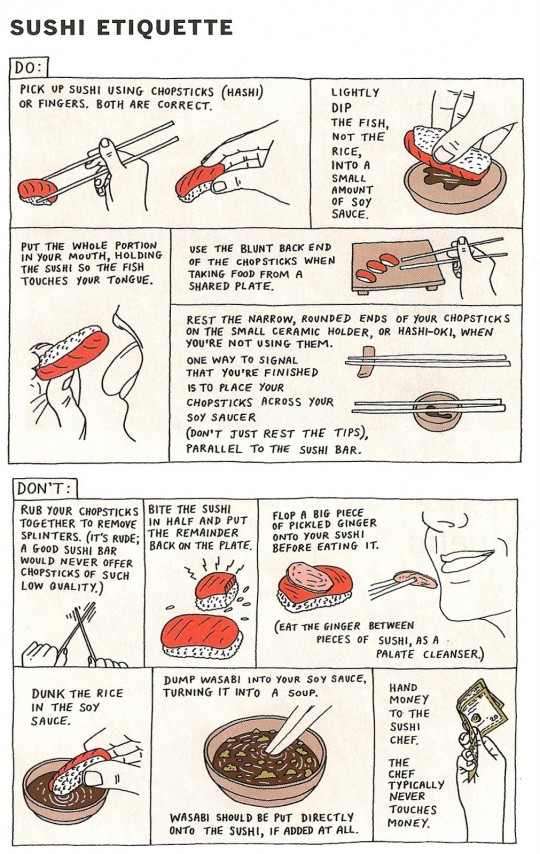
We also talked about how most people are introduced to sushi by a friend or family member who is already an aficionado. This kind of “sushi sensei” makes the first time less intimidating by explaining various processes and ingredients to the newcomer. Eating sushi can be a “rite of passage” that tests people’s taste buds. There is procedure and a lot to learn, as demonstrated by the infographic below from designer Peter Arkle that illustrates basic sushi etiquette for beginners.
Literal vs Abstract Thinking
Finally, Professor Argo reminded us how literal thinking and imagery lead to unoriginal, ineffective designs. Instead, we are encouraged to think in abstracts, to think of the basic needs that the product or brand is addressing or the problem it is solving. We should “try to find metaphors that capture the psychological essence of a problem more than simply its external reality” (Felton, 2013).
A sushi brand represented by a roll and chopsticks will not be distinctive. Therefore, our strategic development research is meant to funnel down the information we’ve gathered into a singular message that directly addresses the client’s needs. Finding that “zag” is essential before creating any brand visuals.
References:
Felton, G. (2013). Advertising: Concept and Copy (Third). New York: W.W. Norton.
Tom, H. (n.d.) 21 Unique Recipes for Sushi Without Raw Fish. Retrieved from: https://spoonuniversity.com/recipe/21-unique-recipes-for-sushi-without-raw-fish
 Joshua Siegel's Mastery Journal