
Outcomes and Knowledge
In the second week of the Organizational Structures course, we researched the Structure of Storytelling in Design. The title of this course finally made sense to me through the readings about developing effective stories that are structured in a specific, mindful way. Like the research and copywriting skills learned in previous courses, storytelling is an important tool for a master designer. Huber (2017) remarks “Being able to understand your client, garner their attention, and leave them with a message that is clear, purposeful, and inspiring has never been more critical.” Strong knowledge of storytelling concepts and processes will help me develop more effective design solutions.
The first project this week was an After Effects Challenge to review our motion design technical skills. After watching tutorials from Adobe and LinkedIn Learning, I created a short animation that demonstrated the basic concepts and features of After Effects CC. This project took more time that it should have, but I picked up several new skills and learned more about motion design. Robinson (2019) describes how the After Effects graph editor allows designers to “take true ownership” of animation by customizing the speed between keyframes. This creates more natural, organic movements than linear keyframes.
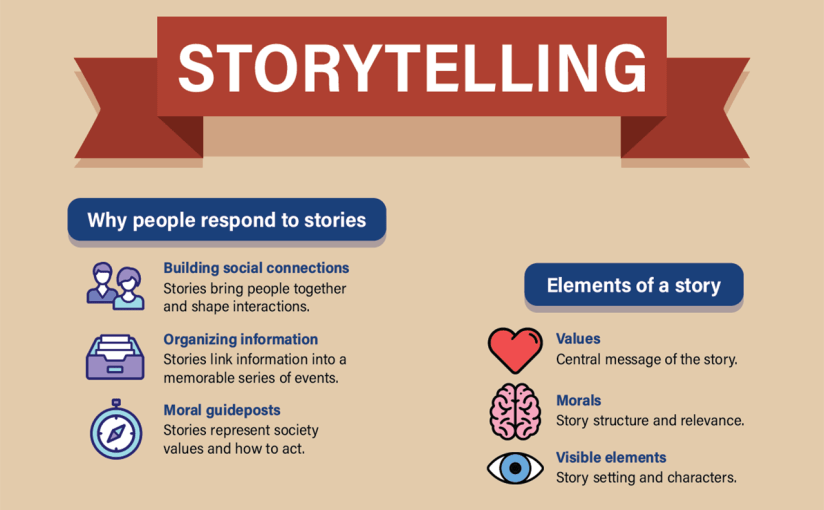
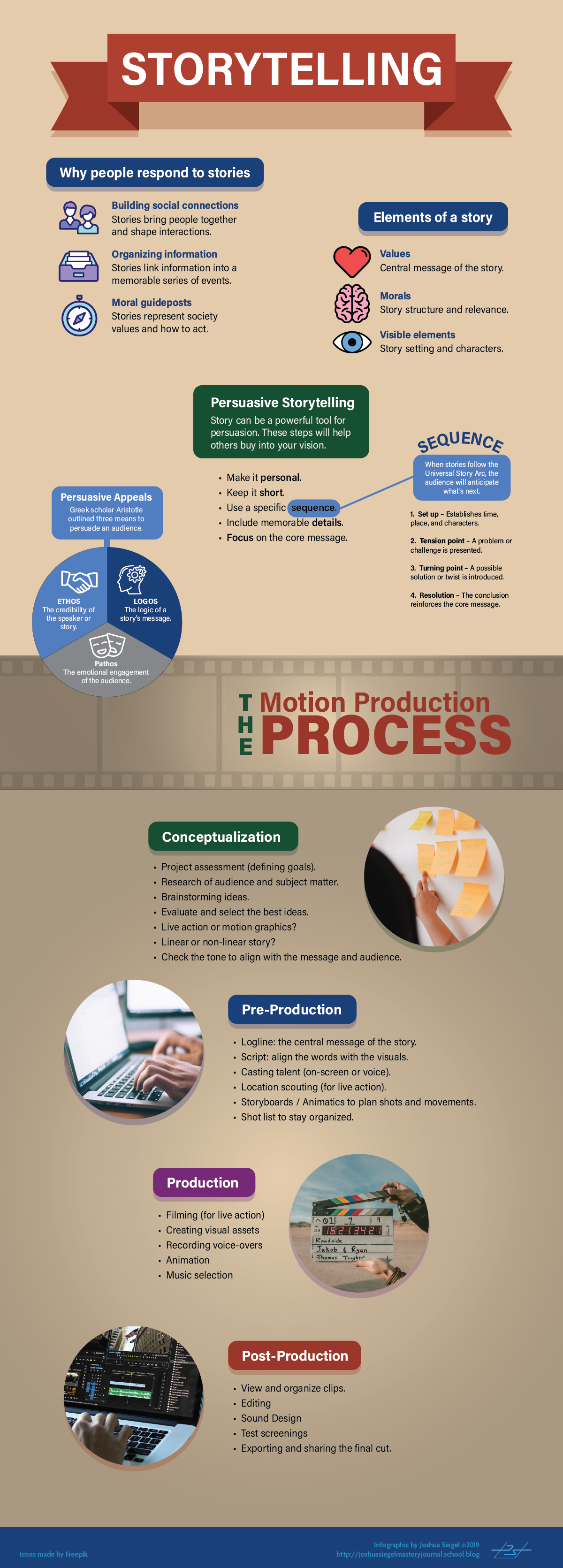
The second project was an Infographic outlining what I learned this week (see above). Infographics are another Organizational Structure for communicating with an audience. This project helped me sort through many pages of notes, organize what I learned, and translate it into a visual design. Even though I have produced videos for over twenty years, this week’s lessons provided new insights into the conceptualization stage of production. Krasner (2013) notes “Regardless of tools and delivery format, concept development is critical to all forms of graphic communication.” Ideas must be formulated, evaluated, and refined at a very early stage. This reinforces what we learned in last month’s Design Research course.
Acquired Competencies
The following are concepts or skills learned in the second week of the Organizational Structures course. They are categorized as Academic (pertaining to school work) or Occupational (pertaining to work in the Media Design field), and Technical (pertaining to software or other design skills) or Conceptual (new terminology, procedures, or ideas).
Academic
| Technical | Conceptual |
| A story’s theme is its underlying message. A story’s tone should align with its audience, its values, and its message. Story Elements: Values: central message of the story. Morals: story structure and relevance. Visible elements: story setting and characters. Logline: a one sentence summary that conveys the central message of the story. | Aristotle’s Three Persuasive Appeals: Ethos – The credibility of the speaker or story. Logos – The logic of a story’s message. Pathos – The emotional engagement of the audience. Synaesthesia: a merging of senses (ie: hearing colors). Causal Reasoning: the process of identifying relationships between a cause and a corresponding event. |
Occupational
| Technical | Conceptual |
| Materials: real-world textures, materials, and found objects can provide inspiration and add authenticity to design. Audience Segmentation: analyzes audience characteristics including demographics, psychographics (i.e., personality), and firmographics (or business setting). Affective Primer: the process of manipulating the emotions of an audience before the message is delivered. | Universal Sequence or story arc: Set up – Establishes time, place, and characters. Tension point – A problem or challenge is presented. Turning point – A possible solution or twist is introduced. Resolution – The conclusion reinforces the core message. Pictorial Continuity: cohesion in content and style of visuals. Sequential Continuity: logical flow of events between frames. |
References:
Huber, A. (2017). Telling The Design Story. Focal Press. Retrieved from https://learning.oreilly.com/library/view/telling-the-design/9781351849210/
Krasner, J. (2013). Motion graphic design. Applied history and aesthetics. 3rd, rev. ed. Oxford: Focal Press. Retrieved from https://learning.oreilly.com/library/view/motion-graphic-design/9780240821139/
Robinson, I. (2019). After Effects: Principles of Motion Graphics. LinkedIn Learning. Retrieved from https://www.linkedin.com/learning/after-effects-principles-of-motion-graphics-2/custom-speed-changes?u=50813145
 Joshua Siegel's Mastery Journal