
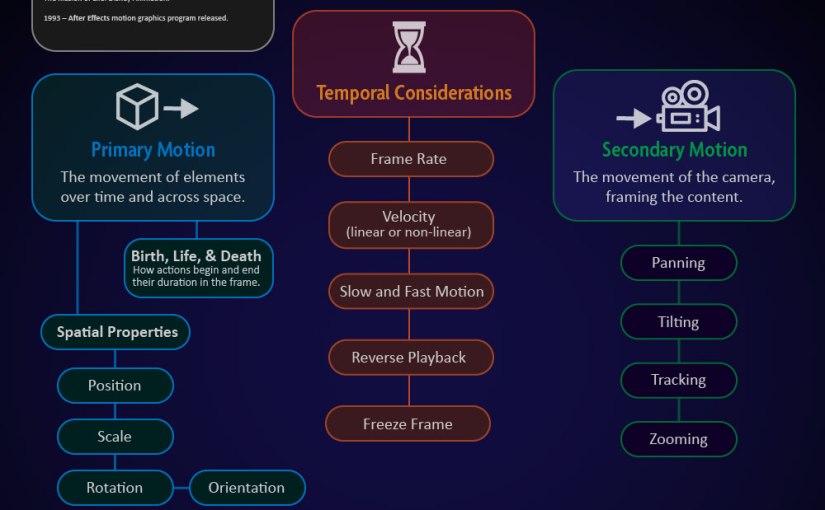
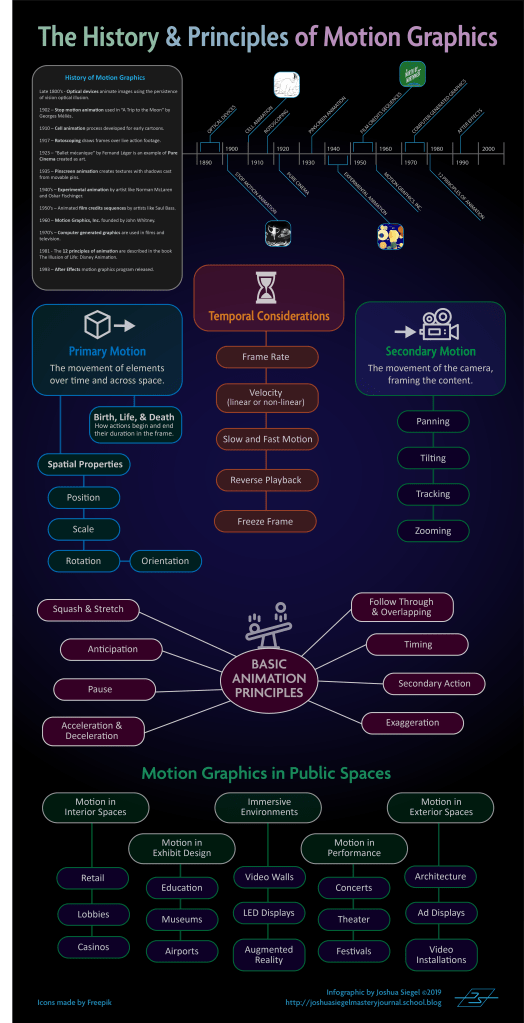
The infographic below was created in Adobe Illustrator using information from the book Motion Graphic Design, 3rd Edition by Jon Krasner.
The Structure of Motion in Design
Its history, theory, and application
Overview
The majority of this week’s information comes from the book Motion Graphic Design, 3rd Edition by Jon Krasner (2013). Krasner provides a brief but thorough review of the history, inventions, and innovators of Motion Graphics. He describes the many applications of Motion Design in film, television, interactive media, and public spaces.
Furthermore, Krasner explains the basic theories and principles of animation. These principles were established by Disney animators and described in the book The Illusion of Life by Frank Thomas and Ollie Johnston (1995). The online article “Understand Disney’s 12 Principles of Animation” by Tammy Coron (2019) summarizes the book and provides sample animations for each principle.
The concepts learned from these books and articles were displayed in an infographic created in Adobe Illustrator. Prior to creating the infographic, I completed the LinkedIn Learning course “Illustrator Infographics” by Tony Harmer (2019).
Acquired Competencies
The following are concepts or skills learned in the first week of the Organizational Structures course. They are categorized as Academic (pertaining to school work) or Occupational (pertaining to work in the Media Design field), and Technical (pertaining to software or other design skills) or Conceptual (new terminology, procedures, or ideas).
History of Motion Graphics (academic, conceptual)
Precursors of Animation: Multiple optical devices used the persistence of vision phenomenon to achieve early forms of animation.
Early Cinematic Inventions: Animation evolved with motion pictures in many forms including stop-motion and cell animation.
Experimental Animation and Innovators: Animators create new techniques for motion design and pure artistic expression.
Motion Literacy (occupational, technical)
Primary (Object) Motion: Animation of an element’s spatial properties and how it moves over time and across space.
Secondary (Camera) Motion: Movement of the camera and how it frames the content.
Temporal Considerations: Linear movements mimic mechanical devices, while non-linear movements are more natural. Techniques such as slow motion and reverse playback can alter the sense of time.
Principles of Animation: The basic language of how objects move was established by Disney animators and described in the book The Illusion of Life by Frank Thomas and Ollie Johnston (1995).
Motion Graphics Applications (academic, conceptual)
Motion Graphics in Public Spaces: LED technology makes large public displays more interactive and purpose driven.
Motion Graphics in Film, Television, and Interactive Media: Animation can entertain, inform, and drive audience participation by combining traditional graphic design with the visual language of film.
Infographics Design (occupational, technical)
Creating Adobe Illustrator Infographics: Adobe Illustrator, Microsoft Excel, and other programs provide many tools for creating data-driven illustrations.
References:
Coron, T. (2019, June 17). Understand Disney’s 12 principles of animation. Retrieved from https://www.creativebloq.com/advice/understand-the-12-principles-of-animation
Harmer, T. (2019, July 19). Illustrator Infographics. Retrieved from https://www.linkedin.com/learning/creating-illustrator-infographics/illustrator-infographics?u=50813145
Krasner, J. (2013). Motion graphic design. Applied history and aesthetics. 3rd, rev. ed. Oxford: Focal Press. Retrieved from https://learning.oreilly.com/library/view/motion-graphic-design/9780240821139/
Thomas, F., & Johnston, O. (1995). The illusion of life: Disney animation. New York: Hyperion.
 Joshua Siegel's Mastery Journal