
Pure Research vs Applied Research
Pure (or Basic) Research looks for understanding of the theoretical aspects of a subject, relying on quantitative data for answers. Applied Research looks for knowledge to solve a specific problem. Design Research is a form of applied research that involves looking at a problem from different perspectives, often using qualitative data to understand the “why’s” of user behavior. Jon Freach notes that design research is not hard science. Instead, it “gives designers and clients a much more nuanced understanding of the people for whom they design while providing knowledge that addresses some of the most fundamental questions we face throughout the process” (Freach, 2011). In other words, design research provides insight of what users need and the best ways to address those needs.
Developing Brand Equity
Design strategy can change with understanding of brand equity: how users perceive a brand. What makes it unique? What works and what doesn’t? Articles from Inkbot Design (2017) and Modicom (2017) both refer to the Brand Equity Pyramid described by Kevin Lane Keller in his book, Strategic Brand Management (Keller, 2013). Keller’s model, pictured below, visualizes the stages of brand development used to shape the audience perception of the brand.
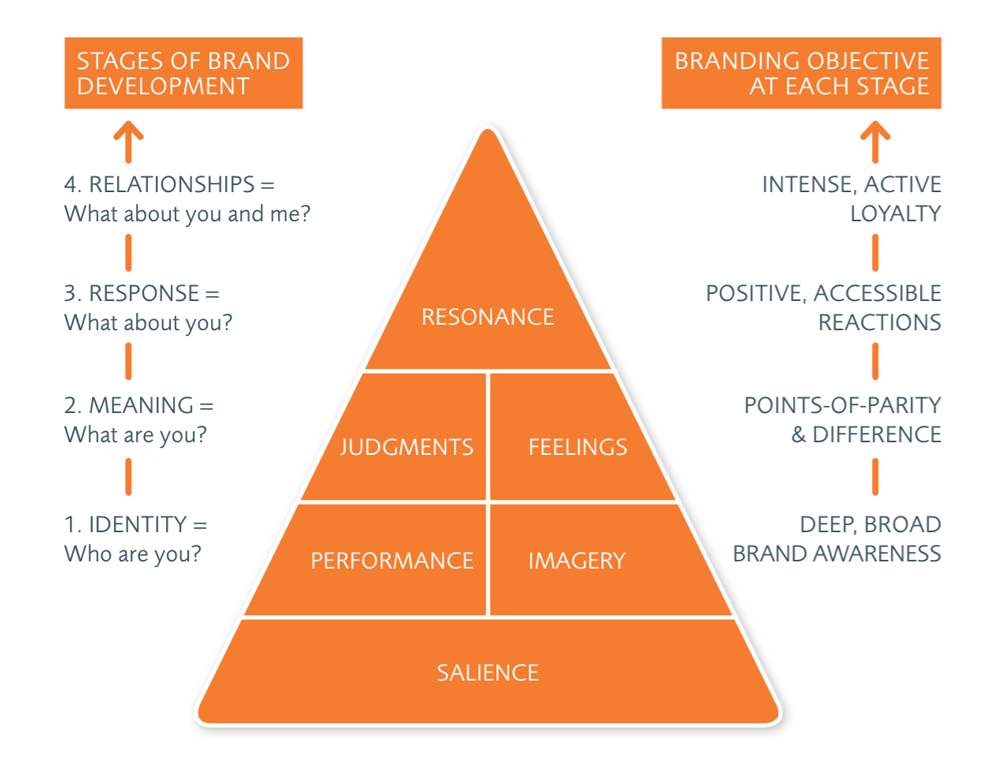
At the base of this pyramid is Salience, or brand identity. Who is the brand and how do people recognize it? The next level, Meaning, relates to “how you communicate what your brand means and stands for” (Modicom, 2017). This includes the performance of the brand and how imagery meets psychological needs. The third level is the Response to the brand, based on both judgments and feelings of the user. The top of the pyramid is Resonance, or “how much of a connection your customers have with your brand” (Design, 2017). This highest level of brand equity promotes customer loyalty and encourages them to share the brand with others.
Defining a Design Problem
In design research, knowing the problem is the first step. Solving it comes later. Branding a district is not a design problem. Instead, you must ask a specific question. How do I change the perception of this place for the target audience? How do I communicate the affordability of housing while still speaking to an affluent audience? Answering questions like these requires knowing the four dimensions of brand equity: brand loyalty, brand awareness, brand associations, and perceived quality (Design, 2017). If there are negatives, focus on the positives. By asking the right questions, you can find effective ways to build brand equity.
References:
Design, I. (2017, December 3). What Is Brand Equity and Why Is It Valuable In Business? Retrieved from https://medium.com/@inkbotdesign/what-is-brand-equity-and-why-is-it-valuable-in-business-a2f875b5e13.
Freach, J. (2011, November 22). The Art of Design Research (and Why It Matters). Retrieved from https://www.theatlantic.com/entertainment/archive/2011/05/the-art-of-design-research-and-why-it-matters/239561/.
Keller, K. L. (2013). Strategic brand management: building, measuring, and managing brand equity. Boston: Pearson.
Modicom. (2017, July 24). Building Brand Equity. Forbes. Retrieved from https://www.forbes.com/sites/propointgraphics/2017/07/08/building-brand-equity/#1b0f2cc76e8f.
 Joshua Siegel's Mastery Journal