
Mastery Goals
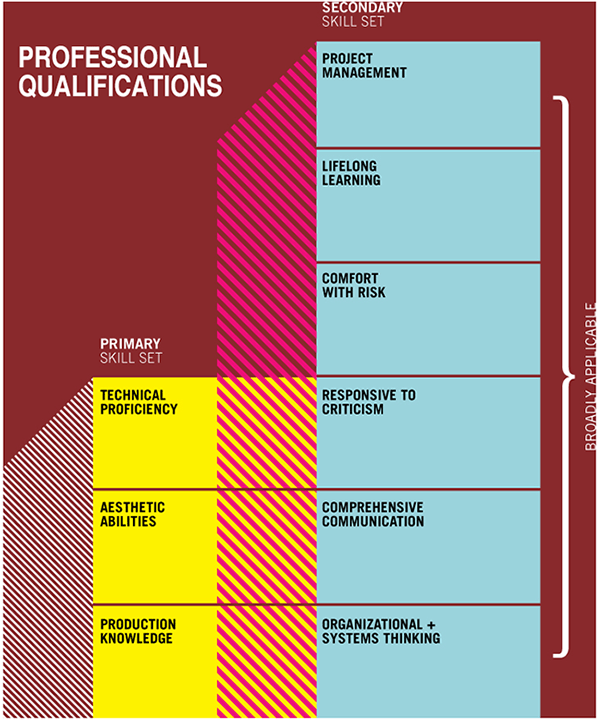
The first live session of Design Research reviewed the month’s projects and how to apply learning from previous courses. Professor Argo’s comments helped me realize the importance of revisiting personal / career goals to determine an education strategy. After losing everything in the Camp Fire last November, I decided to pursue a Master’s degree to help me get more work as a teacher. Now five months into the Media Design MFA program, I understand that I can also redirect my career as a freelance designer / writer / storyteller. The knowledge gained from these courses adds to my professional qualifications in both the primary and secondary skill sets charted in the graph below from Design Currency (O’Grady & O’Grady, 2013).
Active Learning
Professor Argo also encouraged the class to engage in active learning. The Safari Books and Lynda.com subscriptions that are included in the program have helped advance my technical proficiencies and production knowledge, but having so much available information can sometimes feel overwhelming. I need to take a closer look at the job market then focus my time and energy on the specific skills needed to advance my career. Each class in the Media Design MFA program has built on the last, developing my research and strategy skills while I independently develop my technical expertise in vector graphics and design with online courses like Logo Design: Illustrating Logo Marks (Glitschka, 2016). These secondary courses reinforce many of the lessons from the program classes, such as the importance of distinction from competitors and brand continuity.
The difference between art and design.
Art is a personal expression of its creator. It can be interpreted in different ways depending on the viewer and context. Design, however, has a purpose that is unrelated to its creator. Media Design communicates a very specific message, a problem to be solved or a need to be met. The key to effective design is to know what you’re communicating and who you’re communicating to. Designs can be made more powerful by following certain guidelines like David Airey’s “elements of iconic design” described in Logo Design Love (Airey, 2014). Although Airey’s advice pertains to logos, other design ingredients like headlines and colors should be also distinctive and relevant to the message being communicated.
References:
Airey, D. (2014, August 20). Logo Design Love, Annotated and Expanded Edition, Second Edition. Retrieved from https://ce.safaribooksonline.com/book/branding/9780133812589
Glitschka, V. (2016, August 10) Logo Design: Illustrating Logo Marks. Retrieved from https://www.lynda.com/Illustrator-tutorials/Foundations-Logo-Design-Illustrating-Logo-Marks/475455-2.html
OGrady, J. V., & OGrady, K. V. (2013, June 21). Design Currency: Understand, define and promote the value of your design work. San Francisco, CA: New Riders. Retrieved from https://ce.safaribooksonline.com/book/design/9780133052862
 Joshua Siegel's Mastery Journal