Week One of the Organizational Structures course was an introduction to Motion Design. The Live Session video was prerecorded because of the Thanksgiving holiday. This week’s instructional materials introduced motion graphics foundations like the principles of animation and offered insights from several industry leaders.
Motion Design Insights
Brandon Parvini of Ghost Town Media remarks “When everyone else is getting trained by the exact same teachers, everyone’s work starts looking the same” because designers are learning techniques from the same online tutorials (Cox & Parvini, 2014). To differentiate from competitors, inspiration should be found outside of the motion design field. Explore music, architecture, nature, anything that stretches the mind in new directions. Research should be fun. Alberto Scirocco (2014) supports this methodology by advising designers to explore different aspects of their creativity and bring those lessons back to their designs.
Alberto Scirocco and the Motion Graphics of leftchannel
Scirocco states that “Good design connects a message with a person” (Scirocco, 2014). Motion Designers use variety of techniques that require trial & error, exploring how things move and elements interact. It’s important to know typography, color theory, animation principles, and more. Specialization is good, but you should at least know the terminology of other disciplines. Scirocco notes that leftchannel designers rotate through roles on different projects. Having a balance between technical skill and creativity is important. “The more experience you have, the more complexity to you as an individual, the more interesting your work is going to be” (Scirocco, 2014). Furthermore, Jeremy Cox (2014) recommends looking outside the art world to things like data visualization in the tech world.
Diegetic and Non-diegetic Sound
Sound is often the last thing considered when creating motion designs and films. But as Star Wars creator George Lucas once noted, “Sound is half the experience.” A skillfully crafted soundscape immerses the audience in the experience. When talking about sound design, Josh Hanson (2014) describes the difference between Diegetic Sound and Non-diegetic sound.
Diegetic: Sounds that on-screen character(s) would hear such as dialogue and sounds occurring within the film.
Non-diegetic: Sounds that on-screen characters won’t hear such as the soundtrack music or narration.
The fifth month of Full Sail University’s Media Design MFA
program was focused on Design Research. Design research is different than the pure
research or applied research conducted in other professional fields. Rather, it
is a research-driven design process that explores how a problem is solved, then
communicates the value of the solution. This goes beyond learning about design
elements like typography or color theory. Design research requires looking at a
design problem from multiple angles to uncover new ideas and solutions.
We learned the concepts and methodologies of design research
through place branding assignments. The readings and videos established a strong
basic knowledge, and the assignments put this newly acquired knowledge into practice.
Over a three week period, students were
tasked with choosing a local neighborhood, then conducting a brand analysis and
comparative analysis. We conducted primary research by exploring and
photographing the chosen neighborhoods, then used secondary research to discover
the current brand equity and find ways to differentiate it from similar neighborhoods.
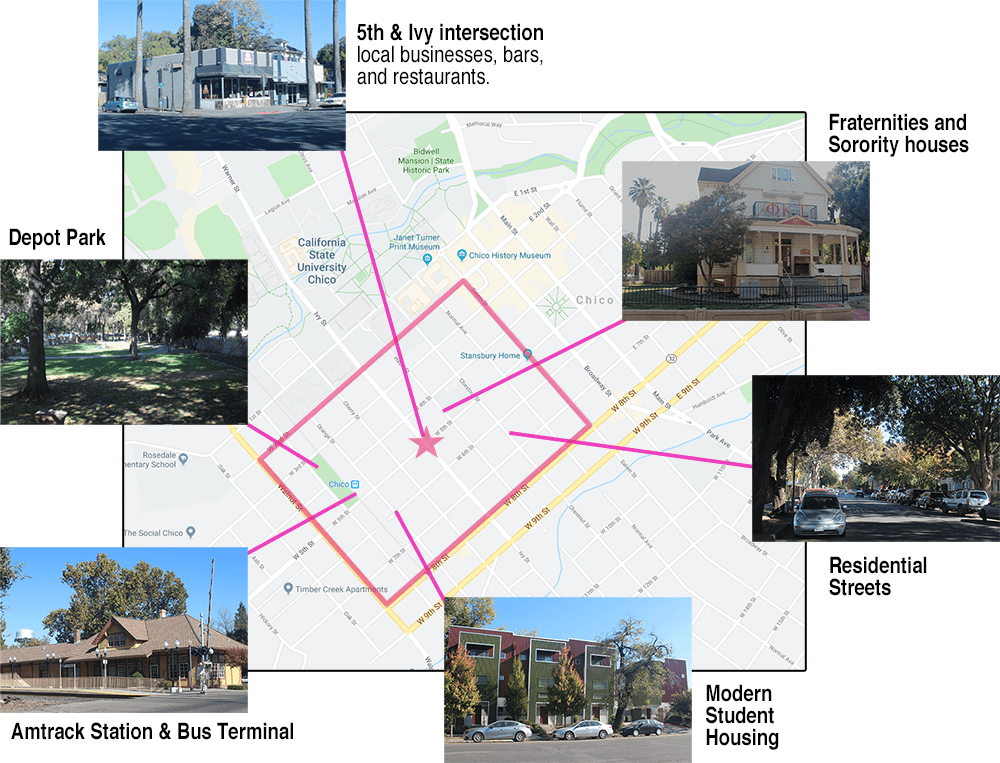
I chose the “U-Town” area in Chico, California. As the oldest residential neighborhood in the city, it has many positive qualities that have often been overshadowed by a reputation for college house parties. For an overview of how each assignment contributed to the learning process, read “Learning Design Research Through Place Branding”.
Prior to each assignment, Professor Argo provided links to
multiple online articles and videos related to the assignment. These
instructional materials established strong knowledge of Place Branding, Brand
Equity, Design Research, and Differentiation. Each week built on previous
lessons in a logical progression. For example, the article “5 Place Branding
Principles for Successful Brand Development and Management” detailed the principles
inherent to effective place branding: distinctiveness, authenticity,
memorability, co-creation, and a sense of the place that drives emotional connections
(Editorial Team, 2019). These principles were reinforced by research into the
current brand equity of the U-Town neighborhood (its authenticity, memorability,
and sense of the place) and a comparative analysis to find its differentiation
(or distinctiveness).
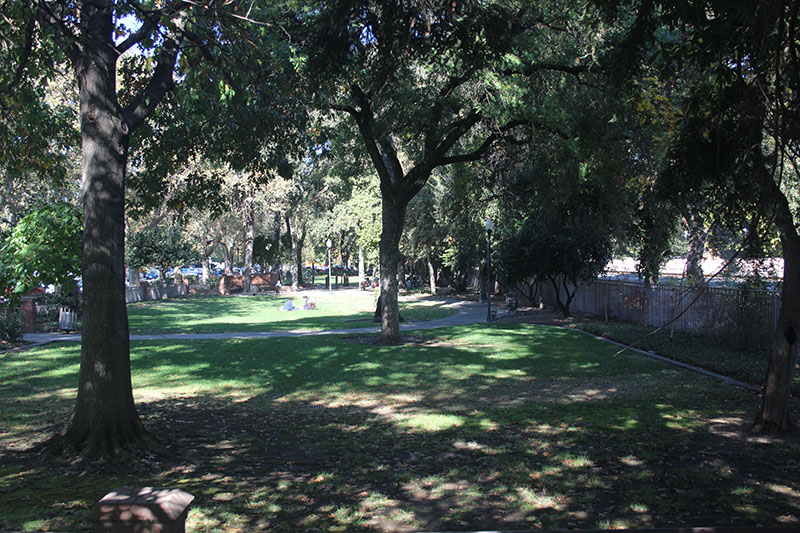
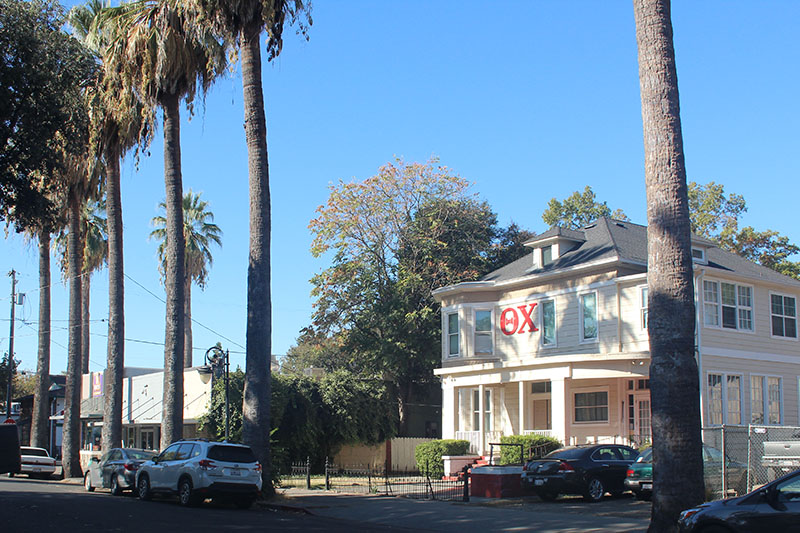
In a video from Gerson Lehrman Group, Turi McKinley explains how design research has both immersion and discovery stages (GLG, 2016). The immersion stage dives deep into the brand’s current equity and needs. The discovery stage explores possible solutions by getting hand-on interaction with people, places, and objects. For the U-Town branding project, the immersion phase was online secondary research into the history and current brand equity of the neighborhood. The information gathered in this phase led to connections made in the discovery stage. Several misconceptions were dispelled by exploring and photographing U-Town. A 2016 article in the Chico News and Review described the neighborhood’s history of raucous house parties and drunken riots, but also noted measures being taken by the city and Chico State to make the area safer for students and residents (Hardee, 2016). A visit to the area on a Saturday afternoon to gather primary research confirmed that those measures were largely successful. Students still drink and party, but those parties no longer spill into the streets and the neighborhood has a very laid-back peaceful vibe.
Depot ParkFraternity house
Problem Solving
The ultimate purpose of design research is solving a design
problem. The first step is defining the problem statement. Branding a district
is not a design problem. Instead, you must ask a specific question, such as “How
do I change the perception of this place for the target audience?” The primary design
problem for branding the U-Town neighborhood is “How do I change the
neighborhood’s party reputation?”
In the LinkedIn Learning video course “Learning Design Research,” Andy Schwanbeck suggests using KWHL tables to directly inform how to solve a problem (Schwanbeck, 2015). For the place branding assignments, the table below categorized the goals for the research process.
K: What do you already know?
W: What do you need to find out?
H: How will you learn it?
L: What do
you hope to learn?
U-Town has largely outgrown its party past, but that reputation remains.
The majority of residents are college students under 30.
A variety of small businesses and restaurants are focused on student needs.
Top reasons why students want to live in the area. Entertainment options besides alcohol.
How is U-Town different from other campus-adjacent neighborhoods?
Brand Equity study utilizing qualitative data from Niche.com neighborhood reviews and studies by the City of Chico Public Works Department.
Comparative Analysis of U-Town, Barber, and Downtown Chico.
What is the current brand equity of U-Town and what is its primary point of differentiation?
The Brand Equity study for U-Town discovered that the most liked aspects of the neighborhood are the beautiful trees and walkability. Both of these aspects provided a path to changing U-Town’s party reputation. The Comparative Analysis study found that the mature urban forest and walkable proximity to the college are two distinctive assets that appeal to nature-minded students. This emphasis on the local, environmentally friendly aspect of the neighborhood can help change its reputation as a raucous party area to a place that is nourishing to personal growth.
Innovative Thinking
A primary take-away from the Design Research course is that innovation
is about differentiation. The place branding research required us to find
the qualities that make a location stand out. Miguel Rivas notes that “distinctiveness
emerges from the singular combination of different city assets and approaching
the city narrative as an honest introspection, projected with healthy optimism
into the future” (Rivas, 2015). Researching a location’s assets and narrative
provides unique insights and understanding of how the brand connects with the
target audience. By synthesizing innovative designs based on differentiation,
we are building skills that can be used on future brand development projects.
The design research skills learned in the course are basic to the profession, but how they are used is a demonstration of innovative thinking. Finding U-Town’s “Zag” required a deep immersion in its current brand equity plus discovery of its differentiation. Comparisons were made to Downtown Chico, which also suffered from a negative “party town” reputation before being transformed into a family-friendly destination. With effective branding as an environmentally friendly neighborhood, U-Town can make a similar transformation.
Acquiring Competencies
The following are concepts or skills learned in the Design
Research course. They are categorized as Academic (pertaining to school
work) or Occupational (pertaining to work in the Media Design field),
and Technical (pertaining to software or other design skills) or Conceptual
(new terminology, procedures, or ideas).
Week 1
Mastery Goals and Active Learning. Academic, Conceptual.
The difference between art and design. Occupational, Conceptual.
Principles of Place Branding. Occupational, Conceptual.
Week 2
What is Design Research? Academic, Conceptual.
Pure Research vs Applied Research. Academic, Conceptual.
In the final week of Design Research, we are updating our Mastery Journals to describe our progress and reflect on the course. The overview will include documentation of what we’ve learned and how we’ve met the learning objectives. To demonstrate Innovative Thinking, we must compare our work to others in the industry. Professor Argo noted that innovative thinking can be applied even if the product isn’t 100% innovative. For example, our place branding research uncovered unique qualities to neighborhoods that are unremarkable at first glance. The comparative analysis was an important tool for discovering differentiation and “finding the zag” as recommended by Marty Neumeier (2006). This innovative thinking helps us understand the choices we must make to create more effective designs.
Differentiation in Place Branding
Innovative thinking is necessary for strong Differentiation.
It requires looking at the status quo, then doing something different. However,
there should be reasoning and purpose behind the differentiation. We compare our
work to others to know WHY they did what they did, not to imitate them. The
article “5 Place Branding Principles for Successful Brand Development and
Management” states that “Place branding is above all about the distinctiveness
of a place” (Editorial Team, 2019). This month’s research was about discovering
the unique qualities of our chosen place that make it stand out in comparison
to its competitors. Professor Argo encouraged us to find an “Onliness”
statement about our place:
_____ is the ONLY neighborhood that _____.
This differentiation will help set the voice and tone for
the visuals we will create in the next class.
APA Formatting
Like all academic writing in the Media Design MFA program, this
month’s Mastery Journal and paper must be written in APA format. Professor Argo
recommended the
Purdue Online Writing Lab as a valuable reference for proper formatting. He
also noted that the APA paper templates included with Microsoft Word may not
necessarily use the correct font, so it is important to check the minor
details. Specifications are there for a reason. They demonstrate
attention to detail, a requirement for mastery and professional success. In the
book Mastery, Robert Greene suggests that artists’ works suffer when
they “think in large brush strokes” (Greene, 2013). Attention to detail
demonstrates a deeper understanding of the work, helping it connect with the
audience.
References:
Greene, R. (2013). Mastery [VitalSource Bookshelf version]. New
York: Penguin Books. Retrieved from vbk://9781101601020
This week was all about finding differentiation: one
thing about the brand that provides the best value and sets it apart from the
competition. In his book ZAG, Marty Neumeier explains that “radical
differentiation doesn’t test well in focus groups” (Neumeier, 2006). People
will claim to want more of the same, but better. Real innovation can be
uncomfortable to many because it’s new and often risky. This leads to a level
playing field of sameness. In the video “Why Isn’t Your Brand Differentiation
Working?”, David Brier says that “Finding and taking advantage of
differentiating factors in your brand communications serves to unlevel this
playing field” (Brier, 2018). This week’s research will help us find useful
differentiation for our place brand. Neumeier concluded that the keys to finding
your zag are “hitting ’em where they ain’t (differentiation) and getting in
front of a parade (finding a trend)” (Neumeier, 2006).
You can’t be all things to all people.
Research provides a wealth of information that must be funneled
down to find focus. That focus is your differentiation. It’s important to
find the unique qualities that are of worth to the target audience. In
the video “Why Isn’t Your Brand Differentiation Working?”, David Brier states “it’s
important to find aspects of your brand that are superior/unique and align with
the target audience’s wants and needs” (Brier, 2018). Professor Argo added that
we should come up with one or two words that define the theme of what we’re
finding and where we want to go. This umbrella concept will guide the
voice and tone of our designs.
Innovation in Media Design
Professor Argo reminds us that innovation is about differentiation. Our place branding research is all about finding the qualities that make a location stand out. Miguel Rivas notes that “distinctiveness emerges from the singular combination of different city assets and approaching the city narrative as an honest introspection, projected with healthy optimism into the future” (Rivas, 2015). Researching a location’s assets and narrative provides unique insights and understanding of how the brand connects with the target audience. By synthesizing innovative designs based on differentiation, we are building skills that can be used on future brand development projects.
Pure (or Basic) Research looks for understanding of the theoretical aspects of a subject, relying on quantitative data for answers. Applied Research looks for knowledge to solve a specific problem. Design Research is a form of applied research that involves looking at a problem from different perspectives, often using qualitative data to understand the “why’s” of user behavior. Jon Freach notes that design research is not hard science. Instead, it “gives designers and clients a much more nuanced understanding of the people for whom they design while providing knowledge that addresses some of the most fundamental questions we face throughout the process” (Freach, 2011). In other words, design research provides insight of what users need and the best ways to address those needs.
Developing Brand Equity
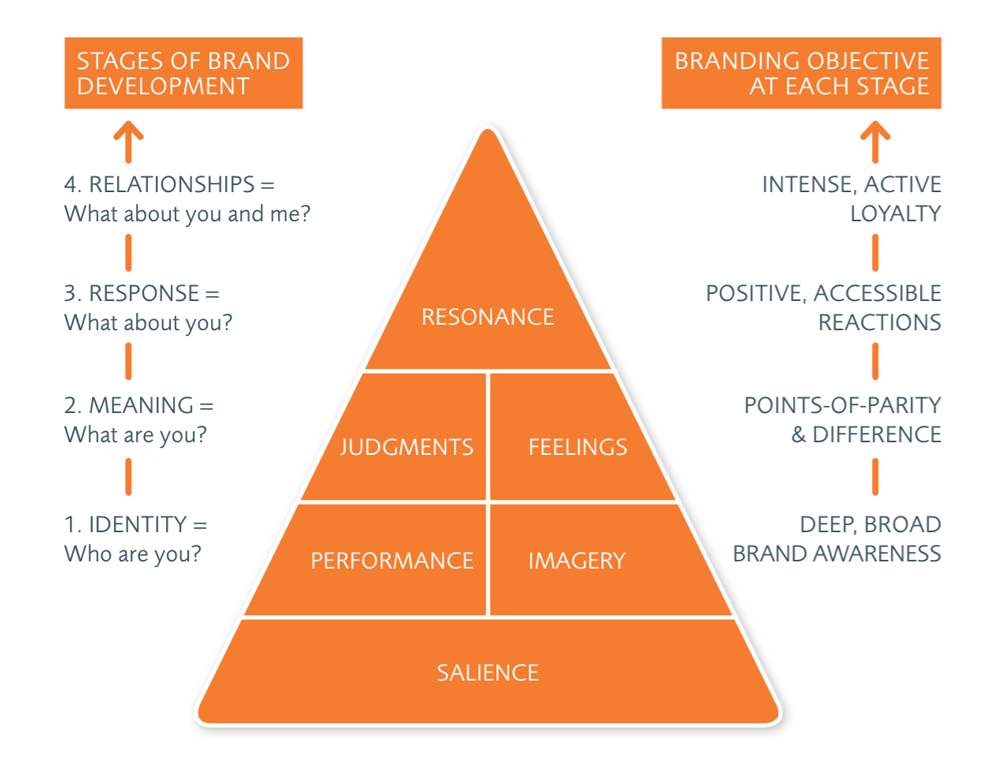
Design strategy can change with understanding of brand equity: how users perceive a brand. What makes it unique? What works and what doesn’t? Articles from Inkbot Design (2017) and Modicom (2017) both refer to the Brand Equity Pyramid described by Kevin Lane Keller in his book, Strategic Brand Management (Keller, 2013). Keller’s model, pictured below, visualizes the stages of brand development used to shape the audience perception of the brand.
Graphic from medium.com and Inkbot Design
At the base of this pyramid is Salience, or brand identity. Who is the brand and how do people recognize it? The next level, Meaning, relates to “how you communicate what your brand means and stands for” (Modicom, 2017). This includes the performance of the brand and how imagery meets psychological needs. The third level is the Response to the brand, based on both judgments and feelings of the user. The top of the pyramid is Resonance, or “how much of a connection your customers have with your brand” (Design, 2017). This highest level of brand equity promotes customer loyalty and encourages them to share the brand with others.
Defining a Design Problem
In design research, knowing the problem is the first step. Solving it comes later. Branding a district is not a design problem. Instead, you must ask a specific question. How do I change the perception of this place for the target audience? How do I communicate the affordability of housing while still speaking to an affluent audience? Answering questions like these requires knowing the four dimensions of brand equity: brand loyalty, brand awareness, brand associations, and perceived quality (Design, 2017). If there are negatives, focus on the positives. By asking the right questions, you can find effective ways to build brand equity.
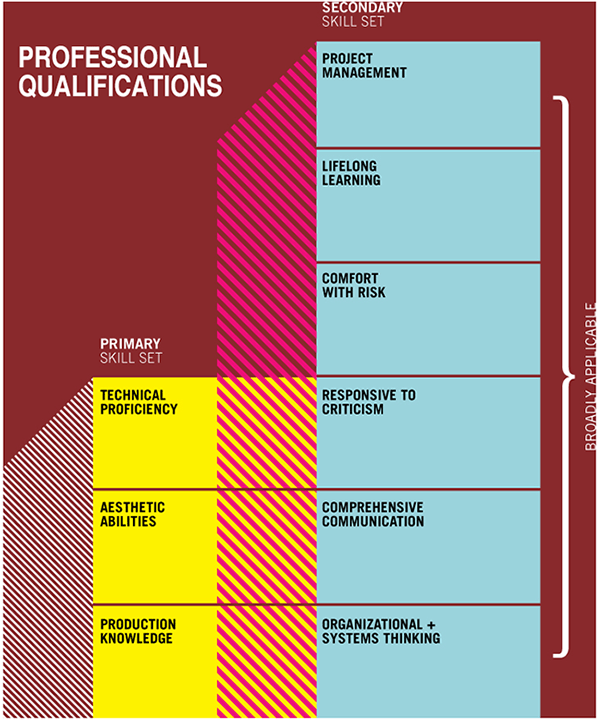
The first live session of Design Research reviewed the month’s projects and how to apply learning from previous courses. Professor Argo’s comments helped me realize the importance of revisiting personal / career goals to determine an education strategy. After losing everything in the Camp Fire last November, I decided to pursue a Master’s degree to help me get more work as a teacher. Now five months into the Media Design MFA program, I understand that I can also redirect my career as a freelance designer / writer / storyteller. The knowledge gained from these courses adds to my professional qualifications in both the primary and secondary skill sets charted in the graph below from Design Currency (O’Grady & O’Grady, 2013).
professional qualifications graph
Active Learning
Professor Argo also encouraged the class to engage in active
learning. The Safari Books and Lynda.com subscriptions that are included in the
program have helped advance my technical proficiencies and production knowledge,
but having so much available information can sometimes feel overwhelming. I
need to take a closer look at the job market then focus my time and energy on
the specific skills needed to advance my career. Each class in the Media Design
MFA program has built on the last, developing my research and strategy skills
while I independently develop my technical expertise in vector graphics and
design with online courses like Logo Design: Illustrating Logo Marks
(Glitschka, 2016). These secondary courses reinforce many of the lessons from
the program classes, such as the importance of distinction from competitors and
brand continuity.
The difference between art and design.
Art is a personal expression of its creator. It can be
interpreted in different ways depending on the viewer and context. Design,
however, has a purpose that is unrelated to its creator. Media Design
communicates a very specific message, a problem to be solved or a need to be
met. The key to effective design is to know what you’re communicating and who
you’re communicating to. Designs can be made more powerful by following certain
guidelines like David Airey’s “elements of iconic design” described in Logo
Design Love (Airey, 2014). Although Airey’s advice pertains to logos, other
design ingredients like headlines and colors should be also distinctive and
relevant to the message being communicated.
 Joshua Siegel's Mastery Journal