The second half of this week was spent revising my Kyoto brand vision boards and updating my SWOT Analysis based on peer feedback.
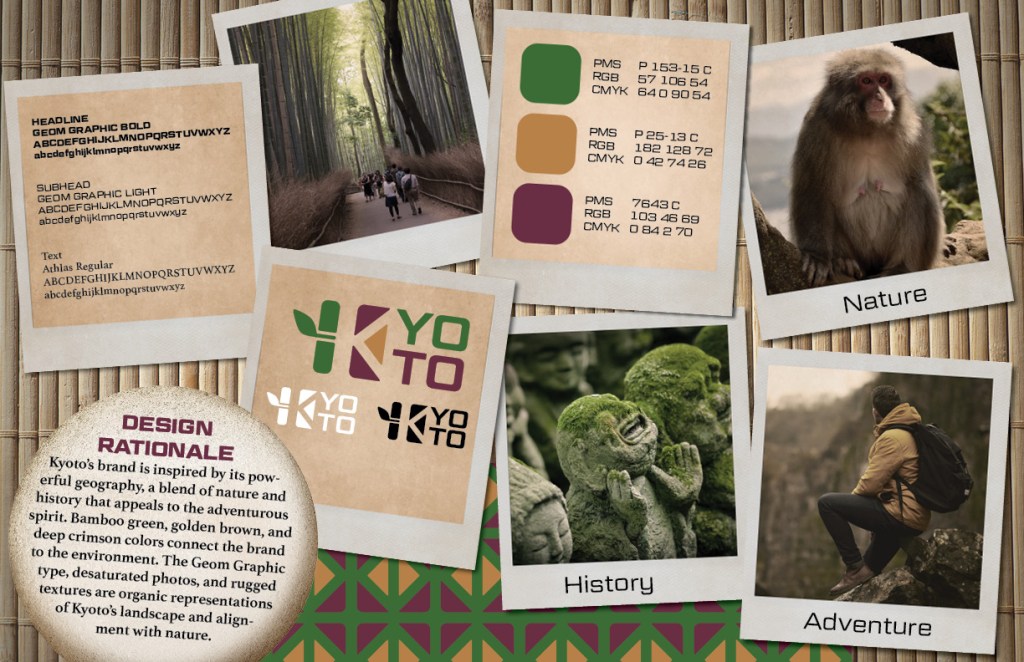
GEOGRAPHY
History – Nature – Adventure
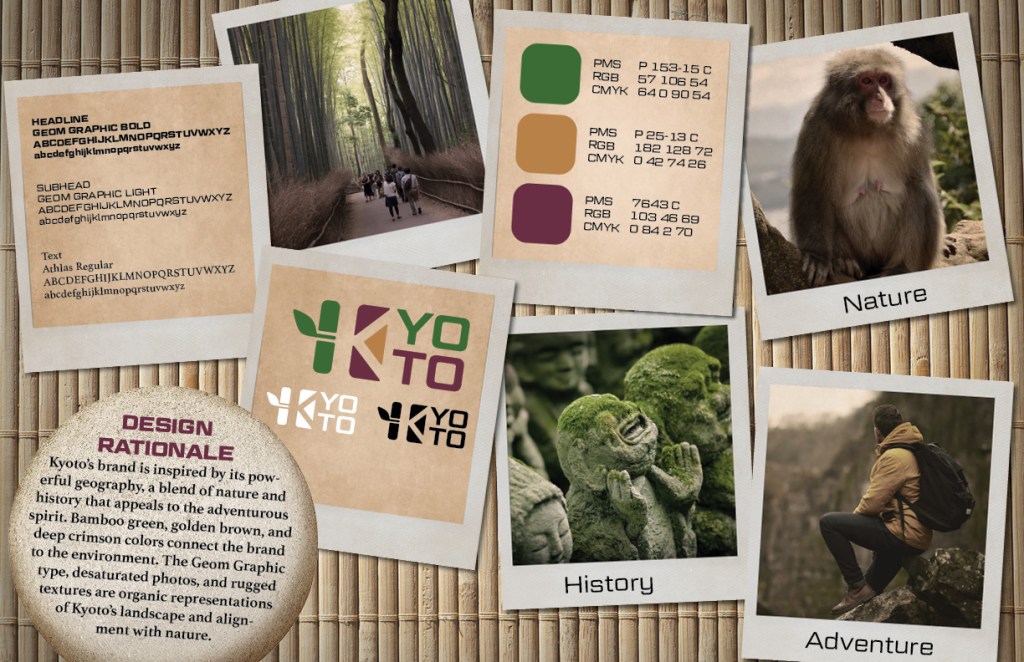
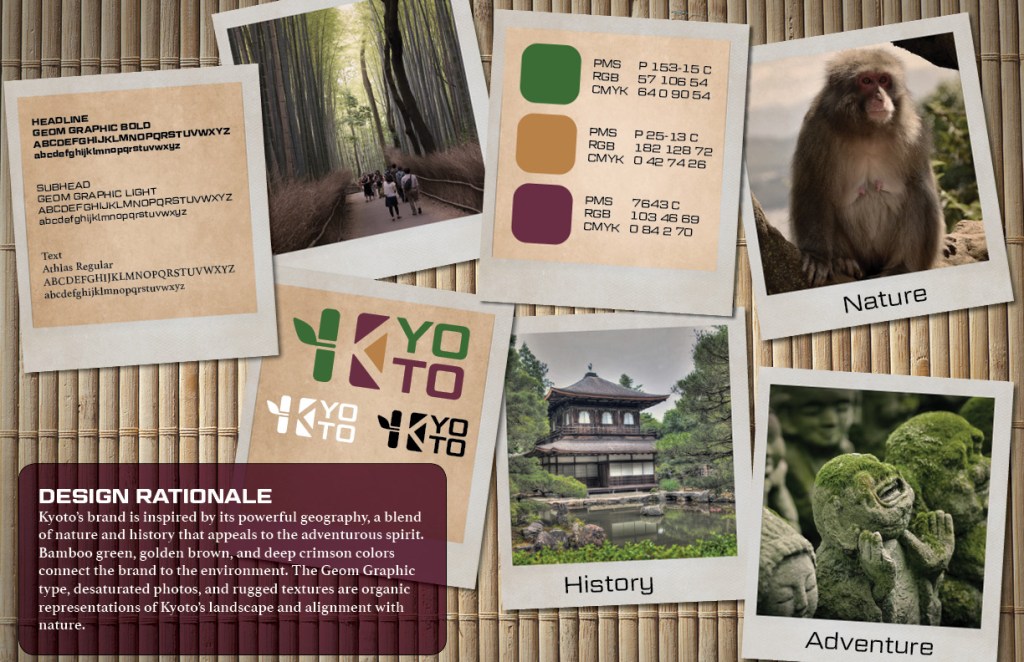
Kyoto geography brand vision board
Design Rationale
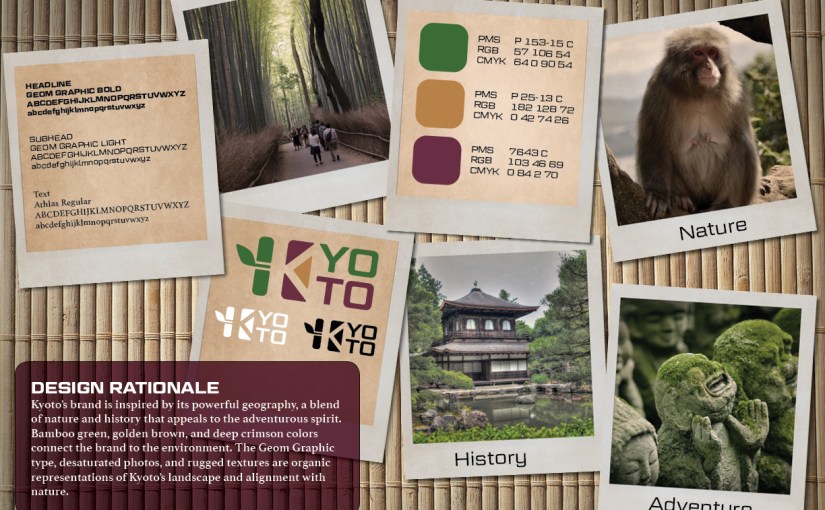
Kyoto’s brand is inspired by its powerful geography, a blend of nature and history that appeals to the adventurous spirit. Bamboo green, golden brown, and deep crimson colors connect the brand to the environment. The Geom Graphic type, desaturated photos, and rugged textures are organic representations of Kyoto’s landscape and alignment with nature.
The first change was to lighten and smooth the rock texture behind the design rationale to help it stand out more. I also adjusted the adventure photo placement and added a brand pattern based on elements of the logo.
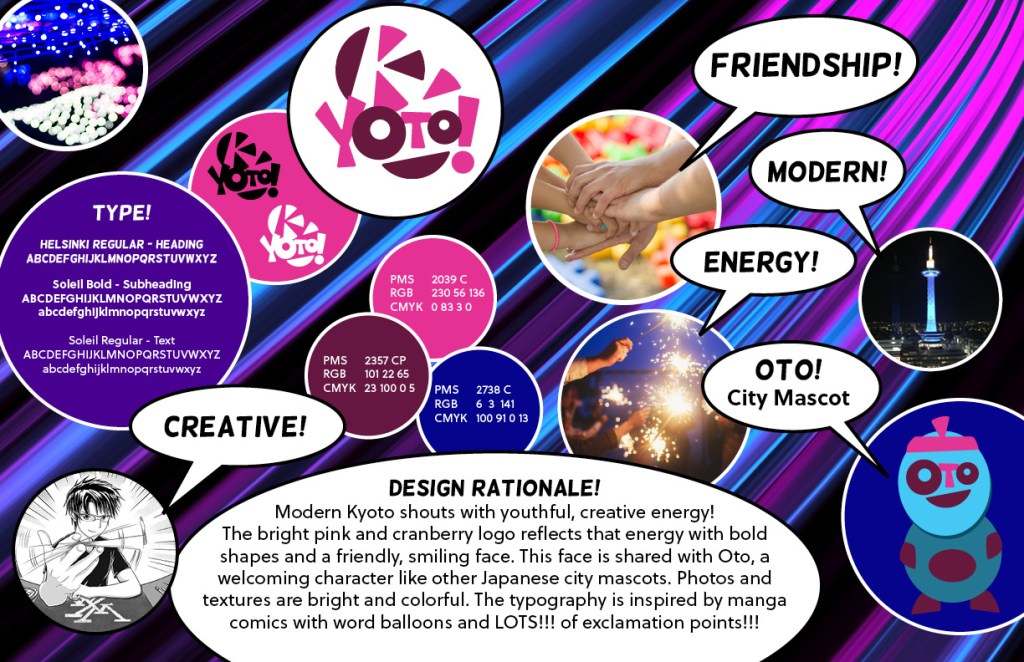
MODERN CULTURE
Creative – Friendship – Modern – Energy
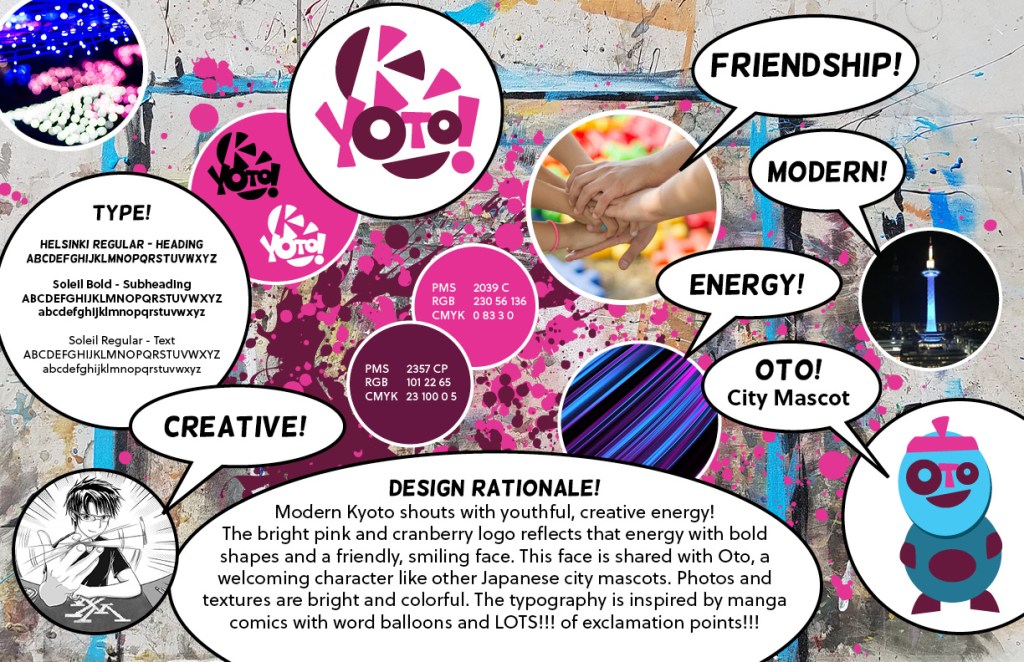
Kyoto modern culture brand vision board
Design Rationale
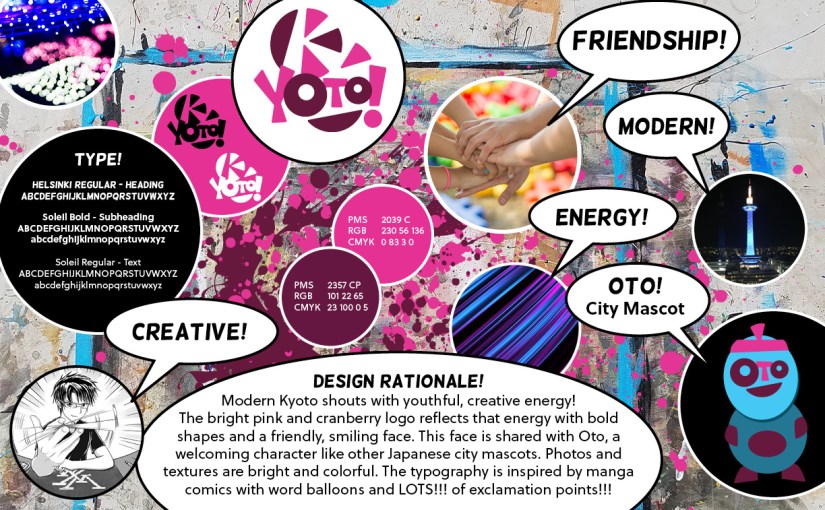
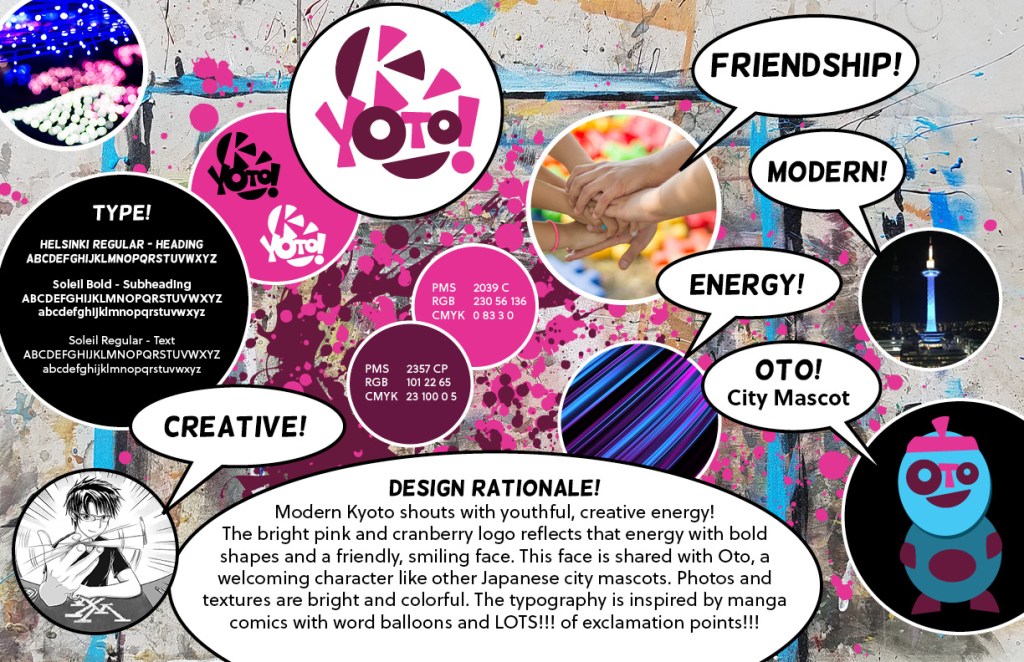
Modern Kyoto shouts with youthful, creative energy! The bright pink and cranberry logo reflects that energy with bold shapes and a friendly, smiling face. This face is shared with Oto, a welcoming character like other Japanese city mascots. Photos and textures are bright and colorful. The typography is inspired by manga comics with word balloons and LOTS!!! of exclamation points!!!
I updated the background of this board based on peer critique, even though the feedback was based on personal tastes and not cited knowledge of the brand. The new background should have a broader appeal to older individuals and those who aren’t in tune with modern art. While not as distinctive as the first solution, it retains the energy of the brand.
A secondary color that doesn’t appear in the logo was also added to the palette. It’s currently only used as the background for the city mascot, but it can be part of brand patterns and other visual assets.
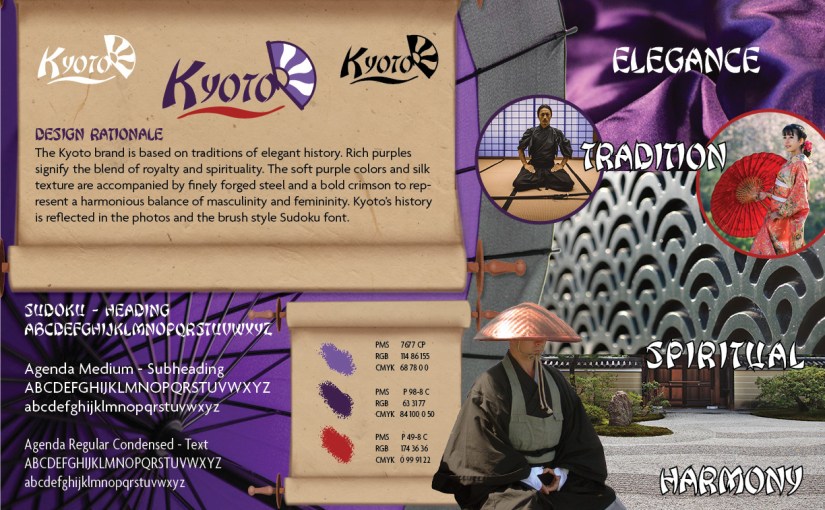
TRADITIONS
Elegance – Harmony – Spiritual
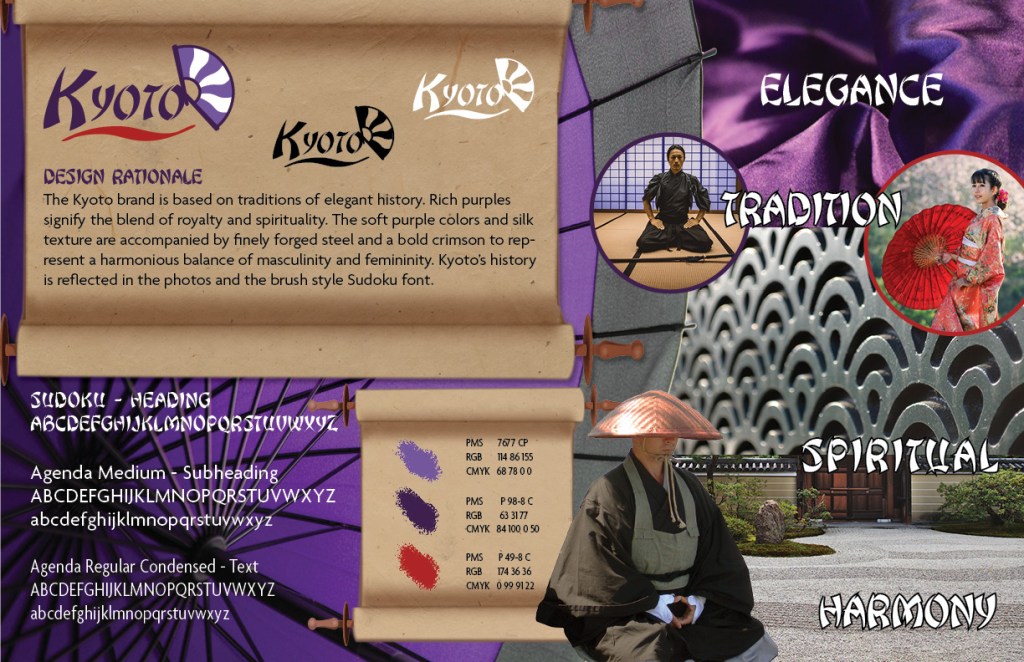
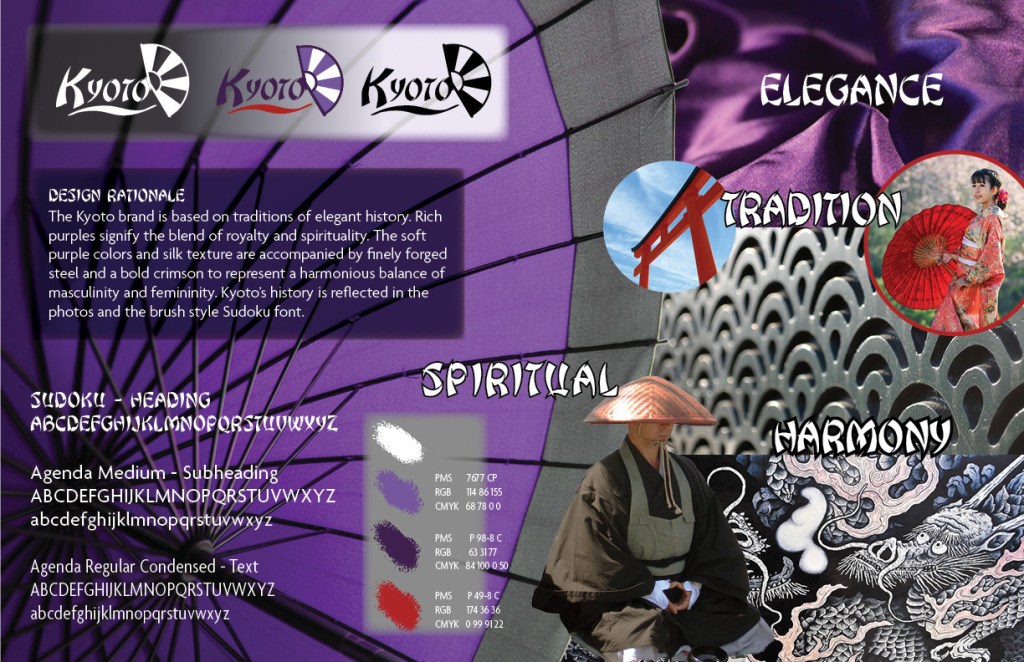
Kyoto traditions brand vision board
Design Rationale
The Kyoto brand is based on traditions of elegant history. Rich purples signify the blend of royalty and spirituality. The soft purples and silk texture are accompanied by finely forged steel and a bold crimson to represent a harmonious balance of masculinity and femininity. Kyoto’s history is reflected in the photos and the brush style Sudoku font.
The Kyoto traditions vision board needed only minor modifications. I lightened the scroll backgrounds and changed the shadows to better match the rest of the design.
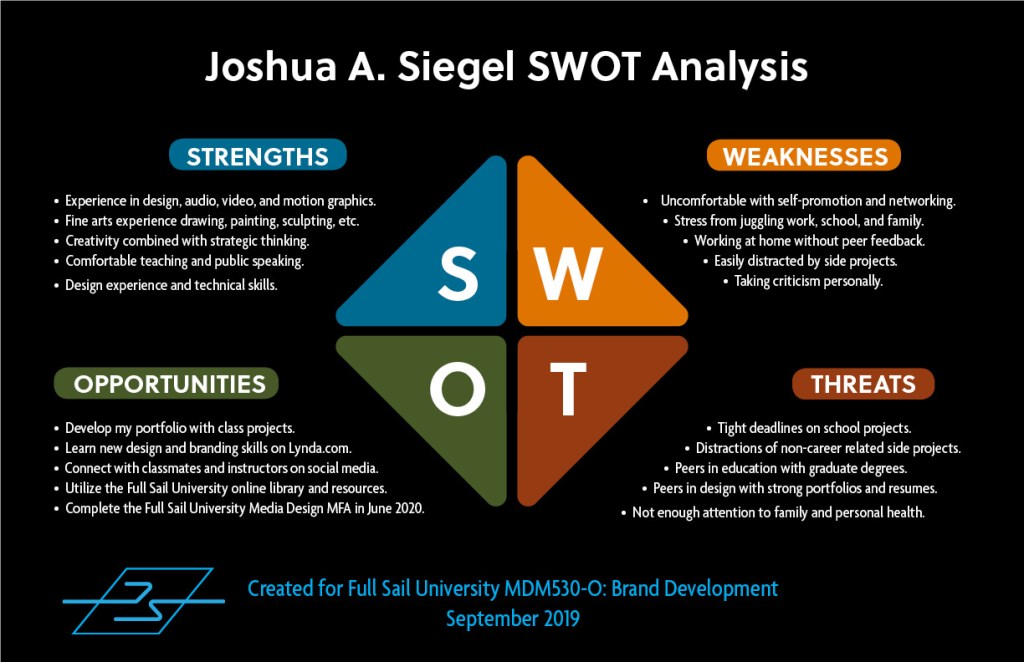
Personal SWOT Analysis Update
A classmate recommended incorporating experiences related to
the Brand Development class. I found additional threats and weaknesses that I
experienced this month, as well as new strengths and opportunities discovered
along the way.
I also simplified the SWOT to concise bullet lists to keep the graphic simple. When writing my analysis, I think of it as TOWS, because I start by looking at external threats and opportunities to overcome those threats. Then I examine my internal weaknesses and find strengths to compensate. This is similar to the way Lisa Quast suggests conducting a personal SWOT analysis (Quast, 2013).
THREATS
Tight deadlines on school projects.
Distractions of non-career related side
projects.
Peers in education with graduate degrees.
Peers in design with strong portfolios and
resumes.
Not enough attention to family and personal
health.
OPPORTUNITIES
Develop my portfolio with class projects.
Learn new design and branding skills on
Lynda.com.
Connect with classmates and instructors on
social media.
Utilize the Full Sail University online library
and resources.
Complete the Full Sail University Media Design
MFA in June 2020.
WEAKNESSES
Uncomfortable with self-promotion and
networking.
Stress from juggling work, school, and family.
Working at home without peer feedback.
Easily distracted by side projects.
Taking criticism personally.
STRENGTHS
Experience in design, audio, video, and motion graphics.
Fine arts experience drawing, painting,
sculpting, etc.
This month I enrolled in the Adobe Education Exchange course Motion Graphics for Educators. I’ve been creating motion graphics for many years, but the class helped me better integrate the newest versions of Adobe Illustrator and After Effects.
WORKSHOP 1: CREATING A STORYBOARD
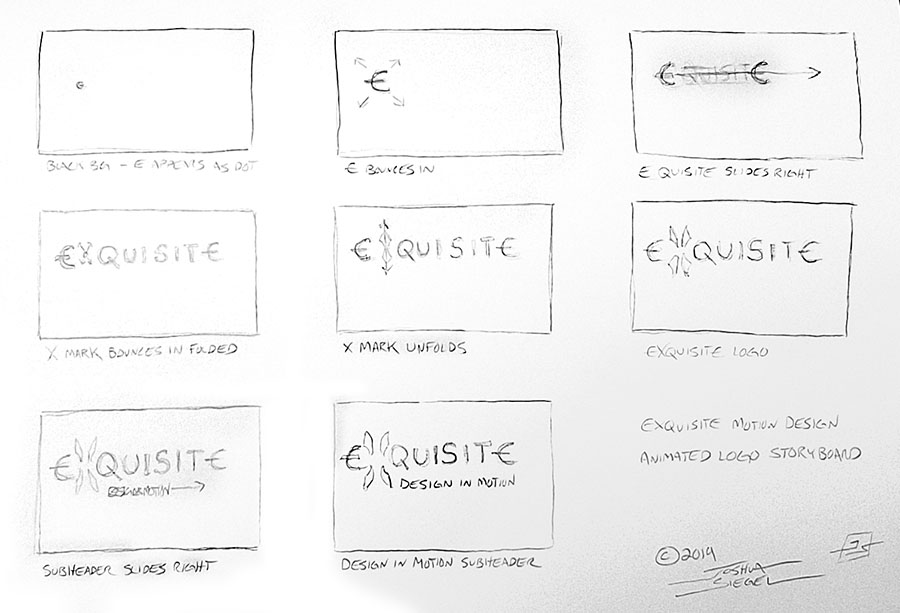
For this assignment, I chose to animate a logo that I recently created. Exquisite is a possible brand for a media design studio, and the animation can be used to promote motion graphics services.
eXquisite logoeXquisite logo animation storyboard
The entire animation will be about 6-8 seconds. As a filmmaker and motion graphics designer, I’m a big fan of storyboarding. It’s an excellent tool for planning shots and trying out ideas in rough form before you even start production.
This animation is relatively simple, but the storyboards will keep me on track when creating the vector assets and timing movements.
WORKSHOP 2 – CREATING GRAPHIC ASSETS
The Exquisite logo was already created in Adobe Illustrator, so I only had to add the assets to my Creative Cloud library and export PNGs to show on this page.
Next, we’ll be animating the graphics in Adobe After Effects.
WORKSHOP 3 – SET UP A MOTION GRAPHICS PROJECT
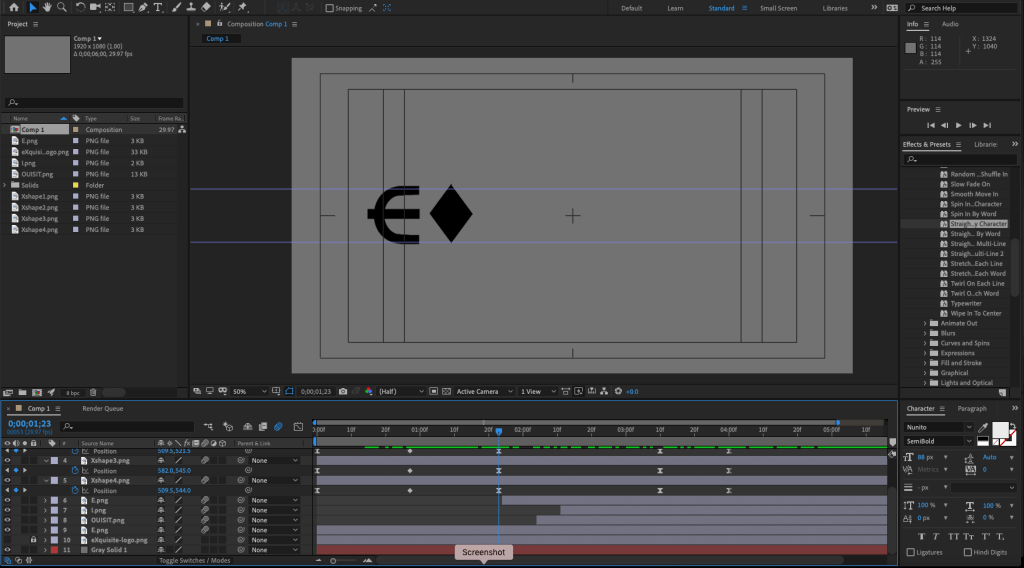
I created a new After Effects composition and imported the graphics assets. A still of the final logo helped me line up everything for the end of the animation.
After Effects project screenshot
I set keyframes for the scale and position of all assets. Next, I will work backwards to the beginning of the animation.
WORKSHOP 4 – MOTION AND VISUAL EFFECTS
With all the visual assets in place, I animated each part starting with the subhead text. For the text reveals, I animated a mask with light feathering. The X logo assets were animated last. After adjusting the timing, I easy-eased the keyframes to make the animation smoother. Finally, I turned on motion blur for all the layers.
After Effects project screenshot
Moving forward with this project, I will experiment with colors, textures, and audio.
WORKSHOP 5 – CREATING A FINAL CUT
After experimenting with metallic textures for the text and background, I decided to keep it simple. I changed the background to dark gray and added a gradient ramp to the main logo. Finally, I added a dark vignette on top of all the layers. Overall the gradient gives the text a 2D lighting effect. On similar projects, I would consider using 3D lighting within After Effects for a more realistic look.
The animations needed some adjustment to make everything smoother and add a little life to the movements. Precomposing the X elements made it possible to add rotation and bounce to the diamond shape before it expands into the X.
The assignment asked for a voiceover, so I tried using my own voice and computer generated speech within Adobe Audition. I experimented with pitch shifting and reverb effects, but nothing felt appropriate for the project. Instead, I mixed a musical sting and a couple whoosh fx to use as the project audio.
eXquisite logo animation
This project was both fun and educational. It was good practice for creating vector assets in Illustrator, animating them in After Effects, and mixing audio with Audition. With these skills I can start making fun explainer videos for my classes.
This week Jose Caceres and professor Andrea Kratz offered
valuable feedback to help improve my Kyoto brand vision boards. Only minor
adjustments were needed for each board, but the changes strengthened the brand
connections.
Geography
Kyoto geography brand vision board
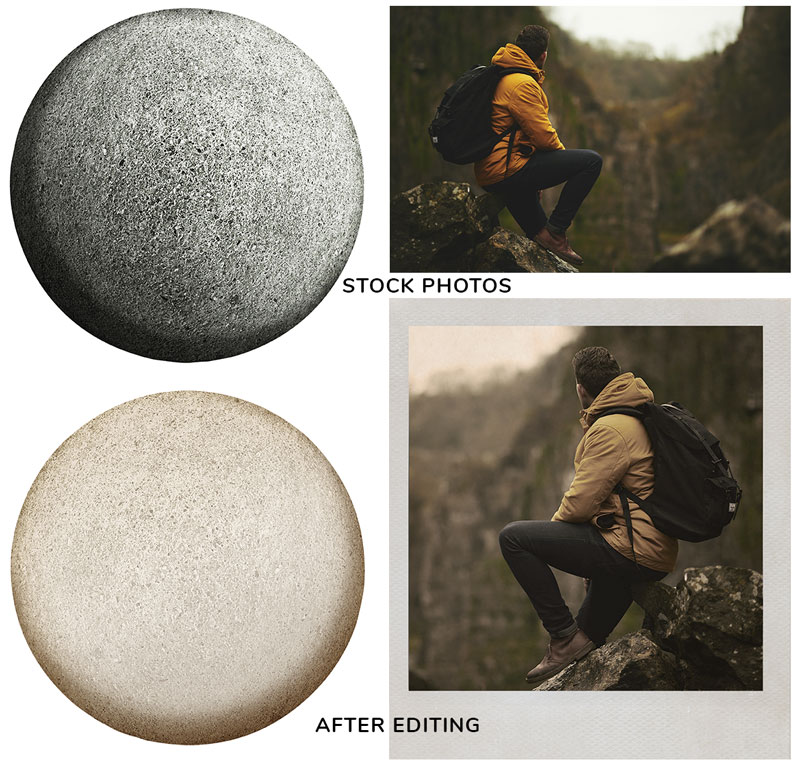
Caceres suggested adding a photo more suggestive of “adventure”, so I found a stock photo that fit the keyword then cropped it, flipped it, and adjusted the colors to more closely match the brand style. I also replaced the “history” temple photo with the moss-covered statues photo that blends both history and nature. Kratz suggested tying the Design Rationale more closely to the design, so I found a round stone image on Adobe Stock and used it as a background with minor hue and brightness adjustments.
On the Freepik.com blog, Orana Velarde offers fifteen ways to customize stock photos to better fit your brand (Velarde, 2017). The image below shows two of the stock images I used, before and after customization.
stock photo customizations
Modern Culture
Kyoto modern culture brand vision board
The modern Kyoto brand vision board needed the fewest
changes. In the Week 4 Live Session video professor Andrea Kratz suggested
changing the background color of some of the bubbles (Kratz, 2019), so I gave
Oto and the typography bubble colorful but dark backgrounds with a white stroke.
This minor change gave the design more contrast and balance.
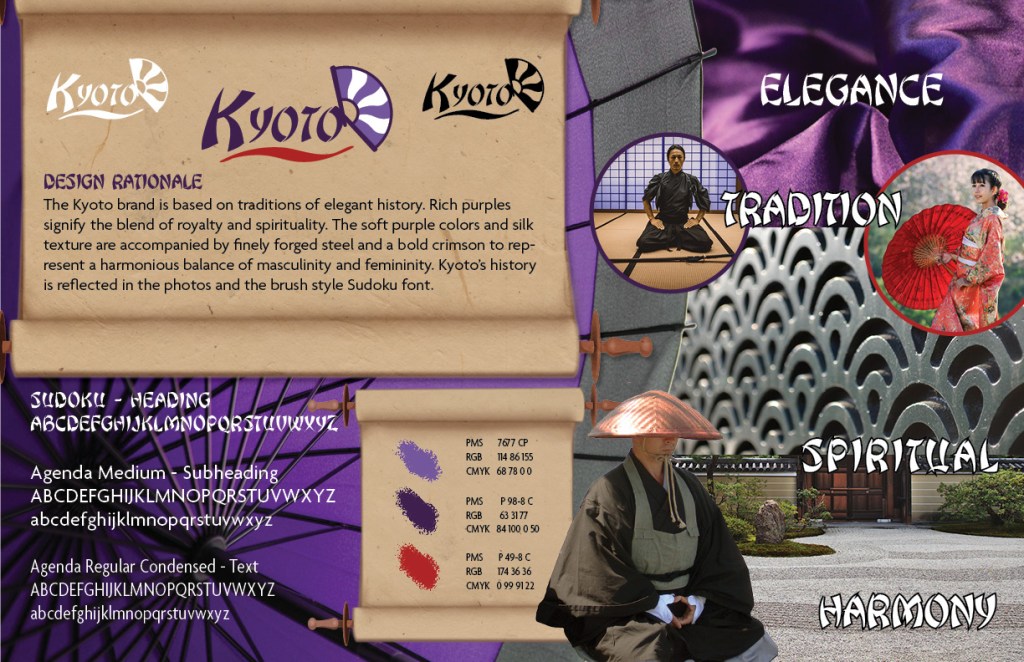
Traditions
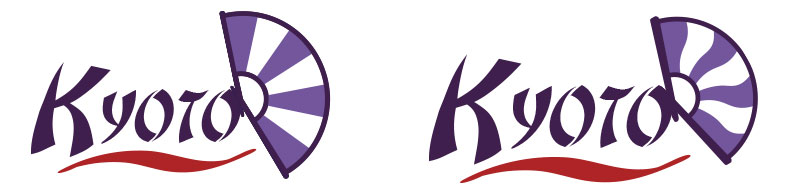
Before updating the traditions brand vision board, I revised the fan logo. The wavy lines on the fan are now more harmonious with the curviness of the wordmark.
Following Kratz’s advice to de-blockify the Design
Rationale, I created a scroll background in Photoshop using elements of clip
art and textured paper. This background worked well for the logos and
rationale, tying more closely to tradition than the previous color backgrounds.
Because it was so effective, I made a second scroll background for the color
palette. This texture can be part of the brand style guide if further
developed.
Caceres suggested adding a photo more closely connected to
“spirituality”. The design was already crowded, so I swapped out the dragons
print for a photo of a Zen garden. I also replaced ambiguous Torii gate photo
with a photo of a samurai. I added the purple background and adjusted the floor
color to match the parchment. The design now feels more cohesive and connected
to Kyoto’s history and traditions. My scroll backgrounds can be adjusted so the
shadows are more consistent with the rest of the design, but that’s a minor
change.
The Mastery journey requires periodic self-analysis of one’s internal Strengths and Weaknesses as well as external Opportunities and Threats. Lisa Quast suggest starting with Threats then identifying Opportunities to overcome those threats (Quast, 2013).
THREATS
Peers with more experience present the greatest threat when
competing for future work. Other college professors already have graduate degrees,
and other designers already have strong portfolios and resumes. Another constant
threat is distraction. Non-career related side projects are fun but do nothing
to further my career or education.
OPPORTUNITIES
I will complete the Full Sail University Media Design MFA program
in June 2020. In the meantime, I will continue to develop my portfolio with
class projects. I will also utilize the Full Sail University online library and
education resources like Lynda.com and Safari books.
STRENGTHS
My years of design and media production experience have
given me a wide range of technical skills, from motion graphics to web design.
I’m also comfortable teaching and speaking to an audience. Most importantly, I’m
learning to combine my creativity with strategic thinking.
WEAKNESSES
Working mostly from home makes it harder to get peer
feedback. It also leads to distraction by side projects that take focus from my
career and education goals. I’m uncomfortable with self-promotion and
networking, which are necessary for growth and advancement.
I began the process of creating vision boards for each of my
three Kyoto brand concepts. At first, I did not understand the difference
between a mood board, a style sheet, and a brand vision board. Fortunately,
professor Kratz defined each tool in the Week 3 Live Session. The vision board
is primarily a presentation tool to explain how you intend to visualize the
brand personality (Kratz, 2019).
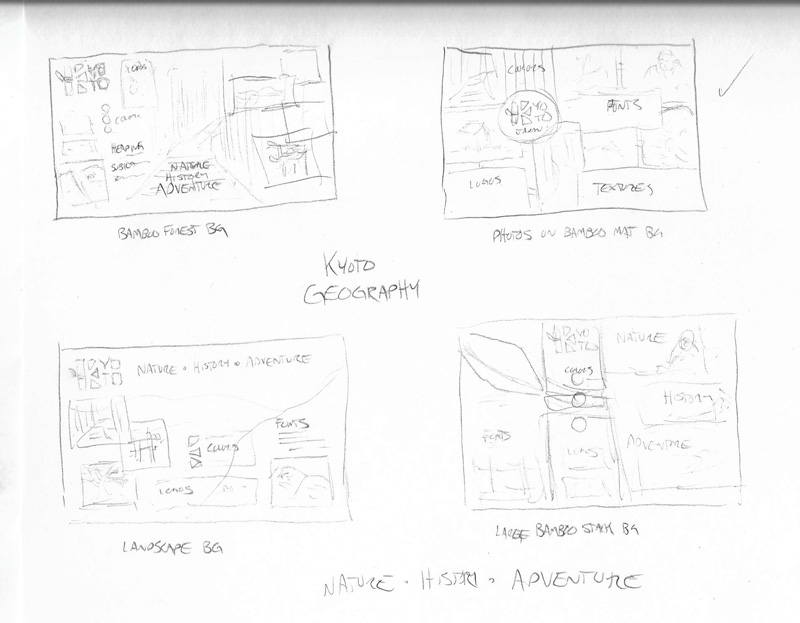
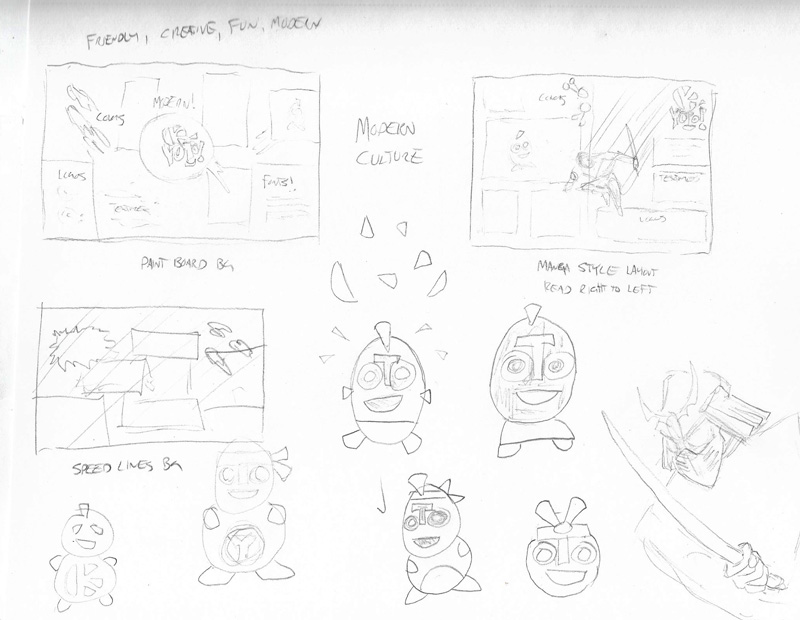
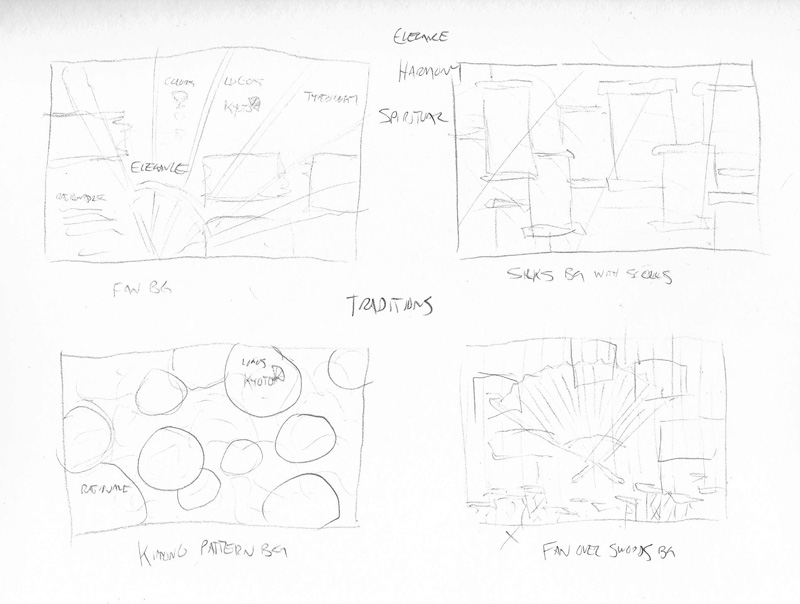
My board prototypes started with rough concept sketches that helped me narrow down ideas.
Kyoto’s brand is inspired by its powerful geography, a blend
of nature and history that appeals to the adventurous spirit. Bamboo green,
golden brown, and deep crimson colors connect the brand to the environment. The
Geom Graphic type, desaturated photos, and rugged textures are organic representations
of Kyoto’s landscape and alignment with nature.
Geography Brand Definition
Key Value 1: reverence for nature
Key Value 2: independence
Key Characteristic 1: adventurous
Key Characteristic 2: natural
Its Differentiation: historic temples surrounded by natural
beauty
Experience / Emotional connection: collecting shared
memories and photos
This brand appeals to adventurous visitors who want to take photos of Kyoto’s natural side. Old Polaroid photos provide an earthy, physical connection to memories. Each frame contains a photo that has been desaturated and lightly sepia toned to match the earth tones of the palette. Other frames contain grungy paper textures displaying the logos, color palette, and typography. The photos are scattered on a natural woven bamboo mat background in a way that leads the eye down toward the design rationale.
Kyoto geography brand vision board
MODERN CULTURE
Creative Friendship Modern Energy
Design Rationale
Modern Kyoto shouts with youthful, creative energy! The
bright pink and cranberry logo reflects that energy with bold shapes and a
friendly, smiling face. This face is shared with Oto, a welcoming character
like other Japanese city mascots. Photos and textures are bright and colorful.
The typography is inspired by manga comics with word balloons and LOTS!!! of
exclamation points!!!
Modern Culture Brand Definition
Key Value 1: creativity
Key Value 2: energy
Key Characteristic 1: fun
Key Characteristic 2: friendly
Its Differentiation: International Manga Museum and other
art exhibits
Experience / Emotional connection: fun with friends
The Kyoto International Manga Museum draws many visitors
each year, and this brand appeals to those who appreciate the city’s young,
creative side (Outline of the Kyoto International Manga Museum, n.d.). I
started with a background photo of my own paint-splattered art table and added
splashes of the brand’s primary colors. The bright, colorful photos and
textures are juxtaposed with word bubbles in a way that appeals to fans of Japanese
fashion and manga.
Yuru-kyara are the cute, adorable, and sometimes creepy
little mascots for Japanese cities and organizations (Niko, n.d.). While
drawing Kyoto modern culture concept sketches, I developed a new yuru-kyara
called “Oto.” The city mascot’s face uses elements from the brand logo, raising
brand recognition and awareness while appealing to modern visitors. The
character design needs refinement, but I wanted to include Oto on the vision
board.
Kyoto modern culture brand vision board
TRADITIONS
Elegance Harmony Spiritual
Design Rationale
The Kyoto brand is based on traditions of elegant history. Rich
purples signify the blend of royalty and spirituality. The soft purples and
silk texture are accompanied by finely forged steel and a bold crimson to represent
a harmonious balance of masculinity and femininity. Kyoto’s history is
reflected in the photos and the brush style Sudoku font.
Traditions Brand Definition
Key Value 1: respect
Key Value 2: harmony
Key Characteristic 1: spiritual
Key Characteristic 2: sophisticated
Its Differentiation: spiritual heart of Japan
Experience / Emotional connection: a spiritual connection to
Japanese history
Most of my concept sketches for the Kyoto traditions were based on the folding fan motif, but while searching stock images I found a photo of a Japanese umbrella that more effectively conveyed elegance and sophistication. I changed the umbrella color from red to purple to reflect the brand color representing spirituality and royalty (Cross, n.d). The Japanese steel texture has a fan-like repeating pattern reminiscent of the fan in the brand logo, adding a refined strength that is balanced by the soft flowing silk.
If color is the strongest and most proprietary part of a visual
system, how can you use it to differentiate the brand identity for the city
represented by your logo from the brand identities of other cities?
Sean Adams recommends doing a color study of the competition.
Find the primary colors that dominate the field, then go the opposite direction
to differentiate your brand from competitors (Adams, 2015).
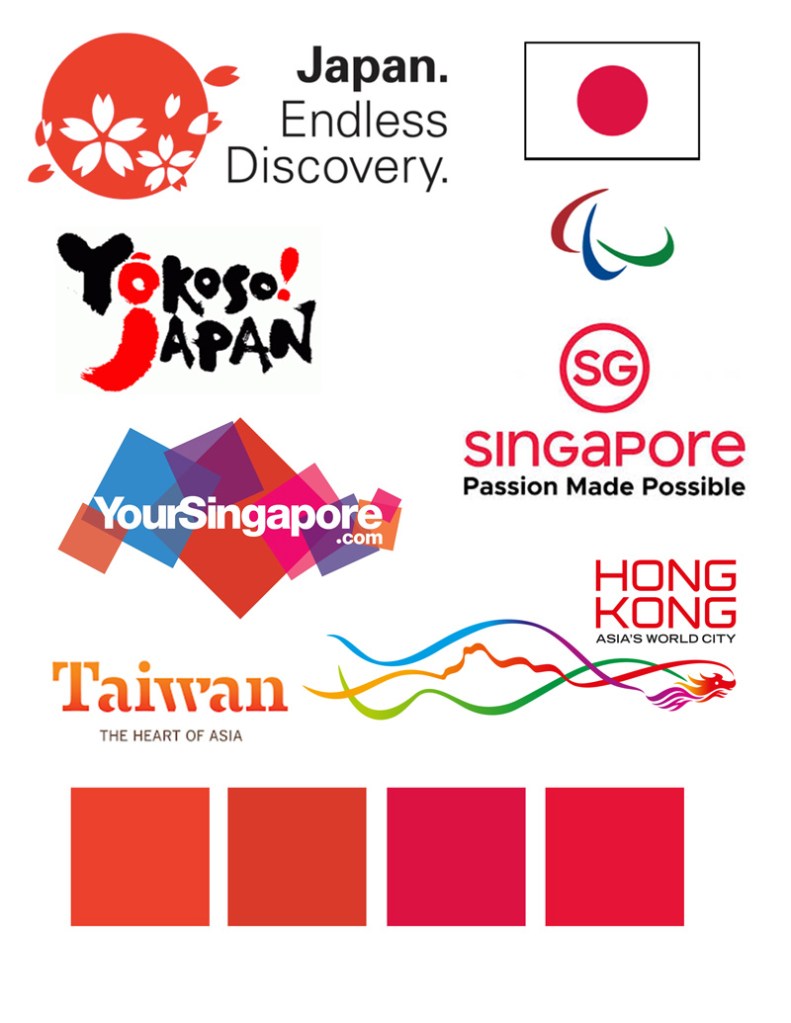
I researched the brand identities of Japan and other Asian countries. Red was the primary color used most often. I saved four swatches of red sampled from the logos and brought that image into Adobe Color.
competition logo colors study
The color wheel helped me find a hue of green that is opposite
the competition’s red color. I then used that green as a starting point for my
city logo color studies.
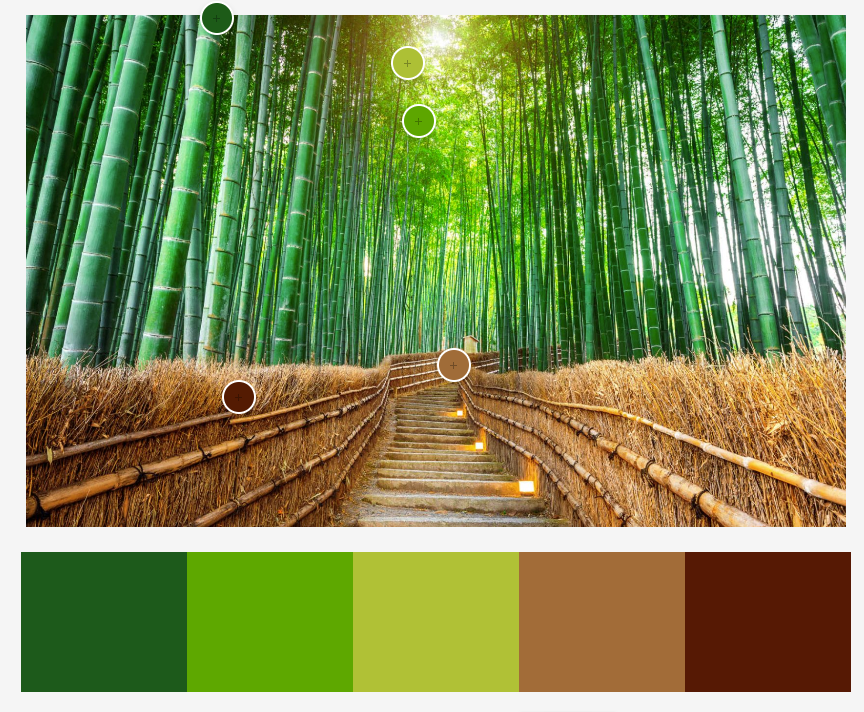
I collected mood photos for each of the three brand identities. For Geography, I used Adobe Color to sample colors from a photo of Arashiyama bamboo forest in Kyoto. The colors in this photo are natural and adventurous according to Steve Douglas, fitting the values and characteristics of the brand (Douglas, n.d.).
bamboo forest color palette
Harajuku fashion is a fun, creative representation of modern
Japan that originated in Tokyo but is popular in Kyoto, so I sampled some of
the most common colors to match the Modern Culture brand definition. After
experimentation with different unique colors, a magenta pink best captured the
friendly, creative spirit of Kyoto without being overtly feminine (Cross,
n.d.).
I repeated the process for the Traditions brand identity,
seeking colors that represent the spiritual sophistication of historic Kyoto.
Again, I consciously avoided bright red to differentiate the brand. Although
the color purple has be overused to represent royalty, it is still effective
for expressing elegance and harmony (Douglas, n.d.).
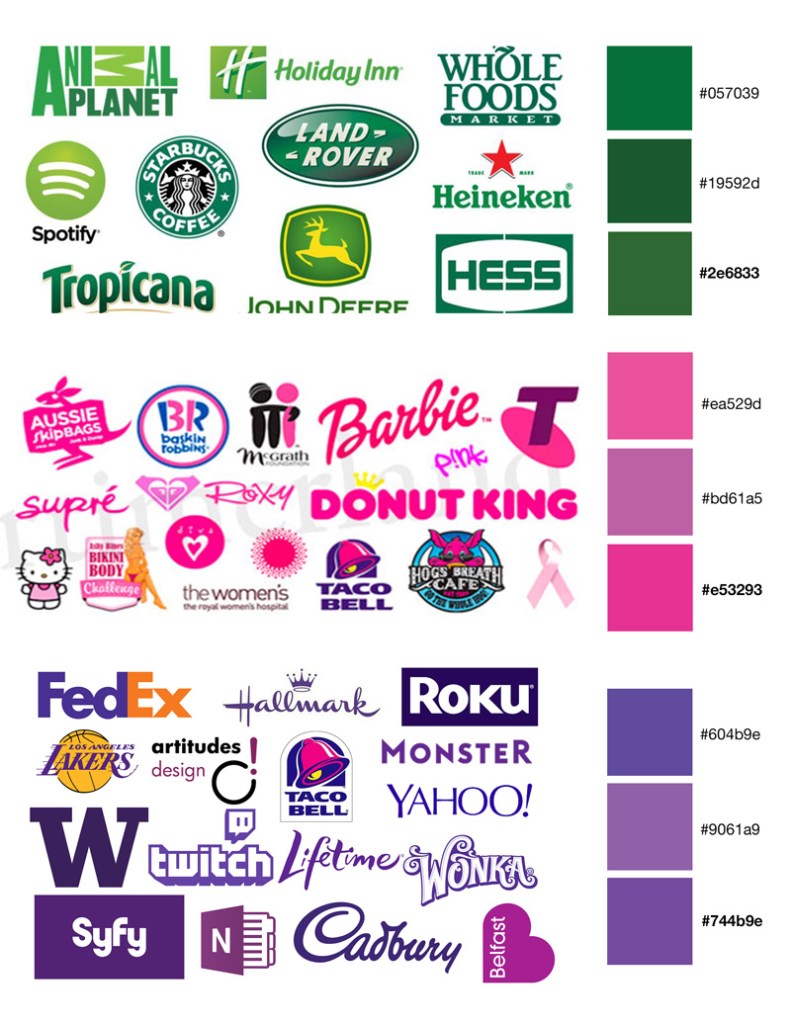
After picking a main color for each of the three brand identities, I made variations to compare with the colors of popular logos. This helped me find unique colors that weren’t immediately identified with another brand.
competition logos color study
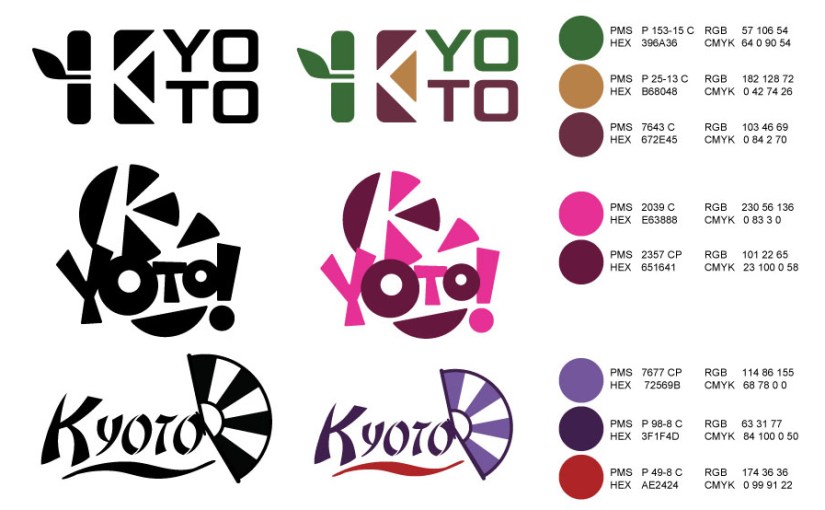
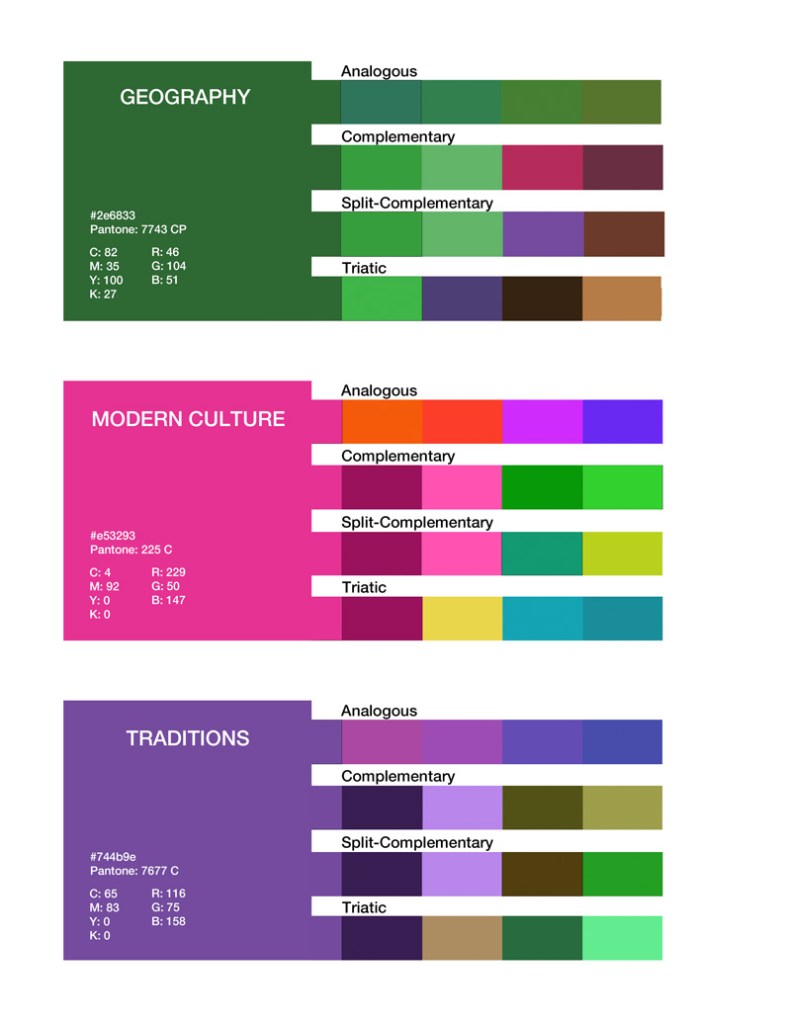
After finding the best variation of each main color, I used Adobe Color to create secondary palettes using the analogous, complementary, split-complementary, and triadic color harmony rules. I labeled the main colors with the hex code, Pantone number, CMYK, and RBG values.
Kyoto city logo colors
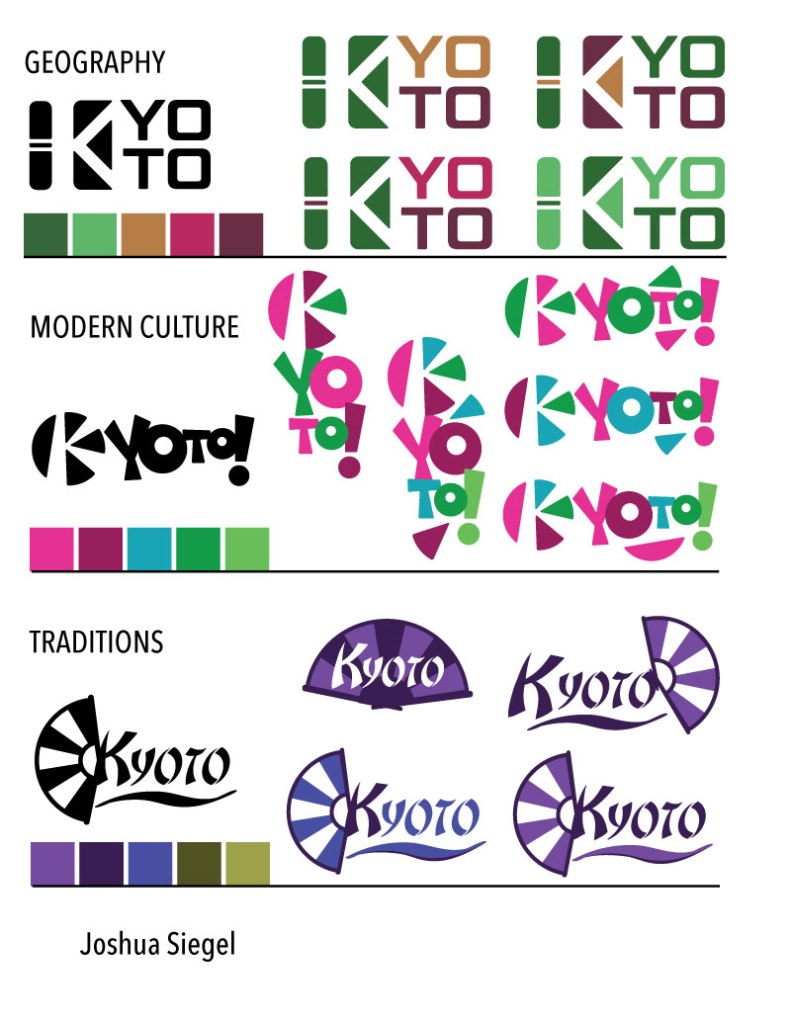
Using those color tests, I selected a secondary palette for each brand identity based on the values and characteristics of each brand. Then I started color tests with the previously designed logos.
Kyoto city logos color studies
Color Choice Rationale
Geography:
Steve Douglas describes green as a serene and peaceful color that represents
health and growth to many people (Douglas, n.d.). The green is complemented by
a dark magenta and earth tones that are adventurous yet simple and comforting
(Cross, n.d). The top right logo is currently the strongest, but much more
exploration is needed.
Modern Culture:
The color choices for this palette are fun and modern without being too
feminine or using overly bright colors that may be difficult to read or
reproduce (Adams, 2015). After exploration in both horizontal and vertical
layouts, the color combinations still don’t feel natural. I will have to
reconsider the two green colors in further development. Although visually
complementary to the pink, green is a peaceful, serene color (Douglas, n.d).
That does not fit with the youthful energy of this brand identity.
Traditions: The purple, its darker shade, and dark blue express the elegant history (Douglas, n.d), but the complementary greens are more appropriate to a nature inspired design (Cross, n.d.). In my efforts to find distinction from competitors, I’ve avoided bright red. However, a deep shade of red may be appropriate as a secondary color in this palette.
Color Logo Revisions
This week I received peer feedback from Krystal Awai, Jorge
Cainas, and Misty Francis. All three gave excellent suggestions on how the city
logo designs and color choices could be improved.
Kyoto geography
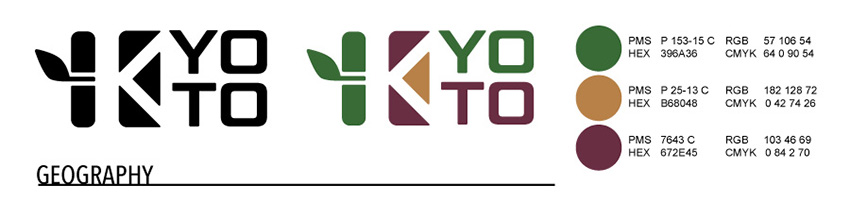
Cainas suggested adding a small detail to the geography logo to make the bamboo icon more recognizable. After trying variations on the bamboo stalk, I found that adding a single leaf was effective way to make the design more distinctive while keeping it simple. The leaf also makes the boxy shaped logo more natural and freer from constraints, keeping with the brand definition.
Geography Brand Definition
Key Value 1: reverence for nature Key Value 2: independence Key Characteristic 1: adventurous Key Characteristic 2: natural Its Differentiation: historic temples surrounded by natural beauty Experience / Emotional connection: collecting shared memories and photos
For the colors, I kept only the primary green and two strongest earth tones.
Kyoto geography revised color logo
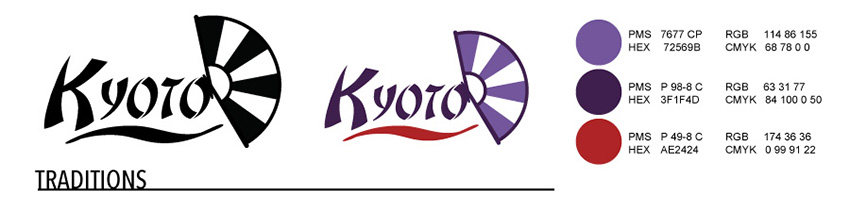
Primary Color: Dark Green PMS P 153-15 C RGB 57 106 54 HEX 396A36 CMYK 64 0 90 54
Secondary Colors: Golden Brown PMS P 25-13 C RGB 182 128 72 HEX B68048 CMYK 0 42 74 26
Dark Magenta PMS 7643 C RGB 103 46 69 HEX 672E45 CMYK 0 84 2 70
Kyoto modern culture
The modern culture logo and color palette both needed improvements
based on feedback from Cainas and Francis. Multiple colors led to color
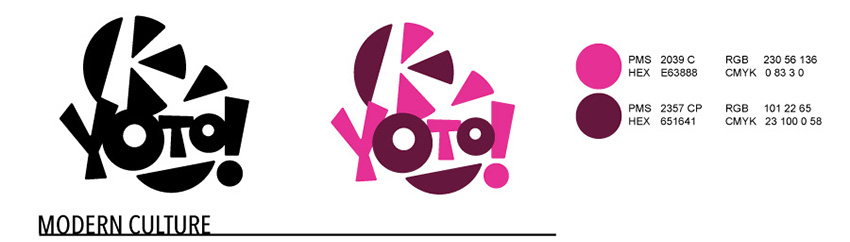
pollution, so I simplified the palette to two colors. Milano Kate Valihura notes that ninety-five
percent of brands use no more than two colors in their logos (Valihura, 2018).
When rearranging the logo, I used the wedges and circle
segment that form the negative space K as accents to the wordmark. Cainas found
the logo more engaging with the newly formed face.
Modern Culture Brand Definition
Key Value 1: creativity Key Value 2: individuality Key Characteristic 1: fun Key Characteristic 2: friendly Its Differentiation: modern but historic Experience / Emotional connection: fun with friends
The bright pink sampled from modern Japanese fashion is a strong fit for the brand, but I chose a slightly different shade that had an exact Pantone match. The dark purple secondary color is more gender-neutral than pink and provides strong contrast.
The traditions brand palette needed more development, so I looked to the traditional Japanese color chart for inspiration. Based on suggestions by Awai, I sampled a dark red from a photo of Romon gate in Kyoto. I then followed Sean Adams’s advice and compared that red to competitor logos, making it slightly more crimson to differentiate (Adams, 2015).
Traditions Brand Definition
Key Value 1: respect Key Value 2: harmony Key Characteristic 1: spiritual Key Characteristic 2: sophisticated Its Differentiation: spiritual heart of Japan Experience / Emotional connection: a spiritual connection to Japanese history
In traditional Japan, purple represented virtue and
spirituality (Tofugu, 2013). Western society also associates purple with
spirituality, royalty, and luxury (Valhura, 2018). A soft light purple fit the
traditions brand, and a much darker violet added depth.
I also included the unique crimson red that evokes Kyoto’s historic shrine gates. In Japanese society, red is a symbol of power with strong connections to religion (Tofugu, 2013).
Valihura, M. (2018, July 24). A Cheat Sheet for Choosing the
Best Logo Colors That Will Grab Your Audience’s Eye. Retrieved from https://foundr.com/best-logo-colors/
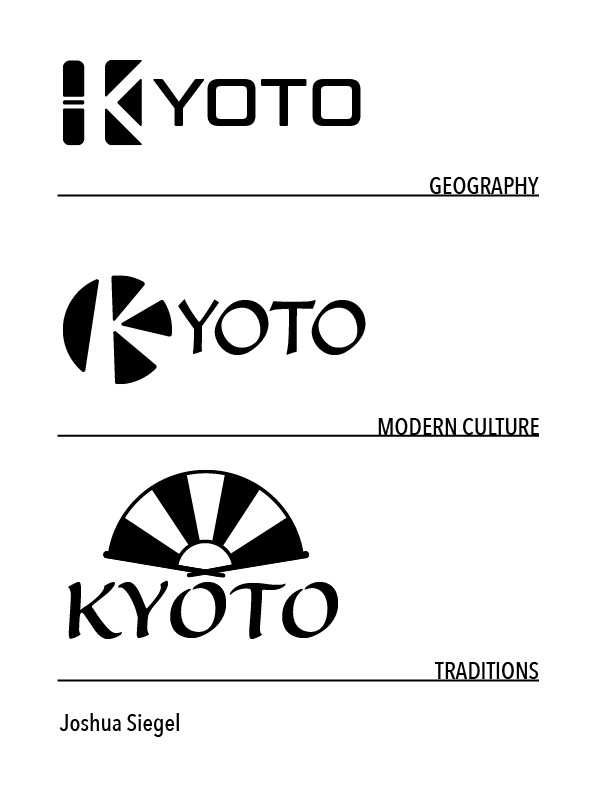
The logo design process that we started last month continued with the creation of vector graphics. At the end of the last stage we selected the three strongest designs guided by peer critique and self-critique based on David Airey’s seven elements of iconic design (Airey, 2014).
I designed the following logos to represent the city of
Kyoto, Japan.
Kyoto Geography
Kyoto geography logo
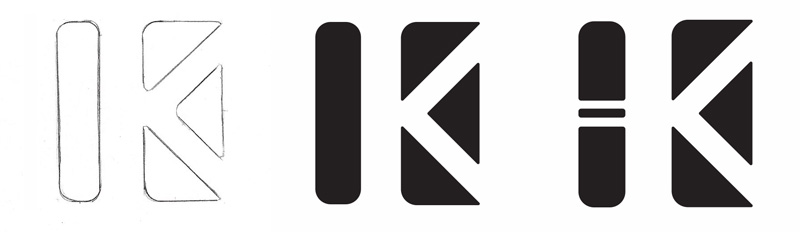
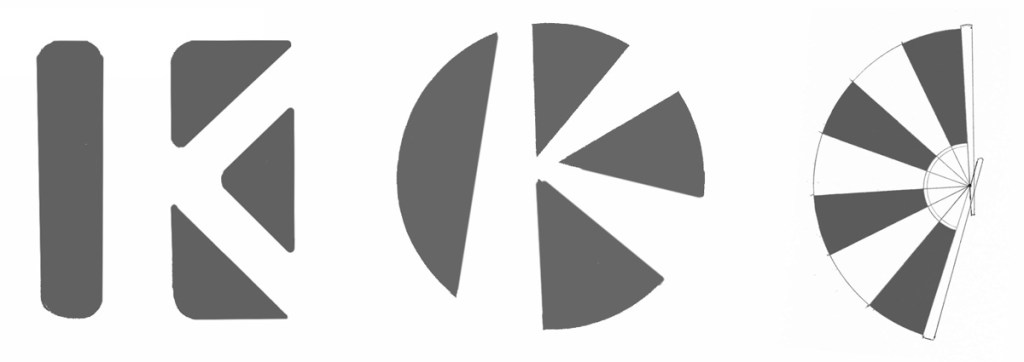
The rounded column and triangles represent the bamboo
forests and gently sloped mountains around Kyoto. A letter K is formed by the
negative space. The concept sketch and first vector graphic were not
distinctive enough, so I added lines to represent a joint in the bamboo stalk. I
also followed Von Glitchka’s advice from Logo Design: Illustrating Logo
Marks and adjusted spacing for visual continuity (Glitchka, 2016).
Kyoto Modern Culture
Kyoto modern culture logo
This design captures the energy and style of today’s people
in Kyoto. The negative space letter K is inspired by manga comics while evoking
the narrow streets of Kyoto’s historic Gion district. After creating a vector
graphic based on the sketch, I added gentle curves to the sharp edges. These
subtle rounds are another of Glitchka’s recommendations for making a design
stand out (Glitchka, 2016).
Kyoto Traditions
Kyoto traditions logo
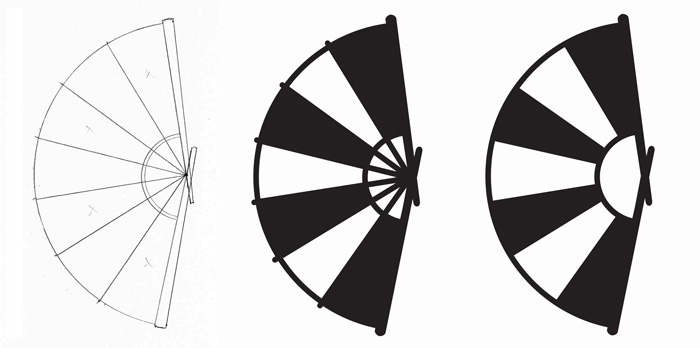
The fan design is a simplified icon based on the folding
fans carried by Kyoto’s geisha. The alternating dark and light panels evoke
Japan’s historic flag, but I must be careful to choose a color other than red
for the primary palette to avoid offense (Taylor, 2015).
After creating a vector graphic based on the sketch, I
realized the design was still not simple enough to be effective at small sizes.
The removal of just a few elements made the design stronger according to Airey’s
elements of iconic design (Airey, 2014).
Font Selection
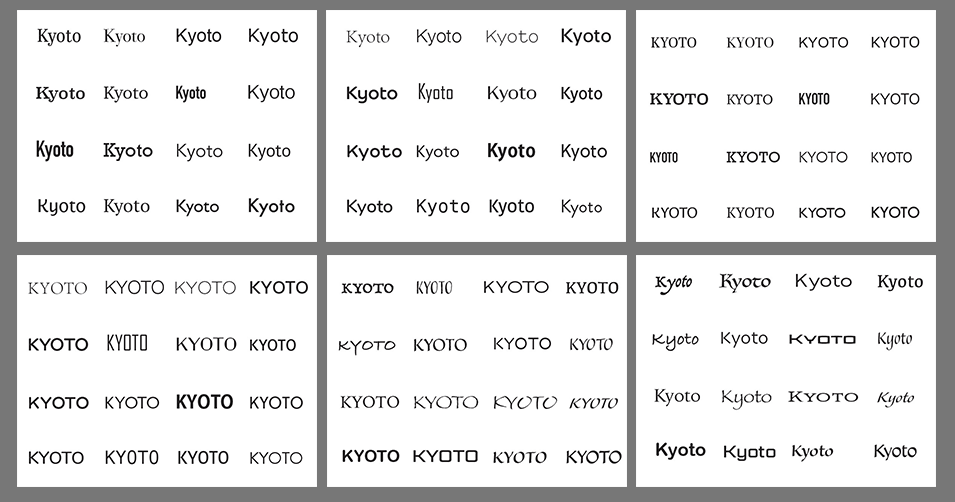
The next step was to choose fonts with the most potential to
be effective wordmarks. In Adobe Illustrator, I created a file with six
artboards. On each artboard, I placed type and used Adobe Fonts to find at
least 32 wordmarks for each of the three logos. This follows the example set by
Sean Adams in Branding for Designers (Adams, 2015).
I looked for typefaces that met the following qualities:
Geography: steady, solid, regular edges
Modern Culture: energy, fun, rounded shapes
Traditions: elegant, respect, calligraphic
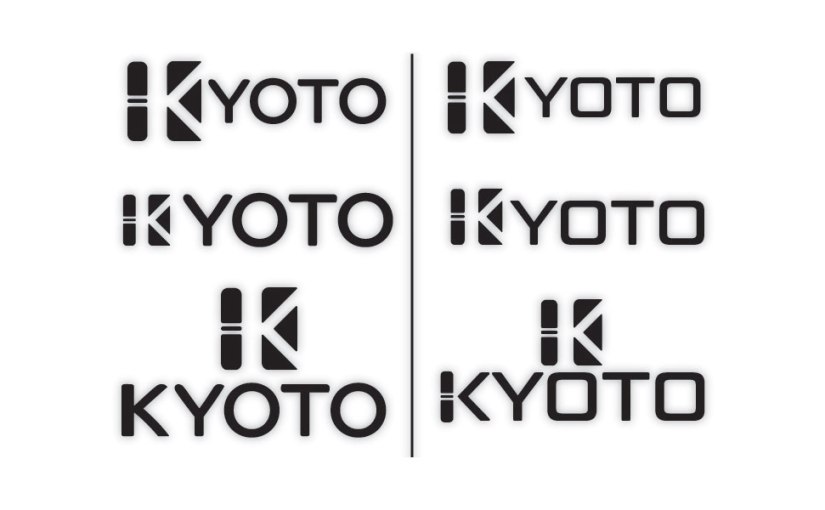
Kyoto logo type tests
After printing and cutting out the logos and wordmarks, I
compared each of them by hand to find complementary shapes and angles. Following
Janie Kliever’s advice, I made choices based on what was appropriate for the
design concept, not my personal tastes (Kliever, N.D.).
I eventually settled on two font choices to pair with each
logo icon in Adobe Illustrator.
With multiple variations to choose from, I selected the
strongest option for each of the three logos.
Mastery Journal
In the Week 4 Live Session video for Defining Client Needs, Ryan McClung explained
why a Mastery Journal is an important part of the learning journey. We are
presented with so much information through research and class assignments that
it is important to keep that information filed somewhere for future reference.
The Mastery Journal is a permanent repository of data, insights, strategies and
reflections gathered during the Media Design MFA program. (McClung, 2019)
This personal catalog of resources will not only come in
handy for future professional work, it is an essential part of preparing for
the Media Design Mastery Thesis in Month 11 of the MFA program. McClung notes
that design is not a linear process. Design is a cyclical journey that goes
back to the research phase again and again. (McClung, 2019) This description of
the cyclical design process is supported by Jennifer Visocky O’Grady and Ken
O’Grady in A Designer’s Research Manual. (O’Grady & O’Grady, 2009)
Effective Critique
O’Grady and Ken O’Grady also state that the design process should have an
assessment phase to help the designer make better informed decisions about the
work. (O’Grady & O’Grady, 2009). We are using peer critiques as a means of
assessment for the Logo Design Workshop city logo sketches. In the Week 4 Live
Session, McClung offers advice for giving better, more productive critiques. He
notes that critique is a life skill that requires balance, truthfulness, and
effective communication. (McClung, 2019)
Kate Lawless and Shannon Crabill suggest the “Love Sandwich”
approach, where negative but constructive criticism is sandwiched between what
is good about the work. (O’Grady & O’Grady, 2009) I have applied this
approach in my own classroom, and I encourage my students to consider the
sandwich when giving peer critiques. Honesty is also important to helping peers
grow as designers. Negative critique, presented in a positive way, helps
determine the most effective solutions. McClung notes that flattery provides a
temporary ego boost but is otherwise a waste of time. (McClung, 2019)
Logo Prototypes
While developing the city logo prototypes, I have tried to adhere to David
Airey’s seven elements of iconic design but found it difficult to resist my
tendency to over-illustrate. In the future, I will continually remind myself to
follow Airey’s advice and “Keep it simple.” (Airey, 2014).
Critiquing my peers’ sketches helped remind me of the
weaknesses in my own work. McClung also offers several questions to consider
when critiquing prototypes. Why are you doing it? Is it well researched? Is it
cohesive with the brand? (McClung, 2019) Questions like theses should be
considered when critiquing your own work as well as your peer’s.
Overall, the information I learned this week will very
useful for my media design career. It will also improve my teaching,
specifically my student critiques. I look forward to the next step of the
mastery journey.
For Part 2 of the Logo Design Workshop, we gave and received
peer critique of our rough concept sketches. Jose Caceres and Krystle Awai
offered valuable feedback that informed my choices of the strongest nine concepts
to take to the next stage. Each reminded me to follow David Airey’s seven
elements of iconic design and pointed out the designs they felt were most
successful. (Airey, 2014)
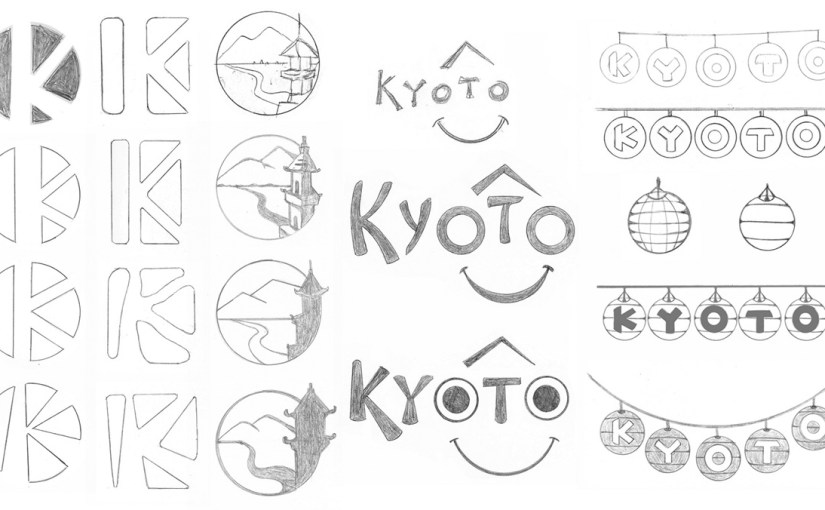
Kyoto Geography inspired designs
Kyoto geography sketches 1
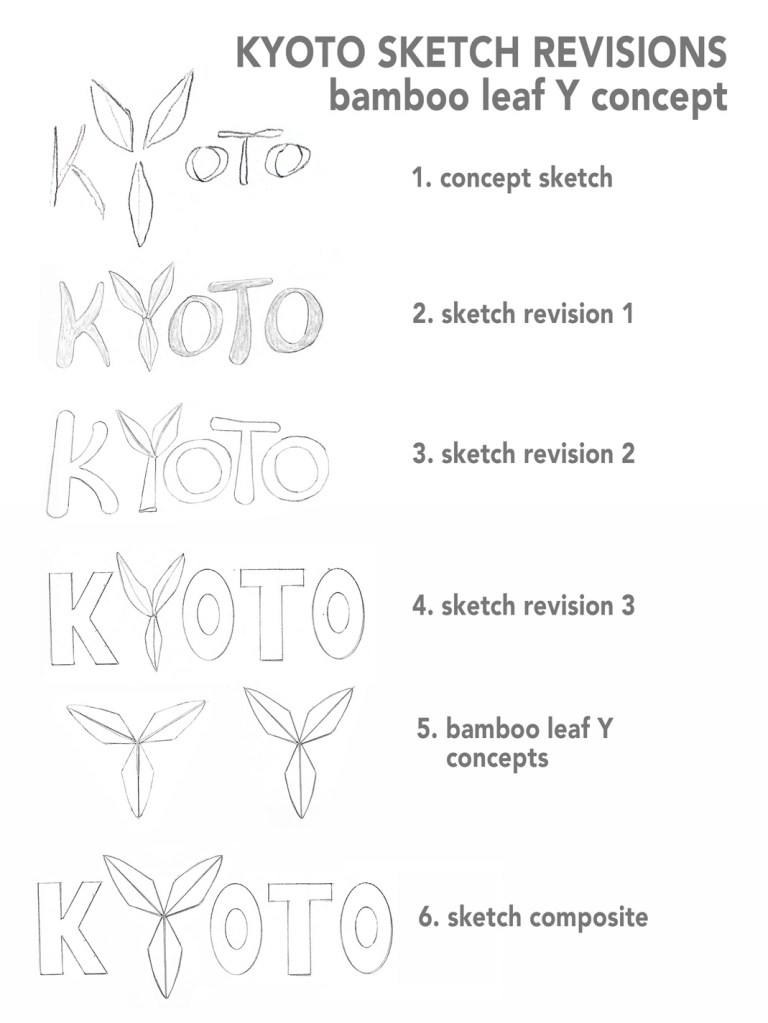
Bamboo leaf Y concept
Concept sketch: Three bamboo leaves replace the
letter Y.
Caceres noted that this design was successful because the simple, symmetrical
shapes are easy to commit to memory as well as providing information about
Kyoto’s natural features.
Sketch revision 1: I kept the style of the
original sketch but adjusted the scale of the leaves in relation to the
letters.
Sketch revision 2: Instead of three bamboo
leaves, I used two leaves atop a bamboo stalk to replace the letter Y. My lettering was cleaner on this revision, but
the hand-drawn type seems cramped and hard to read at a distance.
Sketch revision 3: Using a ruler and oval
templates, I drew sharper modern type to contrast with the soft organic leaves.
This is the strongest revision so far because it is recognizable at any size.
Bamboo leaf Y concepts: I drew and cut out a
single leaf that I used as a guide to create a more symmetrical leaf Y. The
perfect symmetry of the first design was too similar to an upside-down
Mitsubishi logo, so I adjusted the angles on the second design to make it more
distinct as a letter Y.
Sketch composite: After scanning the sketch
revisions, I combined the lettering of revision 3 with the second Y concept
sketch. This composite is a distinctive, modern design but it lacks the organic
quality of the original concept sketch.
Kyoto geography sketches 2
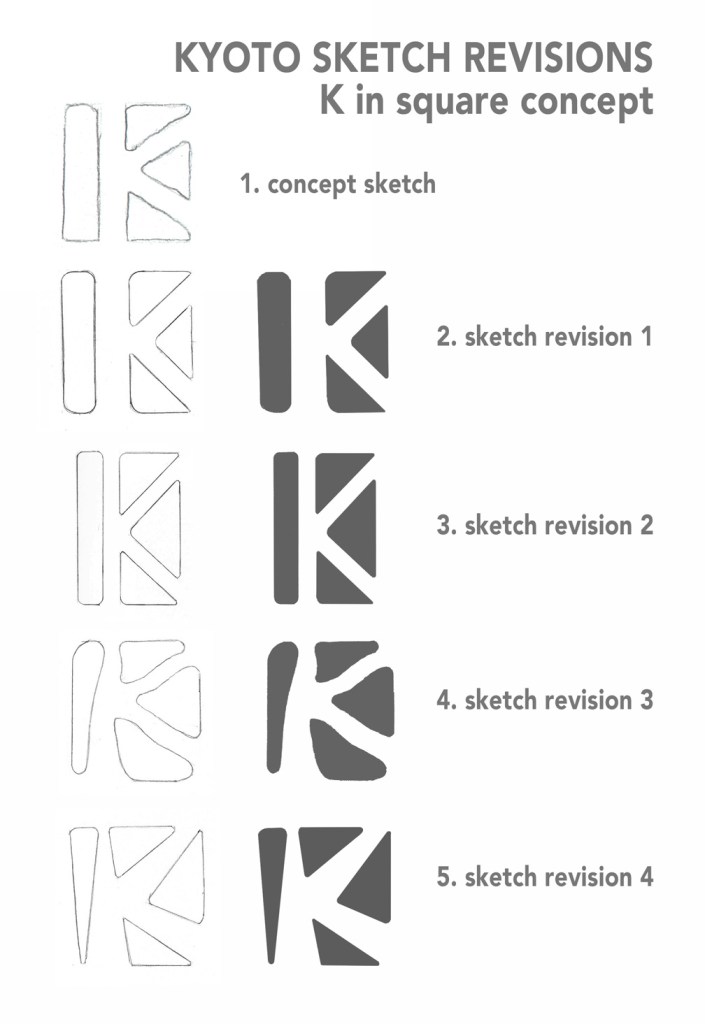
K in square concept
Concept sketch: Three triangles and column form
a K in the negative space.
Both Awai and Caceres found this to be an effective concept because of the
simplicity of the shapes. Awai also noted that the negative space evokes
Kyoto’s scenic walkways as well as the letter K. The triangles represent the
mountains around Kyoto.
Sketch revision 1: I redrew the original concept
with straight lines and refined angles., keeping the rounded edges to soften
the design. I filled in the dark areas after scanning for consistency.
Sketch revision 2: This revision uses symmetrical
shapes and less negative space for a compressed design. The first two revisions
both represent a recognizable pattern that can be used with a Kyoto wordmark,
as an icon, or as a repeating motif in a variety of ways.
Sketch revision 3: There are many recognizable
logos featuring the letter K, such as K-Mart, Circle K, and Special K cereal.
To find distinction as well as incorporate tradition, I rounded the shapes in
the design to make the negative space K resemble the meandering paths in
Kyoto’s Zen gardens.
Sketch revision 4: The fourth revision returned
to straight lined rectangles but kept the energy and historical tradition of
the previous design.
Kyoto geography sketches 3
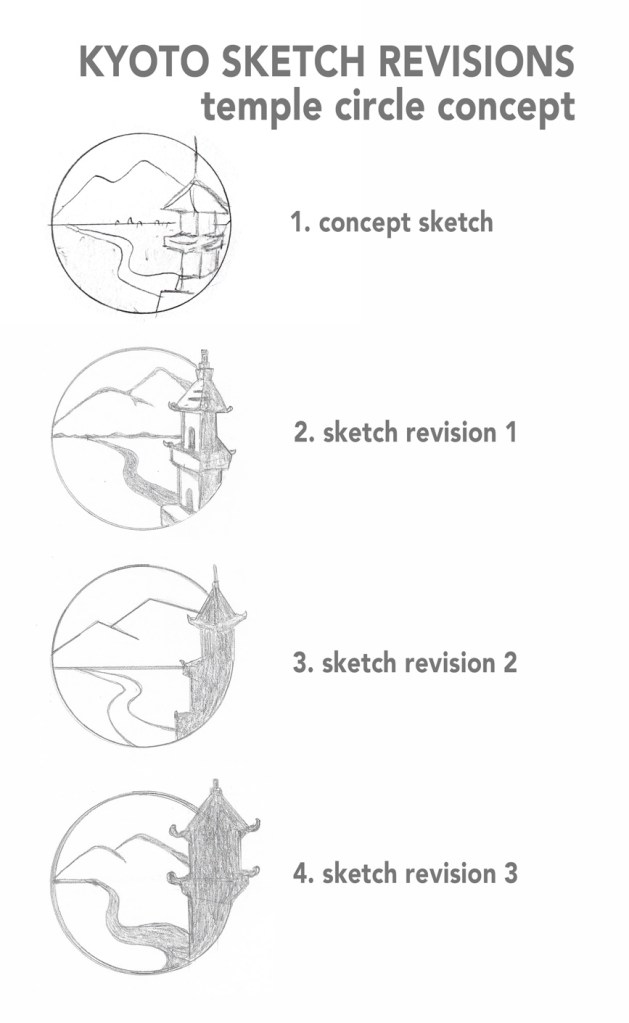
Temple circle concept
Concept sketch: A circle holds a view of a
river, mountains, and a Kyoto temple.
Awai felt that this sketch incorporated tradition with the natural beauty of
Kyoto in a relevant way.
Sketch revision 1: I illustrated the design,
trying to simplify the details. The temple breaks free of the circle, helping
the balance.
Sketch revision 2: The first revision was too
detailed to work at a small scale, so I made the temple into a silhouette. The
curve of the river looks more natural, but this design can be simplified even
more.
Sketch revision 3: The thicker line weight and
modified temple make this design less illustrative and more iconic while
retaining its historic relevance.
Kyoto Modern Culture inspired designs
Kyoto modern culture sketches 1
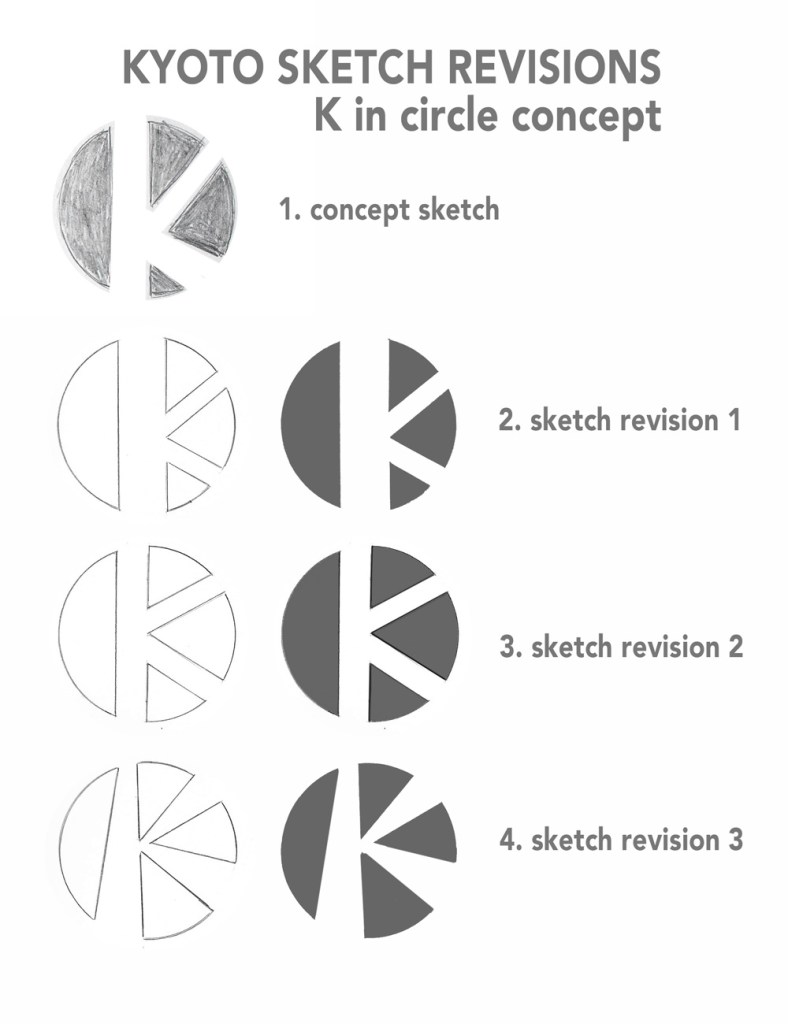
K in circle concept
Concept sketch: A negative space K is made by
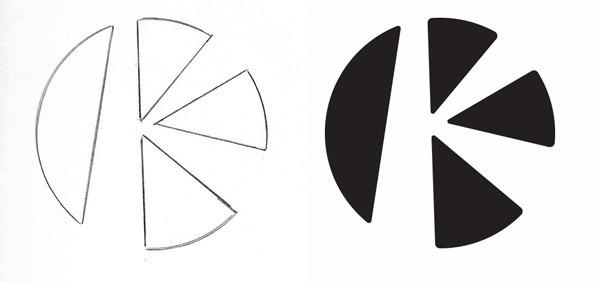
shapes that form a circle evocative of the rising sun.
Caceres stated that this design was successful because of its simplicity. Like
the “K in square” concept, it aims for distinction and is easy to commit to
memory.
Sketch revision 1: I tried to closely recreate
the original concept with cleaner lines. Again, I filled in the dark areas
after scanning for consistency.
Sketch revision 2: My unfortunate fondness for
symmetry influenced this revision. Although the design feels more balanced, it
actually becomes less distinctive than the original concept.
Sketch revision 3: This design sheds the
balanced symmetry and becomes more energetic. It remains distinctive and
incorporates tradition by making the negative space resemble rays of the rising
sun.
Kyoto modern culture sketches 2
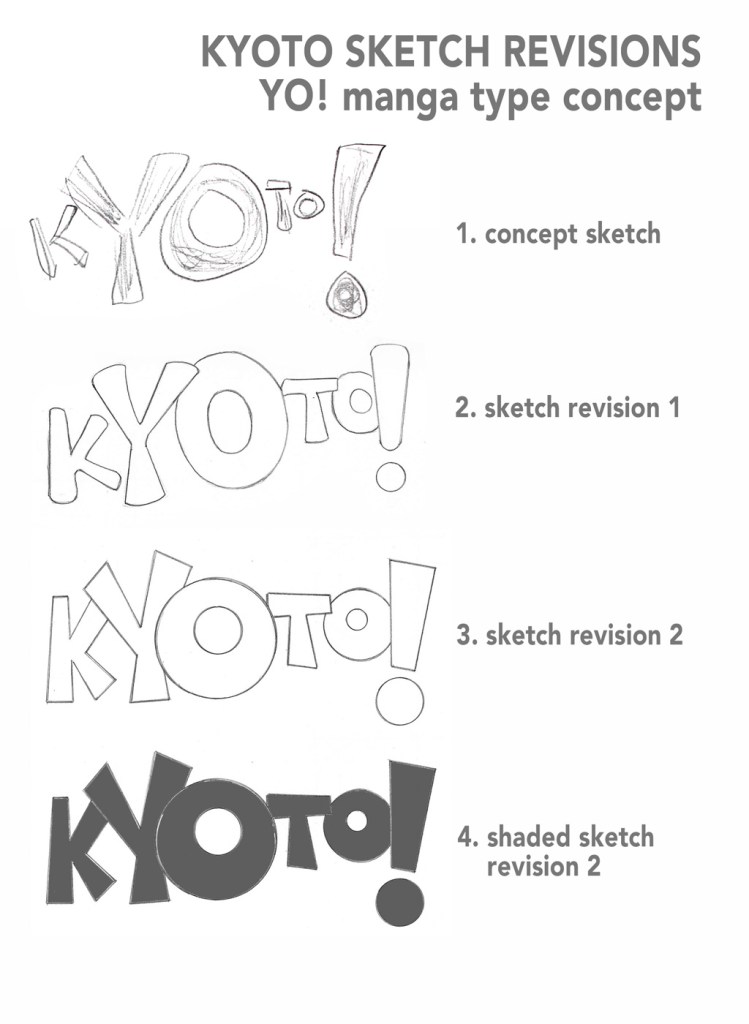
YO! Manga type concept
Concept sketch: Kyoto spelled out with
manga-style comic type, emphasizing the letters Y and O.
Awai said this design captures the young, vibrant energy of Kyoto.
Sketch revision 1: The first revision uses soft,
rounded type to match the concept sketch. I kept the large size of the Y, O,
and exclamation mark but also increased the size of the other letters.
Sketch revision 2: By straightening the lines,
the design became much cleaner and distinctive. The type closely mimics comic
type without using a particular typeface.
Sketch revision 3: After scanning, I filled in
the design too see how it would look. This concept has youthful energy but
might not appeal to older visitors.
Kyoto modern culture sketches 3
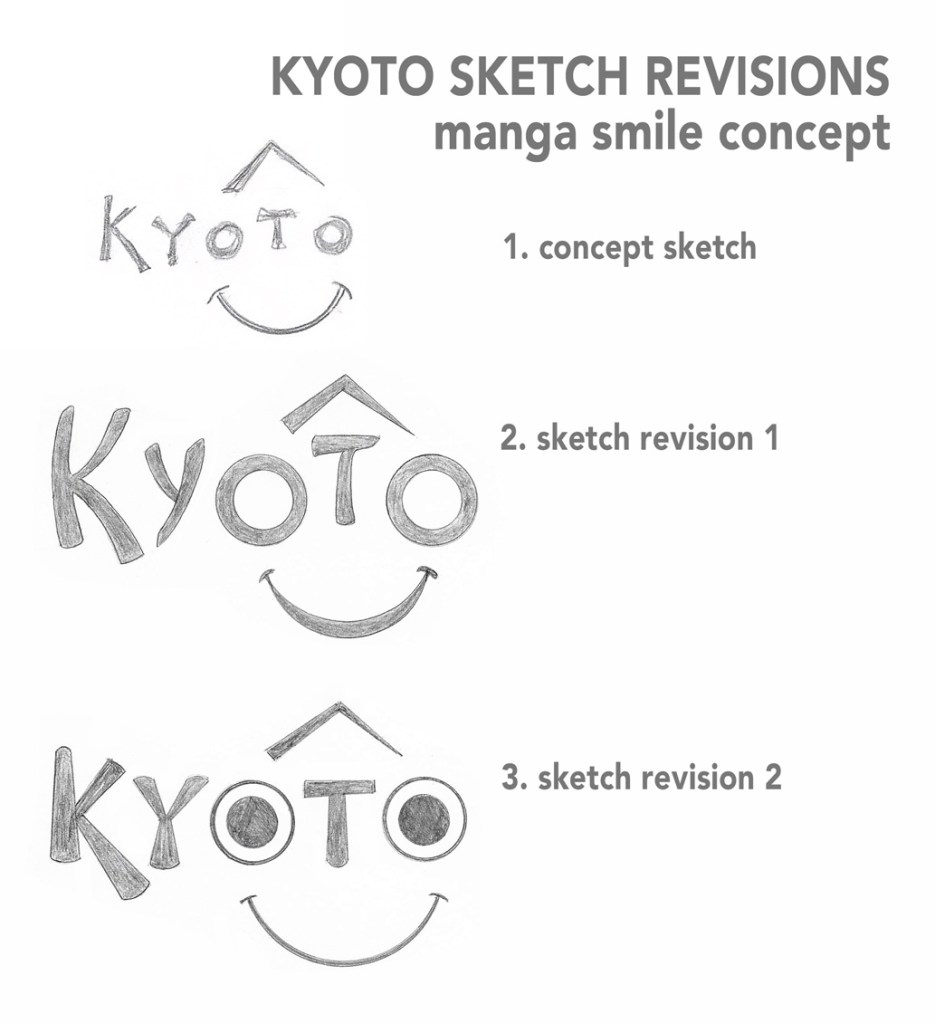
Manga smile concept
Concept sketch: The two letter O’s in Kyoto form
the eyes of manga-inspired smiling face.
This is the only design that I selected without input from peers. I chose it
because it is simple and distinctive.
Sketch revision 1: The first revision is simply
a cleaner, more refined version of the original sketch. The type is reminiscent
of Japanese calligraphy, but simple enough to be read at any size.
Sketch revision 2: I tried a different style of
eyes and thinner smile to make it distinctive from the smile shape in the
Amazon.com logo. This version feels more child-like and less appropriate than
Revision 1.
Kyoto Traditions inspired designs
Kyoto traditions sketches 1
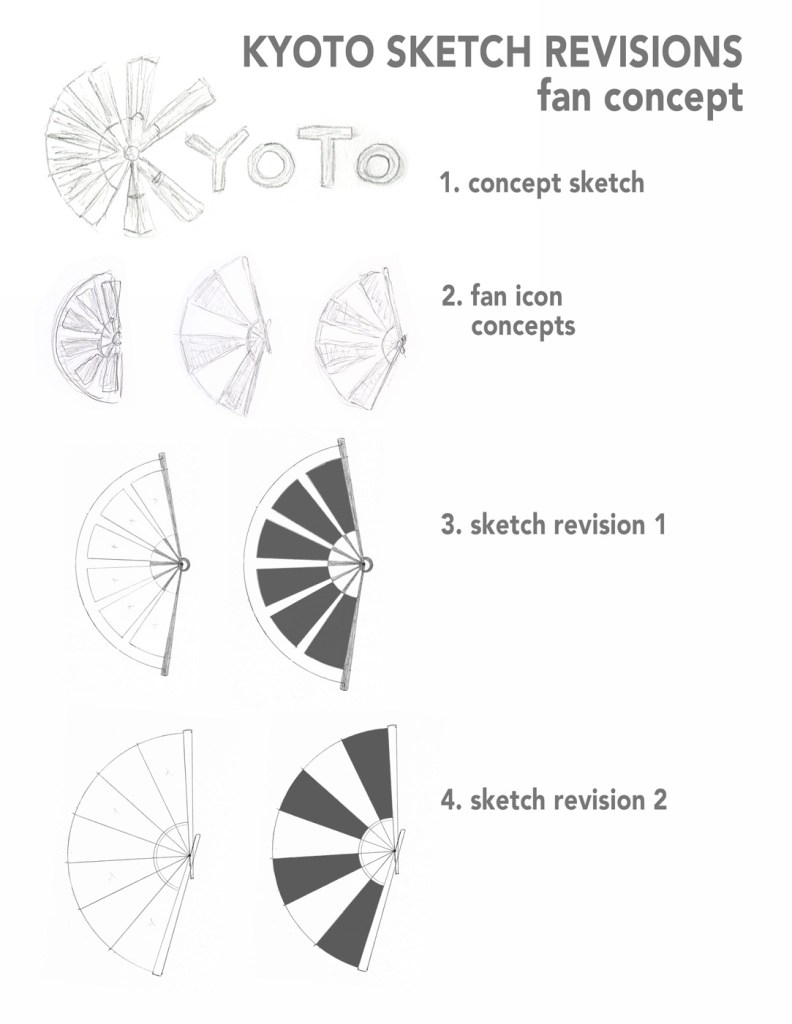
Fan concept
Concept sketch: A folding fan replaces the spine
of the letter K in Kyoto.
Both Awai and Caceres appreciated the simplicity of this logo.
Fan icon concepts: The folding fan in the
concept sketch is very rough, so I first worked on developing a simplified icon
that could be paired with a typeface chosen later.
Sketch revision 1: The first version uses six
dark sections with white dividers. Again, I filled in dark areas after
scanning.
Sketch revision 2: The second revision uses
seven alternating dark and white panels. This simplified fan will be an
effective icon once I thicken the line weights.
Kyoto traditions sketches 2
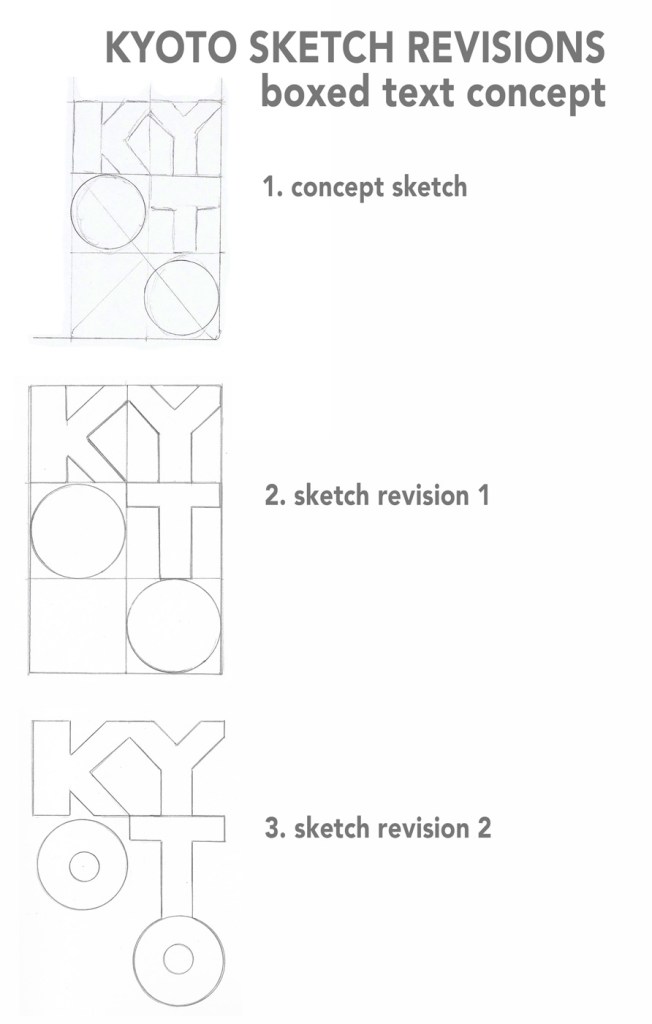
Boxed text concept
Concept sketch: Letters spelling Kyoto are
arranged in boxes.
Caceres said this was one of the strongest designs because it is simple, different,
and traditional.
Sketch revision 1: The first revision in a
cleaner version of the original sketch. I left out the diagonal line that runs
through the O’s because it was reminiscent of “no smoking” signs and other
negative images.
Sketch revision 2: I removed the bounding boxes
from the letters and added center circles to the O’s. This design is not as
effective because it is less distinctive and does not feel as relevant to
Kyoto’s traditions.
Kyoto traditions sketches 3
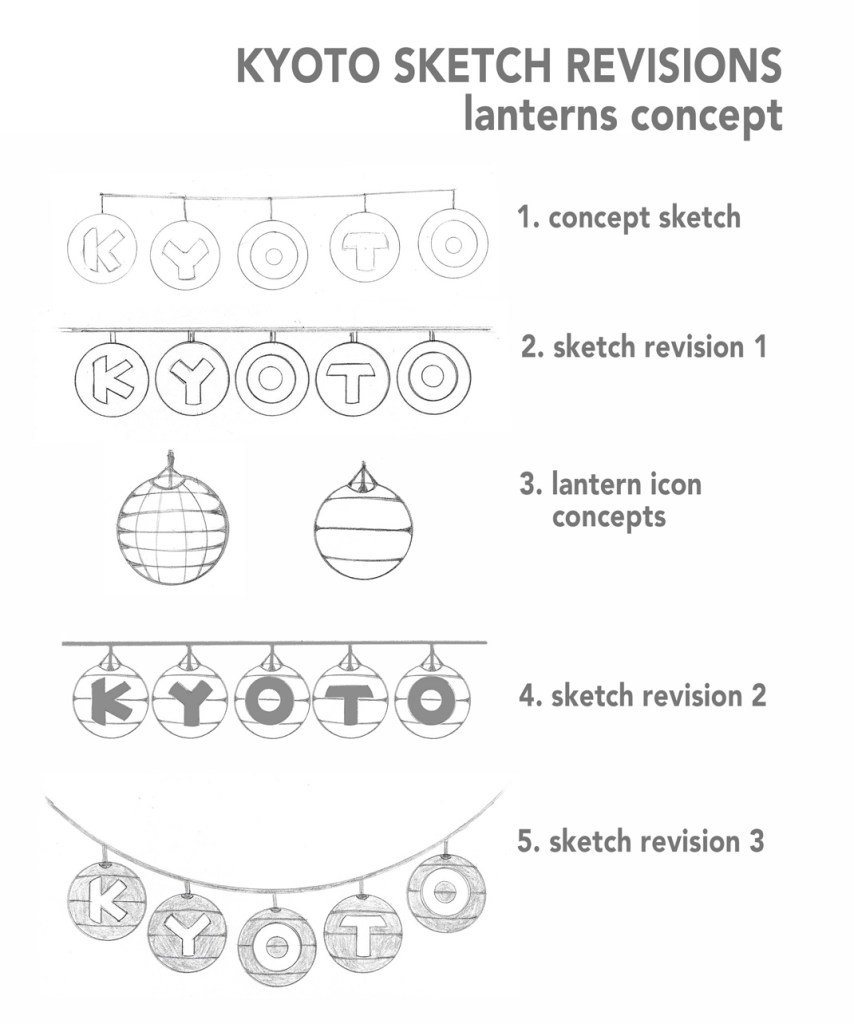
Lanterns concept
Concept sketch: Hanging paper lanterns spell out
Kyoto. Awai appreciated the tradition and symbolic meaning of the lanterns in
Japanese culture.
Sketch revision 1: I tightened the spacing of
the lanterns and tried to make the type clearer than in the concept sketch.
Lantern icon concepts: My next step was to draw
simplified icons to represent the paper lanterns. The first illustration was
too busy, but the second was simple enough to use in the design.
Sketch revision 2: I replaced the empty circles
of the first design with the lantern icons and made the overlying text dark.
Sketch revision 3: For the final revision, I
curved the line that the lanterns hang from and made the letters white over
dark. While not as simple as many of the other designs, this logo captures the
history and culture of Kyoto.
The feedback from Jose Caceres and Krystle Awai helped
improve my work by reminding me to follow David Airey’s seven elements of
iconic design. Their recommendations helped remove my personal preferences and allowed
me to focus on why a particular design was effective. The most common note was
that many of the concept sketches were too illustrative, so I payed extra
attention to keeping designs simple.
I did not move forward with one of Awai’s preferred designs
because it felt too similar to another of the top choices. Otherwise, I tried
to implement all the feedback from both peer critiques. Both were constructive
and well thought out, following the advice from Lawless and Crabill in How
to Give and Receive a Good Design Critique. (Lawless & Crabill, 2015).
Top 3 Designs
Kyoto logos – top 3 designs
Geography: Although I tried several revisions, the “K in square” design closest to the original concept sketch is the strongest. It meets most of the seven criteria, and it can become more distinctive with minor revisions and when paired with text.
Modern Culture: Inspired by Japan’s rising sun flag, the “K in circle” design is very similar to the first due to its use of negative space. The third sketch revision is strongest because it shares the positive qualities of the “K in square” design but is more distinctive and culturally relevant.
Tradition: The original concept sketch was a very quick doodle inspired by Geisha. It was one of my least favorite designs personally, but the peer critique helped me see past the roughness of the drawing and understand why it worked as an appropriate design. The simplified fan icon focuses on one thing associated with Kyoto, is easy to commit to memory, and incorporates tradition.












 Joshua Siegel's Mastery Journal